Chainsaw guide · Troubleshoot 101
Chainsaw won't start?
It's usually flooded, stale, or dull.
Chainsaws flood faster than any other small engine, their fuel mix goes bad in a month, and their fuel lines rot inside the tank where you can't see them. This guide works through every common symptom in the order a mechanic checks them: cheapest and most likely first, shop jobs clearly flagged last.
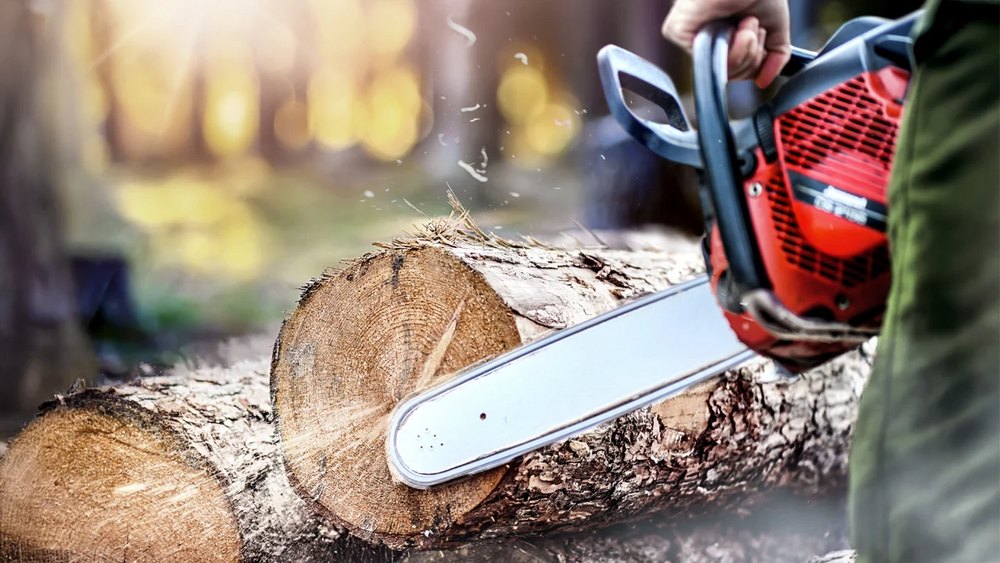
- Smell strong raw gas? You're flooded. Stop pulling on choke — go to the clear-out in section 1, step 2.
- Chain brake state known? Guard pushed forward = brake ON (locked); pulled back toward the handle = released. Most manuals say start with it ON.
- How old is the mix in the tank? Over a month old = suspect #1 after flooding.
- Is it mix at all — never straight gas in a 2-stroke — and bar oil in the oil tank?
- Primer bulb (if fitted): does it fill with fuel, or is it cracked and sucking air?
1 · Chainsaw won't start — or flooded itself trying
Chainsaws flood faster than any other small engine. The choke enriches the mix aggressively, the cylinder is tiny, and a few too many pulls on full choke drowns the plug — after which every additional pull makes it wetter, not closer to starting. Flooding is cause #1. Stale mix and hidden fuel-line failures fight for #2.
Work the causes in this order. Most saws are running again by step 3.
| Cause | How to tell | Fix time | Cost |
|---|---|---|---|
| Flooded engine | Strong raw-gas smell; plug wet; several pulls on choke already | 10 min | Free |
| Controls / chain brake | Brake left on, lever not on cold-start, stop switch on | 1 min | Free |
| Stale fuel mix | Mix over a month old; sour smell; sat since last season | 15 min | Price of fresh mix |
| Fouled spark plug | Plug black/carboned, or no blue spark when tested | 10 min | ~$5–9 |
| Perished fuel lines / clogged in-tank filter | Primer bulb won't fill; lines soft, split, or crumbling in the tank | 20–30 min | ~$8–15 |
| Clogged spark arrestor screen | Starts hard, low power, muffler screen caked black | 15 min | Free to clean |
| Carburetor (gummed / diaphragms stiff) | Fresh fuel + spark, still nothing; sat for years | 45 min | $15–35 kit or carb |
| Low compression | Starter pulls with almost no resistance; saw won't even pop | — | Shop job |
The fix, step by step
- Set the controls — and check the brake state. Pushing the front hand guard forward engages the chain brake (chain locked); pulling it back toward the front handle releases it. Most manufacturers recommend starting with the brake engaged — follow your manual. Set the master control to cold-start/full choke, and make sure the stop switch isn't latched off. Prime the bulb, if fitted, until it fills with fuel.
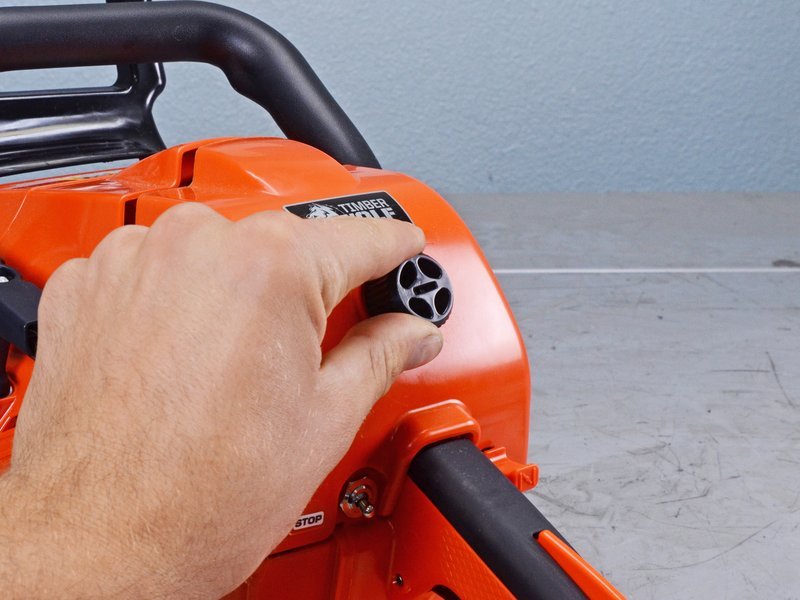
What you're looking at: the master control / choke knob in place on the side of the housing — this is the control you set to cold-start, with the STOP position marked just below it. The chain brake is the wide black guard ahead of the front handle at the top of the frame: pushed forward the chain is locked, pulled back toward the handle it's released. - If you smell raw gas, clear the flood before anything else. Choke off, control to run, throttle held fully open (wedge it or hold the trigger), and pull 10–15 times. The saw will often sputter and catch near the end. No luck? Pull the plug, dry it over a rag, crank the engine 8–10 times with the plug out to blow the cylinder clear (away from any flame — fuel mist comes out), refit, and start with no choke.
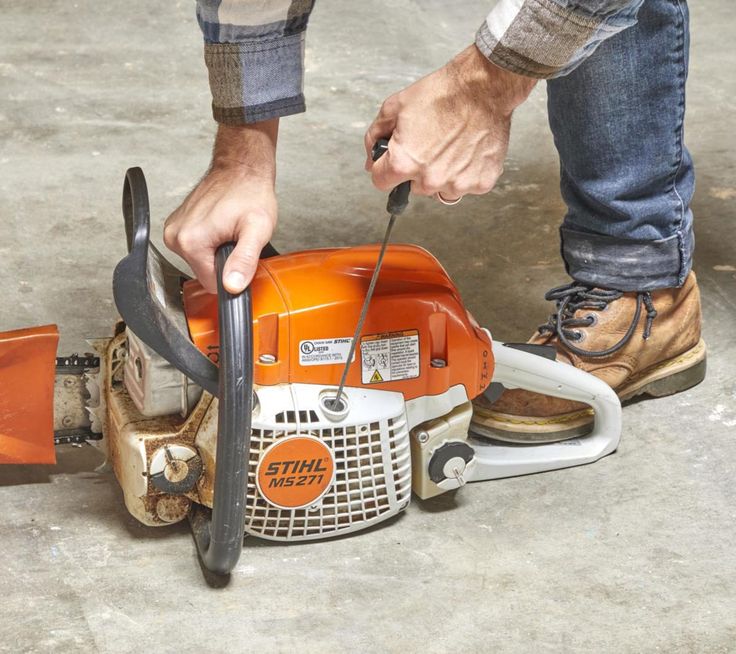
What you're looking at: the clearing pulls, done from a stable ground start — saw flat on the ground, boot through the rear handle holding it down, one hand on the front handle. With the choke off and the throttle held open, pull like this 10–15 times; you're blowing raw fuel out, not trying to start it yet. - Dump the mix and start over with fresh fuel. Mixed fuel stales in 30–60 days — the oil doesn't preserve it — and last fall's can is the classic no-start. Mix a small fresh batch at the exact ratio in your manual (50:1 on most modern saws) with fresh gasoline. Never run straight gas, even “just to test it”: minutes without oil can seize the piston.
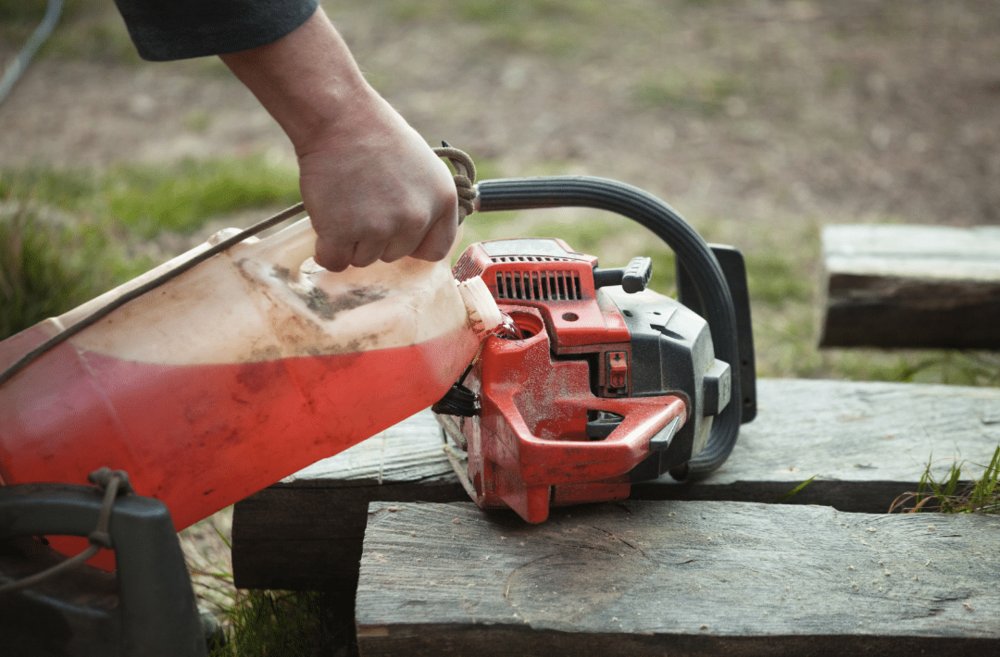
What you're looking at: fresh mix going into the filler neck. Note the tint in the fuel — that colour comes from the 2-stroke oil already mixed in. If what you're about to pour looks like plain, untinted gasoline, stop: it has no oil in it yet. - Pull the plug and read it. Wet = flooded (see step 2). Black and sooty = carbon-fouled; replace it — plugs are cheaper than your Saturday. Ground the plug against the cylinder and pull: you want a fat blue spark. No spark with a new plug points to the stop-switch wiring or the ignition coil — check the switch wires aren't pinched or chafed before buying a coil.
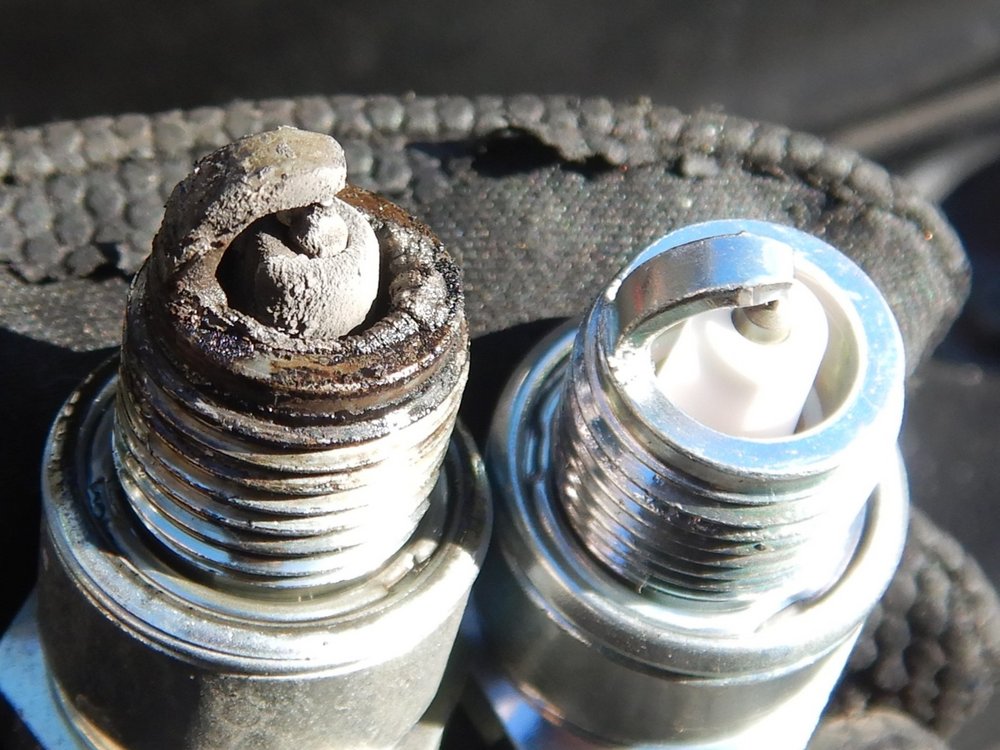
What you're looking at: the firing end is the whole story. Left: a fouled plug — electrode and insulator crusted grey-black with carbon, the gap barely visible. Right: a new plug — bright metal strap, clean white insulator, open gap. If yours looks like the left, don't clean and hope; replace it. - Go inside the tank: fuel filter and lines. The saw-specific failure other engines don't have. Ethanol fuel perishes the lines from the inside; they crack and split inside the tank, invisible until you fish the weighted fuel filter out through the filler neck with a hooked wire. If the line feels gummy, stretches like taffy, or the filter is amber and varnished, replace both. A bulb that won't fill is this same failure waving at you.
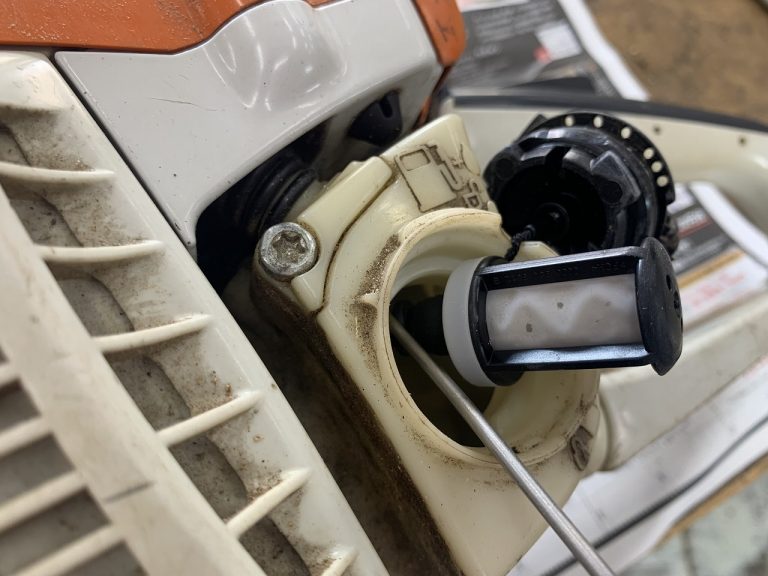
What you're looking at: the weighted in-tank fuel filter, fished out through the filler neck with a hooked wire (the metal rod in frame), cap off beside it. This is as far inside the tank as the fuel system gets — check the filter body for amber varnish and the line behind it for splits or a gummy, stretchy feel. - Clean the spark arrestor, then the carburetor. Unbolt the muffler screen and brush or burn the carbon off — a caked arrestor strangles the exhaust and mimics carburetor trouble. If the saw still won't fire with fresh mix and a blue spark, the carburetor's diaphragms have stiffened or its jets are varnished: a rebuild kit or a complete replacement carb ($15–35 on most homeowner saws) is the fix.
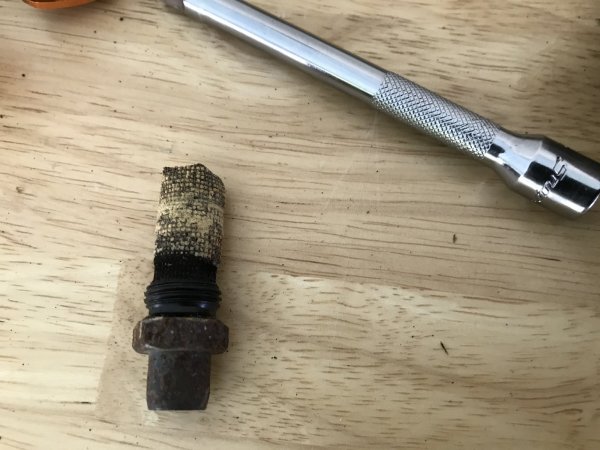
Caked: a spark arrestor screen (this style unscrews from the muffler as a small cylinder) the way a bad one looks — mesh pores closed over with black and tan carbon. Hold it to the light and almost nothing comes through: the exhaust is strangled. 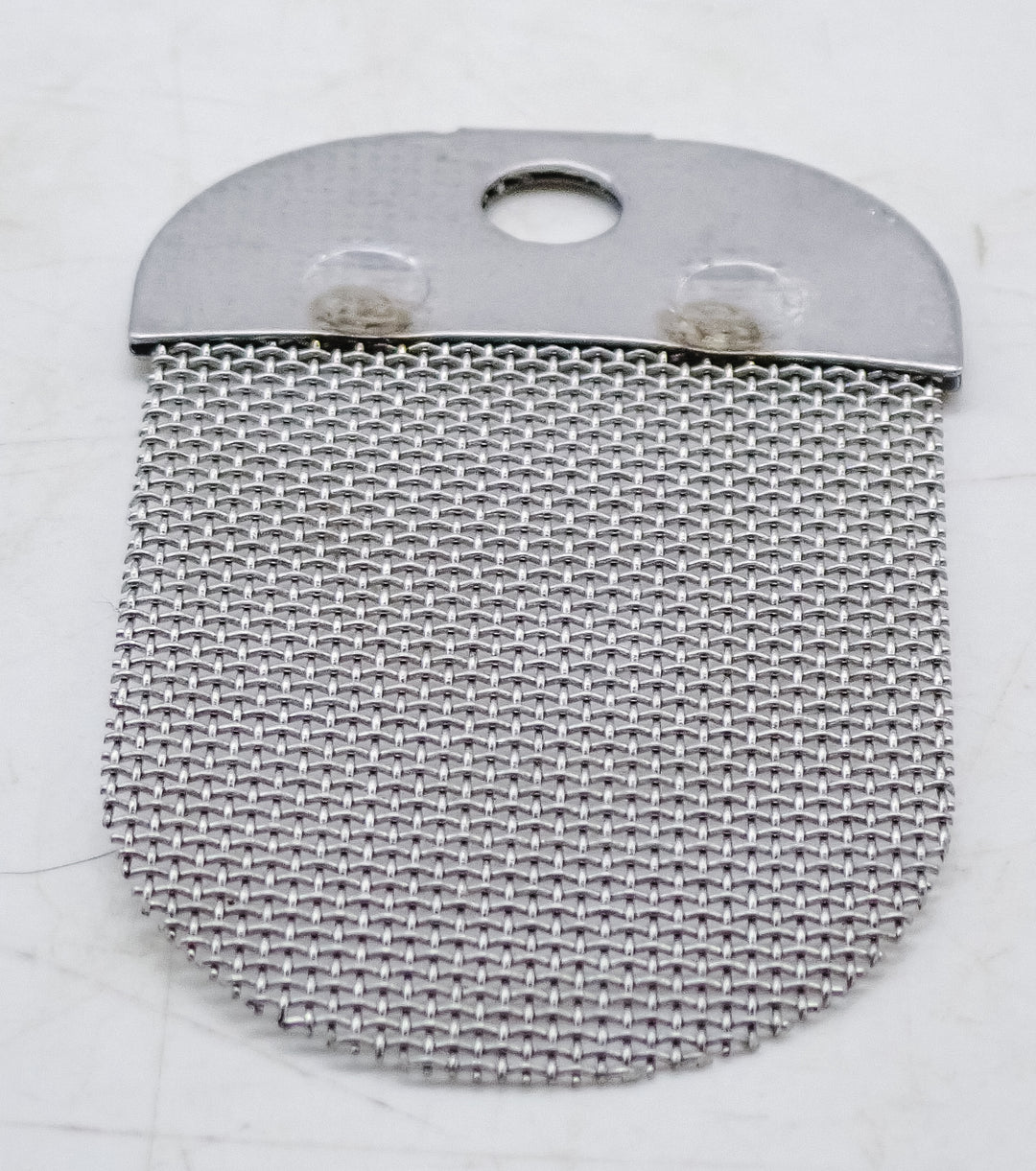
Cleaned: the same screen with the carbon gone (a new flat-style screen shown — shape varies by saw, the test doesn't). Every mesh opening is clear and light passes straight through. Brush or burn yours back to this; if it stays blocked or the mesh is torn, replace it.
2 · Starts, then dies — or dies when you throttle it
A saw that starts has fuel, spark, and compression — briefly. Dying is about what runs out or leaks in. When it dies is the diagnosis:
Dies the moment you squeeze the throttle
The classic lean bog: it idles, you throttle up, it gasps and dies. The engine is starving at high fuel demand — a clogged in-tank filter, a cracked fuel line sucking air instead of fuel, a stiff carburetor metering diaphragm, or the high-speed jet partly blocked. Work that list in order. Do not just richen the high screw to mask it and keep cutting: a lean 2-stroke under load overheats and can seize.
Dies after a minute or two, restarts after sitting
Loosen the fuel cap and listen for a hiss of air rushing in. That's a blocked tank vent vacuum-locking the tank — the saw drinks until the vacuum wins. Clean or replace the vent (often built into the cap area; check your manual). Restarting after a rest, once pressure equalizes, confirms it.
Dies in the cut, restarts easily
Heat and load are exposing a marginal part: a plug breaking down hot, a coil failing as it warms, or the spark arrestor screen choking the exhaust at full flow. Clean the arrestor first (free), swap the plug second (cheap), suspect the coil last.
3 · Runs rough, races, or won't idle right
Rough running on a 2-stroke is usually an air/fuel accounting problem: air getting in that the carburetor didn't measure, or fuel arriving in the wrong amount.
Racing or hanging idle (revs stay high, chain wants to creep) is a lean idle: a cracked intake boot, a loose carburetor, perished lines, or — the expensive one — leaking crank seals. Start with the boot, carb bolts, and lines. Reset the low (L) and high (H) mixture screws to your manual's baseline (commonly one turn out from lightly seated, but the book wins) and tune from there: L for idle and throttle pickup, H for full-throttle in the cut, idle-speed screw so the chain just stops moving.
Four-stroking and blubbering — rich, rough, smoky at full throttle, clearing in the cut — is the opposite: too much fuel. A saturated air filter is the overlooked cause; a foam or felt filter choked with sawdust and oil leans nothing and richens everything. Wash or replace it before touching the screws.
Random missing points back at the plug and at borderline-stale mix. And if the saw runs worse the longer you cut, revisit the arrestor screen — carbon builds exactly there.
4 · Cuts slowly and throws dust instead of chips
This section is not the engine. Chain sharpness is chainsaw power: a sharp chain takes big bites, throws chunky chips, and pulls the saw into the wood so the engine just has to keep up. A dull chain makes the engine work twice as hard for half the cut — and cooks the bar doing it.
Read the sawdust
Fine powder = dull cutters. Chunky chips = sharp. Dust plus smoke, a cut that wanders to one side, or having to lean on the saw = file now. One touch of dirt or one second in the soil dulls a chain more than an hour of clean wood.
File it right
Use the round file size matched to your chain's pitch, at the angle marked on the cutter, same number of strokes per tooth, working from the shortest/damaged tooth so they end up even. Don't forget the depth gauges (rakers) ahead of each cutter: if the cutters have been filed down but the rakers haven't been lowered to spec, the teeth skim instead of bite even when sharp. A filing guide makes this a 10-minute skill instead of a guessing game. Stretched, kinked, or repeatedly rock-damaged chain? Replace it — chain is a wear item and it's cheaper than a bar.
Check the oil and the bar
Hold the running saw's bar tip near a clean piece of wood or cardboard: it should sling a line of oil within seconds. No oil = empty tank, clogged oiler outlet, or sawdust packed in the bar groove. A worn bar with a pinched or burred groove drags the chain and cuts crooked no matter how sharp it is — dress the rails or flip/replace the bar.
5 · Chain won't move — or won't stop moving
Chain won't move, engine revs fine
First: is the chain brake still engaged? The front guard clicks forward and locks the drum — it happens mid-job more than anyone admits. Brake off and still stuck: check tension (a chain set banjo-tight, especially hot, can bind), a pinched bar from a felling cut closing on it, and finally the clutch drum and rim sprocket — worn sprocket teeth chew the drive links and slip or jam under load. Sprockets are wear items; replace by pitch and spline.
Chain jumps off the bar
Too-loose tension is cause #1, a worn sprocket #2, a burred bar groove #3. Correct tension: the chain snaps back against the bar but the drive links don't leave the groove when you lift it mid-bar, and it pulls around by (gloved) hand with light effort. Always re-check after the first cuts — new chains stretch.
Chain creeps or spins at idle
Turn the idle speed down first (section 3). Still moving? The clutch is engaging early — worn or broken clutch springs, or a drum bearing failing. This is the one symptom in this guide with no “live with it” option: brake on, saw parked, shop visit.
6 · Prevent it: mix discipline, storage & sharpening
Almost every repair above traces back to the fuel can or the calendar. Three habits delete most of this guide:
The fuel rules
- Mix small and fresh: only what you'll burn in a month, at the manual's exact ratio, with stabilizer added at mixing time if the can will sit.
- Date the can with tape and a marker. Undated mix is how year-old fuel ends up in the saw.
- Never straight gas, never the mower's 4-stroke can. Label the chainsaw can so nobody “helps” with the wrong one.
- Use ethanol-free fuel if it's sold near you — it's kinder to lines, diaphragms, and the in-tank filter than anything else you can do.
End of season / long storage
- Run the saw dry or run stabilized mix through it per your manual, so the carburetor doesn't sit full of fuel turning to varnish.
- Pull the plug, fog the cylinder with a teaspoon of 2-stroke oil, and pull the starter slowly to coat it.
- Clean the air filter, the arrestor screen, and the sawdust packed around the clutch cover and oiler.
- Fill the bar-oil tank (prevents the oiler drying out), slacken nothing, and store with the bar cover on, brake engaged.
Every cutting session
- Five strokes of the file per cutter while the chain is warm at the end of the day beats a full resharpen later.
- Top up bar oil every time you fuel — the oil tank is sized to run out just after the fuel does, on purpose.
- Test the chain brake: at idle, snap your wrist against the front guard — the chain must stop instantly.
Frequently asked questions
Why won't my chainsaw start?
The three usual causes are a flooded engine from too many pulls on full choke, stale fuel mix (mix goes bad in 30–60 days), and cracked fuel lines inside the tank. Clear the flood first, then replace the fuel, then check the plug and the in-tank filter and lines.
How do I fix a flooded chainsaw?
Stop pulling on choke. Choke off, throttle held fully open, pull 10–15 times. If that fails, remove the plug, dry it, crank the cylinder clear with the plug out, refit, and start with no choke.
Why does my chainsaw die when I give it throttle?
Fuel starvation or an air leak: clogged in-tank filter, perished lines sucking air, a blocked tank vent, or a dirty carburetor. It is running lean — fix the cause rather than masking it with the mixture screw, because a lean 2-stroke under load can seize.
Why does my chainsaw race or run rough at idle?
A lean idle mixture: cracked intake boot, loose carburetor, perished lines, or drifted mixture screws. Reset the screws to the manual's baseline and tune from there. If the chain moves at idle afterward, that's a clutch problem — park it and see a shop.
Why is my chainsaw throwing dust instead of chips?
The chain is dull. Sharp chains throw chunky chips and self-feed; dull chains throw powder and need pushing. File every cutter evenly with the correct-size file, check the depth gauges, and confirm bar oil is flowing.
Why won't my chain move — or why does it move at idle?
Won't move: chain brake engaged, chain tensioned too tight, a pinched bar, or a worn sprocket/clutch. Moves at idle: idle speed too high or worn clutch springs. The second is a safety problem — don't cut with it.
How long does chainsaw fuel mix last, and what ratio do I use?
The ratio in your manual — 50:1 on most modern saws — and never straight gasoline. Mix goes stale in 30–60 days; mix small batches, date the can, and add stabilizer when you mix if it will sit.
When is it a shop job, not a home fix?
A chain that moves at idle after adjustment, a chain brake that doesn't stop the chain instantly, crank-seal leaks, low compression, or a cracked tank or crankcase. Fuel, plug, filter, line, arrestor, and sharpening work are all realistic home fixes.
Still stuck? Run the guided diagnosis
Answer a few questions about your exact saw and symptom on Troubleshoot 101 and get your likely causes ranked, the fix step by step, and the parts to grab near you — the interactive version of this guide.
Start the chainsaw diagnosis →If it helped you, consider a tip.Troubleshoot 101 is free to use. A tip helps keep the guides coming — no account, no paywall.
Leave a tip