Lawn mower guide · Troubleshoot 101
Lawn mower won't start?
It's usually not the engine.
A mower that “died over the winter” almost always has one of four cheap problems: stale gas, a clogged air filter, a varnished carburetor, or a fouled plug. This guide works through every common symptom — won't start, starts then dies, surging, no power, bad cutting — in the order a mechanic checks them: cheapest and most likely first, shop jobs clearly flagged last.

- Oil at the full mark? Many mowers have a low-oil sensor that blocks starting entirely.
- Bail bar held tight to the handle, plug wire pushed fully onto the plug?
- Does the gas smell like gas — or like varnish and paint thinner? Stale fuel is cause #1.
- Air filter: pull it and look. Gray-and-crusty means the engine is breathing through a pillow.
- Fuel cap: crack it open — a hiss means a vacuum-locked tank (see starts-then-dies).
1 · Lawn mower won't start after winter
This is the most common mower problem there is, and it's almost never the engine. Gasoline starts going stale in as little as 30–60 days. Left in the tank over winter, it oxidizes, absorbs moisture, and leaves varnish in the carburetor's tiny jets — passages smaller than a pin. By the first mow, the engine is mechanically fine and simply can't drink.
Work the causes in this order. Each one is cheaper and more likely than the next, and most owners fix it at step 1 or 2.
| Cause | How to tell | Fix time | Cost |
|---|---|---|---|
| Low oil / safety sensor | Oil below the full mark; engine won't even try | 2 min | Price of oil |
| Stale fuel | Gas smells sour/varnishy; mower sat 2+ months | 20 min | Price of fresh gas |
| Clogged air filter | Filter gray, crusty, or oil-soaked | 5 min | ~$5–10 |
| Gummed carburetor | Fresh fuel doesn't help; fires briefly on starter fluid | 30–60 min | $0 clean · $15–40 replace |
| Fouled spark plug | Plug black, wet, or no blue spark when tested | 10 min | ~$5–9 |
| Bail cable stretched / broken | Bail bar feels loose; kill switch never releases | 20 min | ~$10–18 |
| Low compression | Cord pulls with almost no resistance | — | Shop job |
The fix, step by step
- Check the oil and the start basics — really check them. Oil below the full mark trips the low-oil sensor on many modern engines, and the mower won't spark at all. Top up to the mark with the oil grade in your manual. Hold the bail bar fully against the handle (that's the kill switch releasing), and push the plug wire on until it clicks.
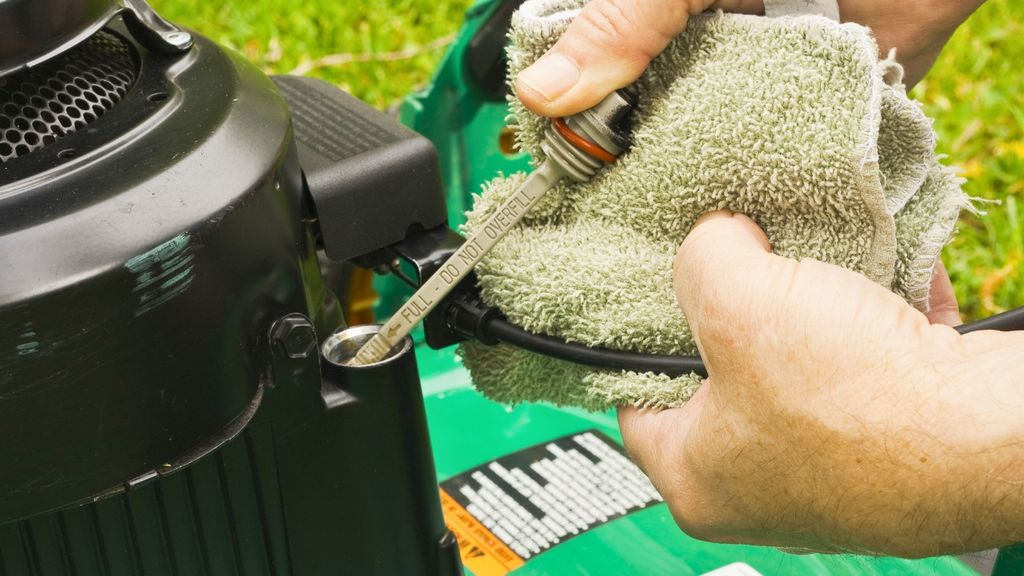
Where to look: the dipstick lives in the oil fill tube on the side of the engine. Wipe it, seat it fully, pull it again — the oil should reach the FULL mark stamped on the stick. - Drain the old fuel completely. Siphon the tank, or run the line into an approved container, then drain the carburetor bowl (small bolt at the bottom of the bowl) to empty what's sitting in the carb itself. Dispose of stale fuel per your local rules — don't pour it back in anything.
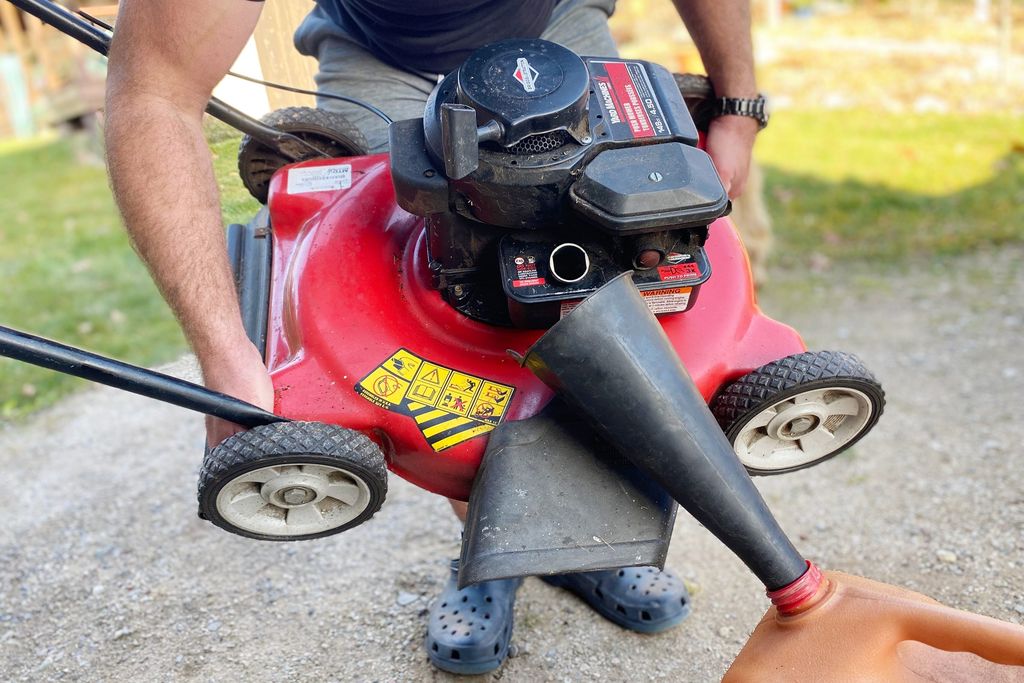
Draining the tank into an approved container, funnel in the filler neck. Stale fuel like this never goes back into any engine — dispose of it per your local rules. - Refill with fuel bought this season. Fresh gas, then prime 3 times if your mower has a primer bulb — it should fill with fuel and firm up. A bulb that stays flat or feels crunchy is cracked; it's a cheap part and a mower that primes air will never start cold.
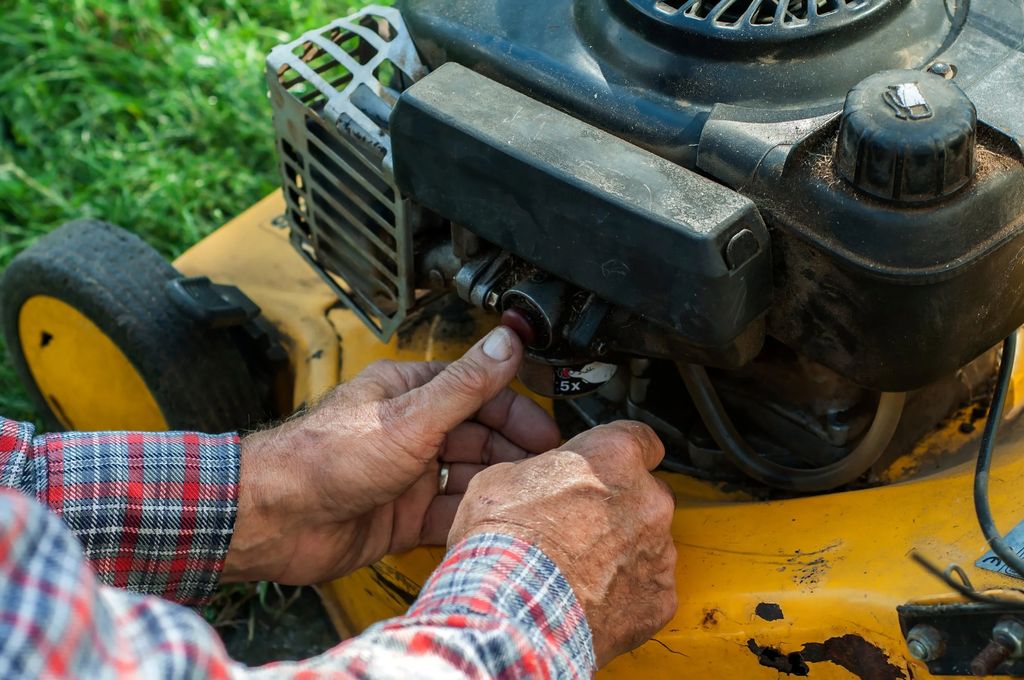
The primer bulb sits on the carburetor, under the air-filter box — this is what you're pressing. It should fill with fuel and firm up; a bulb that stays flat or feels crunchy is cracked. - Pull the air filter and look at it. A filter clogged with a season of dust starves the engine of air — the mower equivalent of breathing through a pillow. Foam filters: wash in warm soapy water, dry fully, work in a spoonful of clean engine oil, squeeze out the excess. Paper filters: tap the dust out for a test, but replace a gray or oil-soaked one — never wash paper.
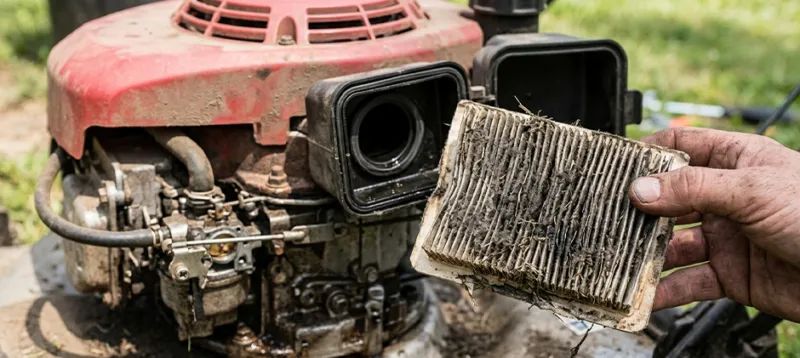
What clogged looks like in the field: pleats packed solid with dirt and grass, held up next to the open housing it came out of. If yours looks like this, replace it — don't try to save it. - Pull the spark plug and read it. Black and sooty = rich/fouled. Wet with fuel = flooded (leave the plug out 15 minutes, then crank with the throttle open to clear it). White or blistered = overheating. Fouled plugs are cheaper than the time to clean them: replace with the exact plug and gap in your manual.
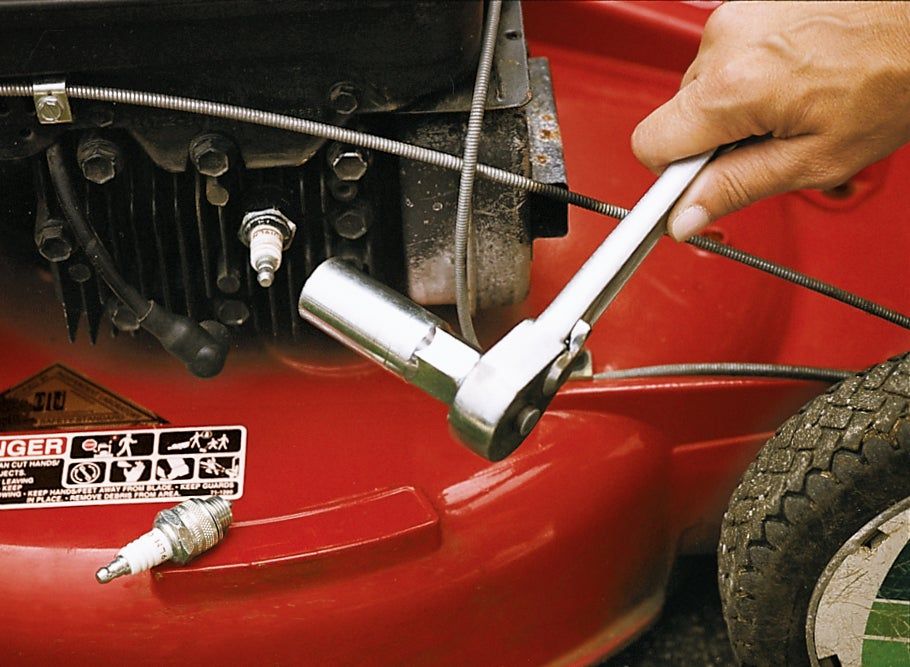
Finding it: the plug sits in the side of the cylinder head under a thick rubber boot. Pull the boot off, then use a deep spark-plug socket like this one. 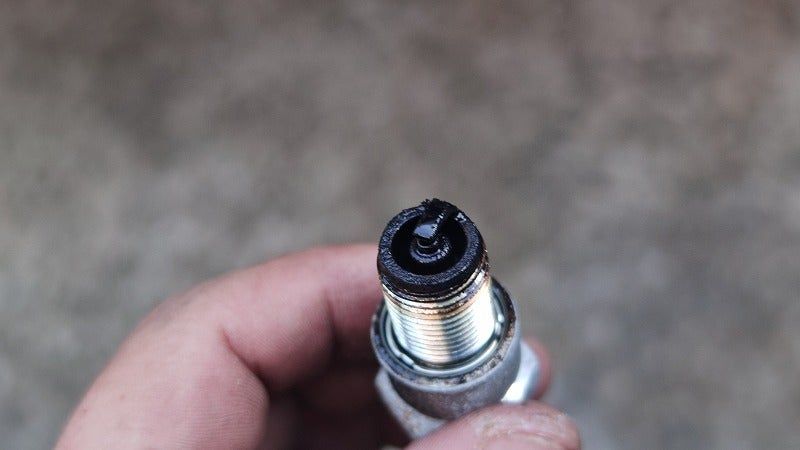
Reading the tip: black and sooty like this means fouled — replace it. A healthy plug's tip is light tan or gray. - If it fires on a sniff of starter fluid but won't stay running, it's the carburetor. Remove the bowl, clean the main jet and the tiny cross-holes in the bowl bolt with carb cleaner and a soft wire, and reassemble with a fresh bowl gasket if the old one is flattened. On many popular engines a complete replacement carburetor costs $15–40 — often less than a shop's diagnostic fee — and swaps with basic hand tools.
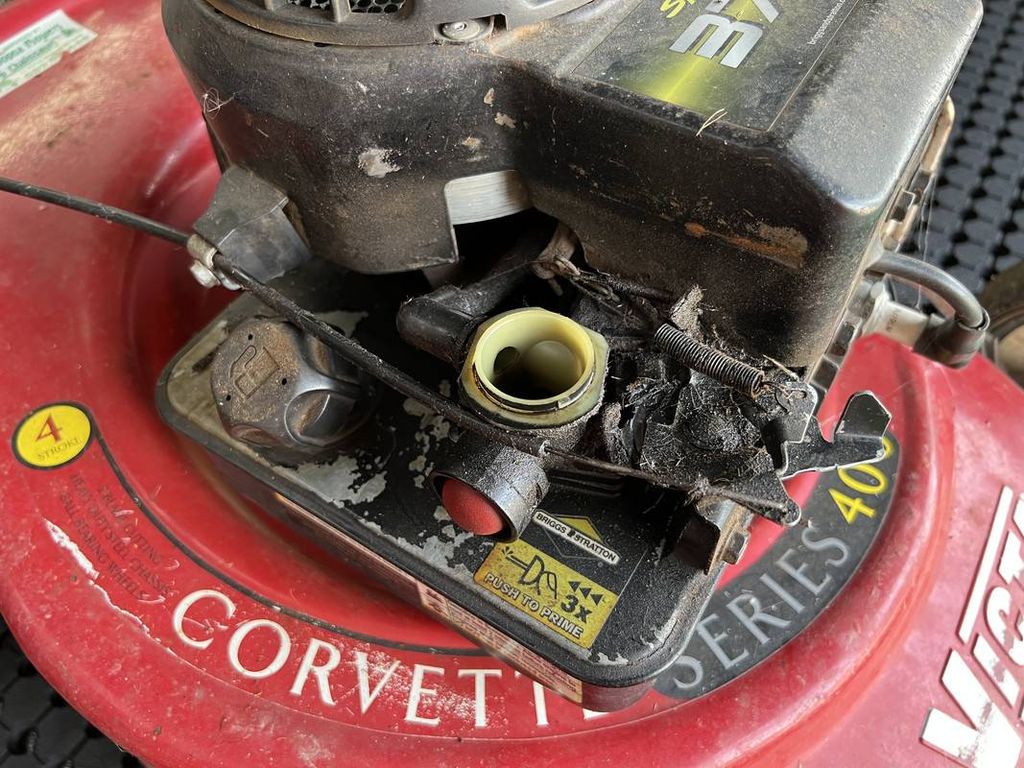
Where the carburetor hides: remove the air filter and its box and the carb throat is right behind them (center) — red primer bulb below, throttle linkage and spring to the right. 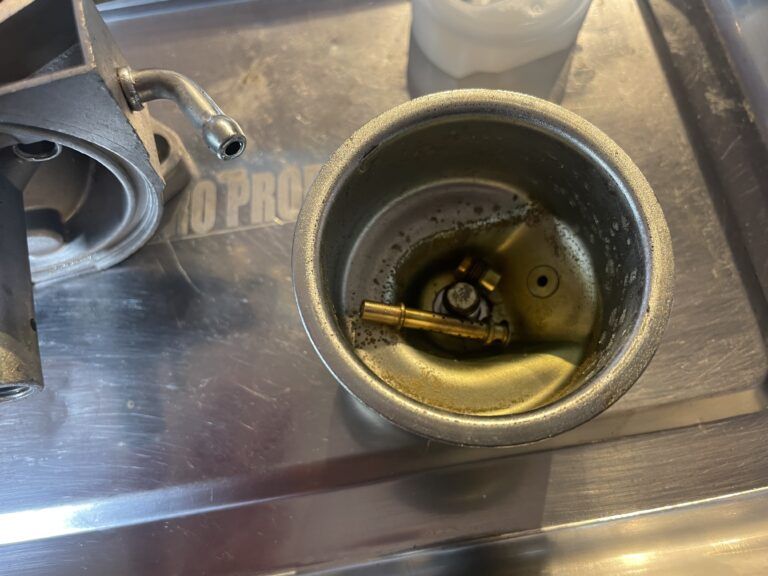
What you're cleaning: the bowl off, showing amber varnish staining and grit around the brass jet. That film is dried stale fuel — it's what blocks the jets.
2 · Starts, then dies
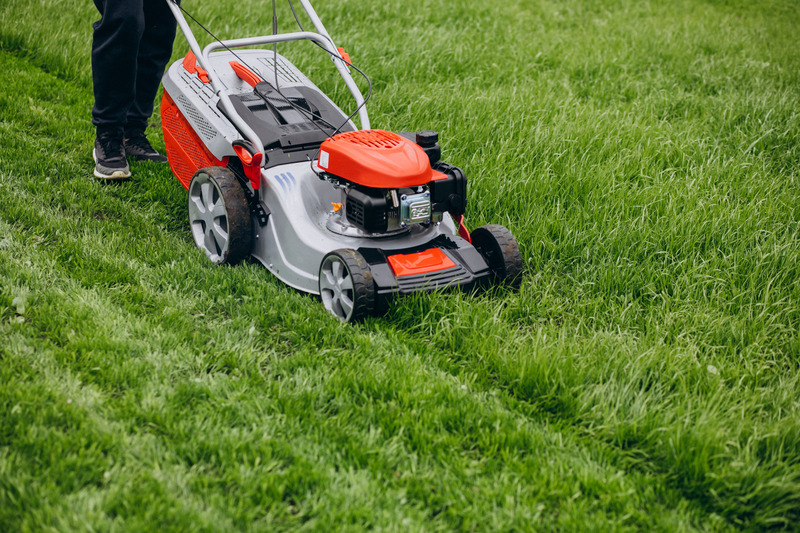
An engine that starts proves it has fuel, spark, and compression — at least for a moment. Dying is about what runs out. When it dies tells you what:
Dies on a timer — runs 30–90 seconds, quits, restarts after sitting
Loosen the fuel cap and listen. A hiss of air rushing in means the cap's vent is clogged and the tank has vacuum-locked: the engine drank until the vacuum beat the fuel flow. Clean the vent passages in the cap or replace the cap (cheap, model-specific). Restarting fine after a rest — once pressure equalizes — is the signature that confirms it.
Dies as soon as you start mowing
It idles fine in the driveway but quits in the grass: it's fine at no load and starved under load. That's a partially blocked main jet or a clogged air filter — idling takes almost no fuel or air; mowing takes all of both. Clean the filter first (5 minutes), then the carburetor (section 1, step 6).
Dies when you tip or tilt it
If it quits when the mower tilts on a slope or when you tip it to turn, check the oil level first — the low-oil sensor cuts spark when oil sloshes away from it. Second suspect: fuel sloshing uncovering the tank pickup with a near-empty tank. Top up both and re-test on the flat.
3 · Surges, runs rough, or loses power
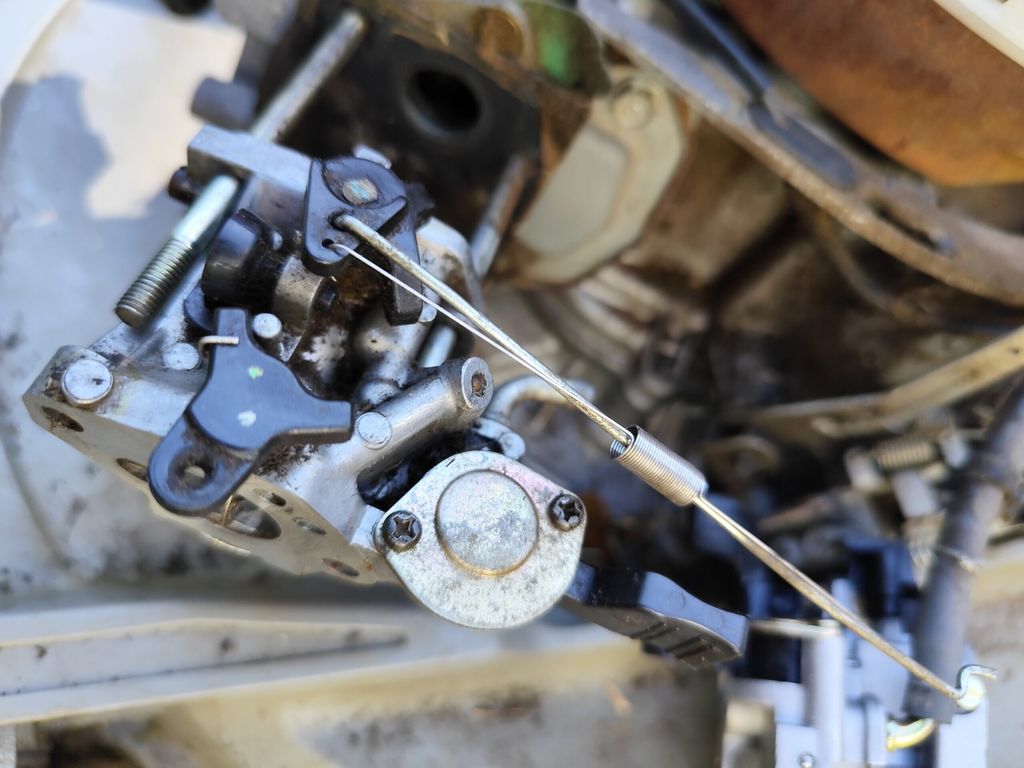
Surging — revs rising and falling in a steady hunting rhythm — is the classic mower complaint, and it's usually the governor fighting a lean mixture. A partially clogged carburetor jet makes the engine run lean; the governor opens the throttle to compensate, overshoots, and repeats. Clean the carburetor before touching any governor parts. If the carb is clean, check the governor spring: stretched, rusty, or hooked in the wrong hole, it hunts exactly the same way. Don't bend governor arms by guesswork.
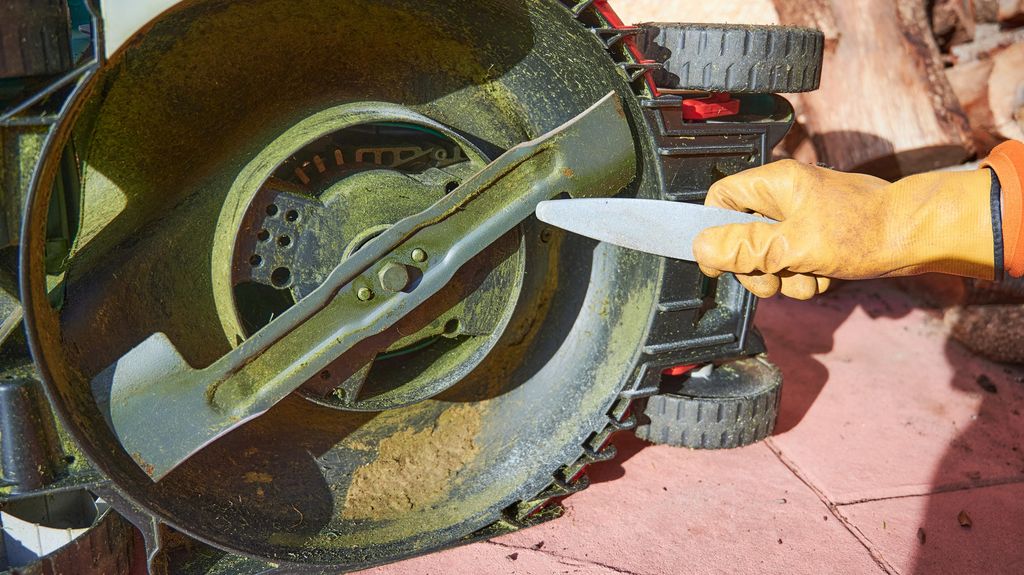
Bogging down in grass it used to handle — work this order: clogged air filter, then the blade. A dull blade is the most overlooked power problem in mowing: it tears grass instead of shearing it, and tearing takes far more power. If the mower has been slowing down over weeks and the grass tips look shredded and white a day after mowing, sharpen the blade before you touch the engine. Then stale fuel, then the carb.
Random missing and stumbling points back at the basics: a plug that's breaking down under load, water in the fuel bowl (a bead of water sits at the bottom and won't burn — drain the bowl), or borderline stale fuel. Plug first (it's $6), fresh fuel second.
4 · Cuts badly: strips, torn tips, clumps, scalps
Leaves strips of uncut grass
Almost always one of four things: a dull or bent blade, a deck packed solid with dried clippings underneath (the blade spins in a cave of its own debris), engine speed too low, or walking too fast for the grass height. Overlap each pass by a few inches, scrape the deck clean, and sharpen. A blade that's too short for the deck — a wrong replacement — leaves a strip no technique fixes; match the length and center-hole shape to your model.
Grass tips turn white and ragged
That's tearing, not cutting — a dull blade, full stop. It's not cosmetic, either: torn grass loses water, invites disease, and is exactly why the lawn looks tired two days after mowing. Sharpen every 20–25 hours of mowing (twice a season for most yards) and balance the blade on a nail or balancer after sharpening — an unbalanced blade vibrates (section 5).
Clumps and a trail of clippings
Wet grass, a too-low deck, or a clogged discharge chute / full bag. Mow when the grass is dry, raise the deck a notch, and slow down so the deck can process what it's cutting. A mulching blade that's gone dull mats clippings instead of re-cutting them — sharpening fixes that too.
Scalps the high spots
Deck set too low for uneven ground, or a deck that's no longer level — check that all four wheels are set to the same notch (a mismatched wheel is embarrassingly common after winter storage). Level the deck side-to-side and front-to-back per your manual, with the plug wire off.
5 · Vibration, blade problems & dead self-propel
Good news: this section is rarely the engine. It's the wear parts underneath doing — or failing — their jobs.
Vibrates badly
Stop. Don't mow through it. Tip the mower air-filter side up (plug wire off) and inspect the blade: bent, cracked, or sharpened lopsided, an out-of-balance blade is the #1 cause — and running it can wallow out the crankshaft bearings. Check the blade bolt is torqued down and scrape off the lumps of dried grass stuck to the deck, which unbalance everything. Never straighten a bent blade — bent metal is weakened metal, and a blade that lets go at 3,000+ RPM is a genuine emergency. Replacement blades are cheap. If the vibration started the moment you hit something solid, and the blade looks straight, the crankshaft may be bent: that's the shop line.
Blade doesn't spin, or drive wheels don't pull
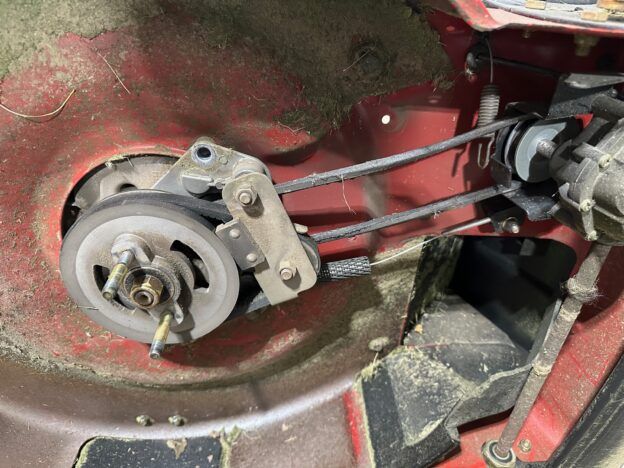
On self-propelled mowers the wheels are driven by a belt off the crankshaft and a small transmission. A belt that's stretched, glazed, or jumped off its pulley is the usual failure — replace by model number and check the cable that tensions it. If the belt is good but one wheel doesn't pull, look at the drive pinion and the ratcheting gear inside that wheel: worn or grass-packed pinions are a known wear item and swap in minutes. For push mowers with no blade drive clutch, a blade that won't turn with the engine running means the blade adapter or its key has sheared — again, a designed weak point that sacrificed itself on an impact.
The pull cord fights back
A cord that kicks or rips out of your hand on the pull points at timing (sheared flywheel key, above) or a blade that's seized against a packed deck. A cord that pulls with no resistance at all: broken recoil pawls or genuinely low compression — section 1's shop line applies.
6 · Prevent it: winterizing & spring tune-up
Almost every repair above traces back to one autumn afternoon. Twenty minutes then deletes most of this guide.
End of season (the 20 minutes that matter)
- Add fuel stabilizer and run the engine 5 minutes so treated fuel reaches the carburetor — or drain the tank and bowl dry, per your manual's storage method. Pick one; doing neither is the problem.
- Change the oil while the engine is warm from that run. Old oil sitting in the crankcase all winter is acidic and abrasive.
- Scrape the deck clean underneath. Wet clippings packed against the deck rust it through from the inside.
- Pull the spark plug, put a teaspoon of oil in the cylinder, and pull the cord slowly twice to coat the walls — or at minimum store the plug wire off.
- Sharpen the blade now, while you're not in a hurry, so spring-you just bolts it on. Store the mower indoors or covered, on a flat floor.
Spring tune-up (before the first mow)
- Fresh fuel for the season — don't start spring on last fall's gas can.
- New or cleaned air filter, new spark plug, oil at the full mark. This trio is the whole tune-up and it's under $20.
- Blade sharpened and balanced; blade bolt torqued; all four height wheels in the same notch.
- Start it in the driveway on a dry day. A no-start in March is an errand; on the first Saturday the grass needs cutting, it's a crisis.
Frequently asked questions
Why won't my lawn mower start after sitting all winter?
Almost never the engine itself. Gasoline goes stale in 30–60 days and varnishes the carburetor jets shut. Drain the tank and carb bowl, refill with fresh fuel, check the oil level (a low-oil sensor blocks starting on many models), clean the air filter, and confirm the spark plug isn't fouled.
Why does my lawn mower start and then die right away?
First loosen the fuel cap — a hiss of air rushing in means a clogged cap vent and a vacuum-locked tank. Dying after 30–90 seconds usually means a partially blocked carburetor jet or clogged air filter: enough fuel and air to start, not enough to keep going.
Why does my lawn mower surge — rev up and down on its own?
Surging is usually the governor fighting a lean mixture from a partially clogged carburetor jet, over-correcting in a steady rhythm. Clean the carburetor first; a stretched governor spring or gummed linkage causes the same symptom.
Why does my mower lose power and bog down in tall grass?
In order: a clogged air filter, a dull blade (the most overlooked cause — tearing grass works the engine hard), stale fuel, then a dirty carburetor. Raise the deck and take half-width passes in tall grass instead of forcing a full cut.
Why does my lawn mower leave strips of uncut grass?
A dull, bent, or wrong-length blade; a deck packed with clippings; engine speed too low; or walking too fast. Overlap each pass by a few inches, clean the deck, and sharpen or replace the blade. Never try to straighten a bent blade — replace it.
Why does my mower vibrate badly?
Check the blade first: bent or out of balance is the usual cause, and running it can damage the crankshaft. Also check the blade bolt and lumps of dried grass under the deck. Vibration that started right after hitting a rock or stump may mean a bent crankshaft — a shop job.
How often should I sharpen my mower blade?
About every 20–25 hours of mowing — twice a season for most home lawns, and always at the spring tune-up. The tell is the grass: torn, white tips a day or two after mowing mean the blade is tearing, not cutting.
When is it a shop job, not a yard fix?
A bent crankshaft, low compression, a seized engine, or a fuel leak you can't trace to a line or fitting. Everything fuel, air, spark, blade, and belt related is a realistic home fix.
Still stuck? Run the guided diagnosis
Answer a few questions about your exact machine and symptom on Troubleshoot 101 and get your likely causes ranked, the fix step by step, and the parts to grab near you — the interactive version of this guide.
Start the lawn mower diagnosis →