Outboard motor guide · Troubleshoot 101
Outboard won't start?
Check the simple things first.
An outboard that cranks all morning at the launch usually isn't broken — the lanyard isn't clipped, the tank vent is closed, or last season's fuel varnished the carburetor. This guide works through every common symptom in the order a mechanic checks them: cheapest and most likely first, shop jobs clearly flagged last. Two-stroke and four-stroke, tiller and remote.
- Kill-switch lanyard clipped fully onto the switch? No lanyard = no spark, by design.
- Portable tank: vent screw on the cap opened a turn or two?
- Primer bulb: squeeze it — does it firm up with fuel, or stay soft and empty?
- Fuel connectors clicked fully onto tank and motor at both ends?
- Motor in neutral, and — once it fires — is the tell-tale streaming? (No stream: see overheating and stop.)
1 · Outboard cranks but won't start
This is the most common outboard problem there is, and it has two causes that take five seconds each and embarrass everyone once: the kill-switch lanyard and the tank vent. After those, it's the same story as every small engine that sat — gasoline starts going stale in as little as 30–60 days, and by the first launch the carburetor's tiny jets are varnished shut. The engine is mechanically fine and simply can't drink, or can't spark.
Work the causes in this order. Each one is cheaper and more likely than the next, and most owners are on the water by step 3.
| Cause | How to tell | Fix time | Cost |
|---|---|---|---|
| Kill-switch lanyard not clipped | Cranks strongly, never fires; clip missing or half-on | 30 sec | Free |
| Tank vent closed | Portable tank; may fire briefly, then starve | 30 sec | Free |
| Primer bulb soft / connector passing air | Bulb never firms up; connector not fully clicked on | 5 min | Free – ~$15 line |
| Stale fuel | Gas smells sour/varnishy; motor sat 2+ months | 25 min | Price of fresh gas |
| Flooded engine | Strong fuel smell after repeated priming/choking | 10 min | Free |
| Fouled spark plug | Plug black, wet, or no blue spark when tested | 10 min | ~$5–10 per plug |
| Gummed carburetor | Fresh fuel doesn't help; fires briefly on a prime, then dry | 45–90 min | $0 clean · kit ~$15–35 |
| Won't crank at all (battery / starter) | Click, slow crank, or silence on electric start | 20 min | Charge free · battery varies |
| Low compression | Pull cord suspiciously easy; fuel + spark confirmed good | — | Shop job |
The fix, step by step
- Clip the lanyard and confirm neutral. Push the kill-switch clip fully onto the switch — an outboard will crank all day with zero spark if it isn't seated, because that's exactly what it's designed to do when a driver goes overboard. Most motors also refuse to start in gear: shift to neutral and wiggle the handle to be sure.
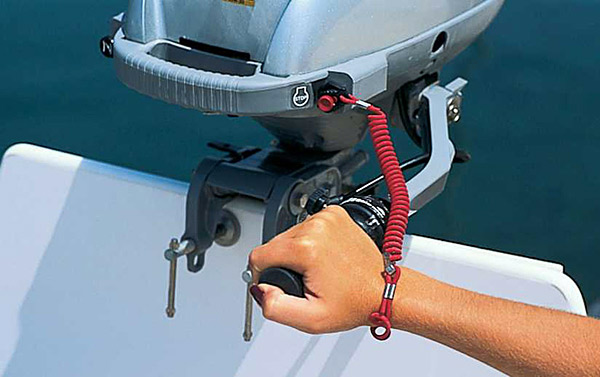
What to look for: the red coiled lanyard fully clipped into the kill switch on the tiller, just above the hand, wrist loop on. If that clip isn't seated, the motor cranks with no spark. - Open the tank vent. On a portable tank, unscrew the vent on the cap a turn or two. As the motor drinks, air has to get in; a closed vent starves it as surely as an empty tank. On a built-in tank, check the vent hose isn't kinked or blocked by a wasp nest after storage — it happens every spring.
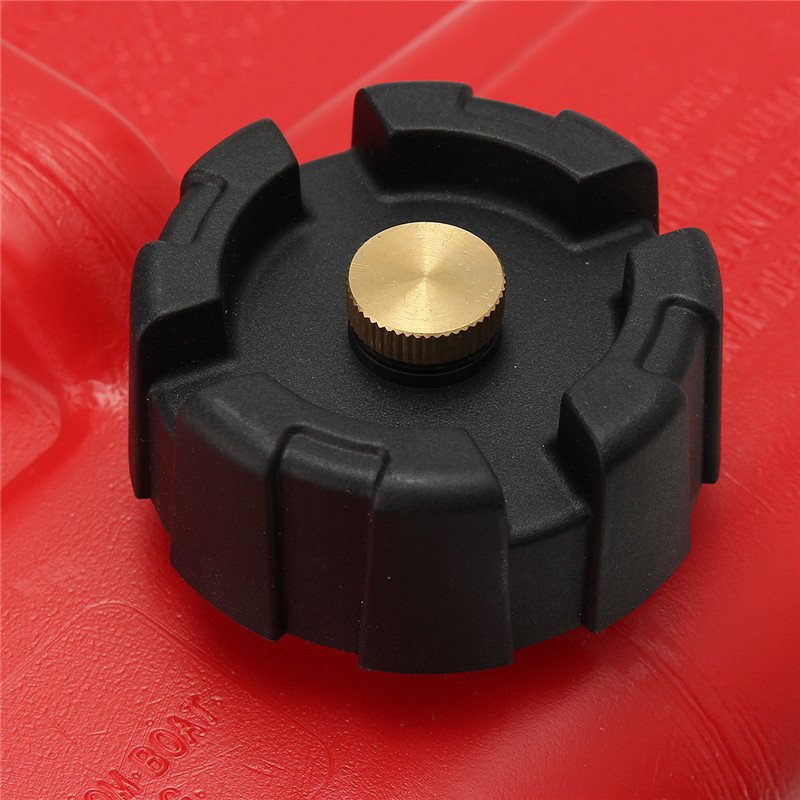
What to look for: the small brass vent screw in the centre of the black cap on a portable tank. Unscrew it a turn or two so it sits proud of the cap — screwed flat shut is the starving position. - Squeeze the primer bulb until it's firm. Arrow on the bulb pointing toward the motor. Firm bulb = fuel at the carb. Bulb that never firms up = air getting in where fuel should be: push both quick-connectors on until they click, check the bulb itself and the line for cracks (ethanol fuel hardens them from the inside), and confirm the tank pickup isn't clogged.
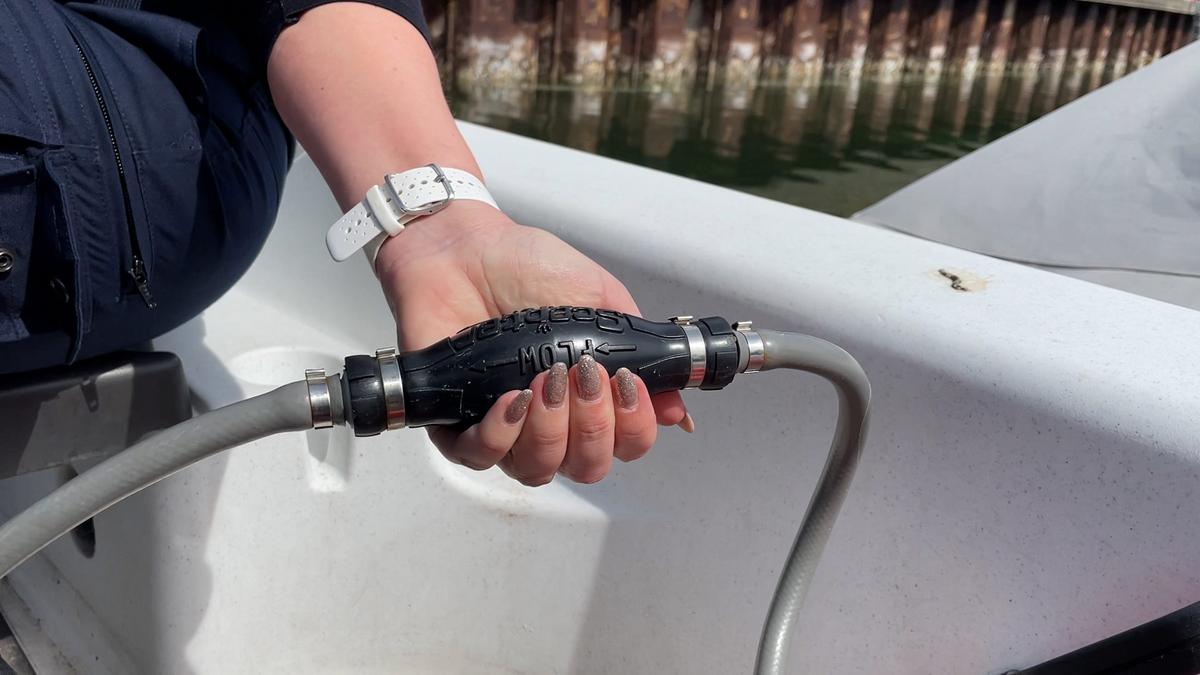
What to look for: the black primer bulb in the fuel line, squeezed in the hand in the boat. The FLOW arrow moulded on the bulb points toward the motor. Keep squeezing until the bulb feels firm, not soft and empty. - Drain the old fuel completely. If the gas sat all off-season, don't try to “burn through it.” Drain the tank and the carburetor bowl/float chamber into an approved container and refill with fuel bought this season, plus stabilizer. Dispose of stale fuel per your local rules — never on the ground or in the water.
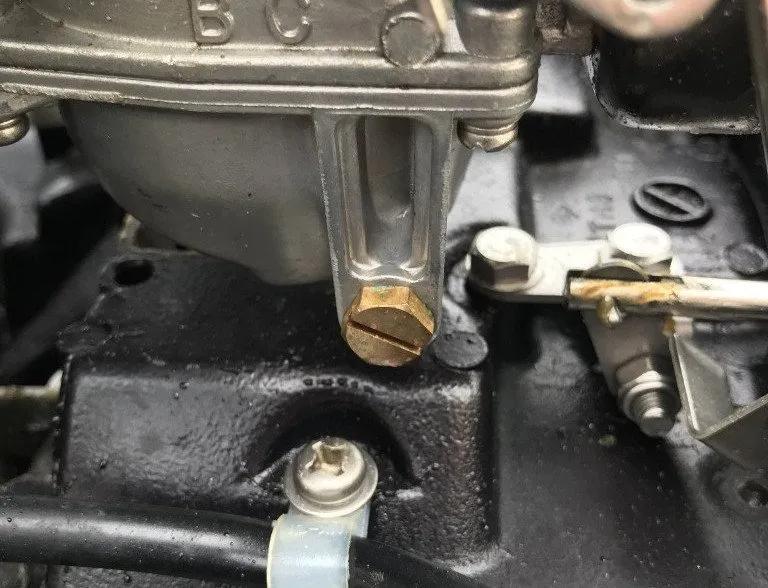
What to look for: the brass slotted drain screw at the very bottom of the carburettor float bowl, in place on the engine (centre), with the throttle linkage beside it. This is the screw you loosen to drain stale fuel and water from the bowl. - Clear a flood before you chase anything else. Too many primes or too much choke drowns the plug. Choke fully OFF, throttle open, crank 8–10 times. Still nothing? Pull the plug, dry it, crank a few times with the plug out to clear the cylinder, and retry with no choke and no prime.
- Pull the spark plug(s) and read them. Black and sooty = rich/fouled. Wet with fuel = flooded or no spark. White or blistered = overheating (see section 4). Fouled plugs are cheaper than the time to clean them: replace with the exact plug and gap in your manual, and confirm spark with an inline tester — don't hold a bare plug by hand.
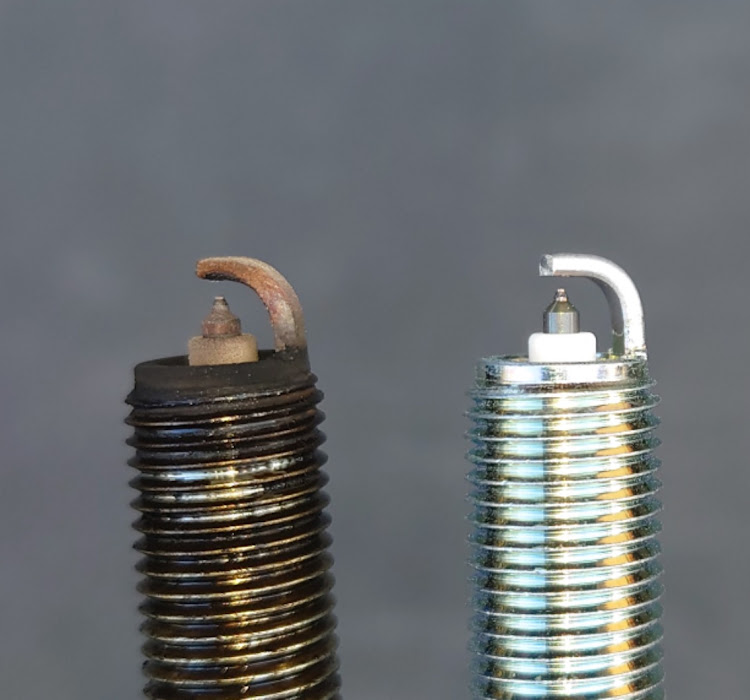
What to look for: left — a fouled plug, blackened threads, rusted ground strap and sooty tip. Right — a new plug, bright threads and clean white insulator. If yours looks like the left, replace it rather than cleaning it. - If it fires on a bulb-prime but won't stay lit, it's the carburetor. Remove the bowl, clean the main and idle jets and passages with carb cleaner and a single strand of copper wire — never a drill bit or steel wire, which enlarge the holes — and reassemble. A rebuild kit (gaskets, needle, seat) is the reliable fix when cleaning alone doesn't hold.
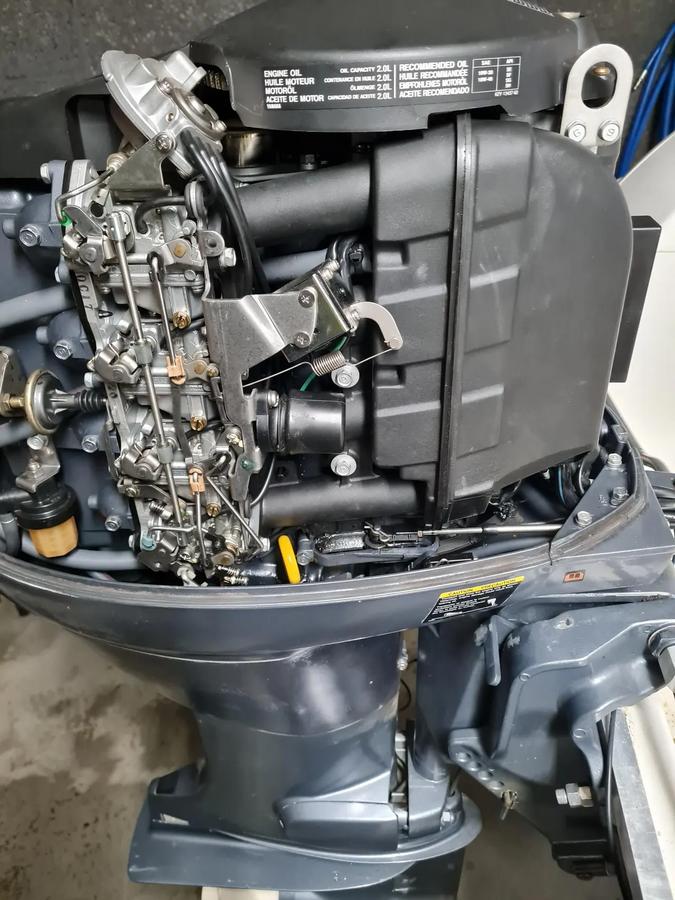
Where it lives: with the cowling off, the carburettors sit on the side of the powerhead with their linkages (left side of this Yamaha). The small fuel filter bowl is just below them at lower left — that's the assembly you're removing. 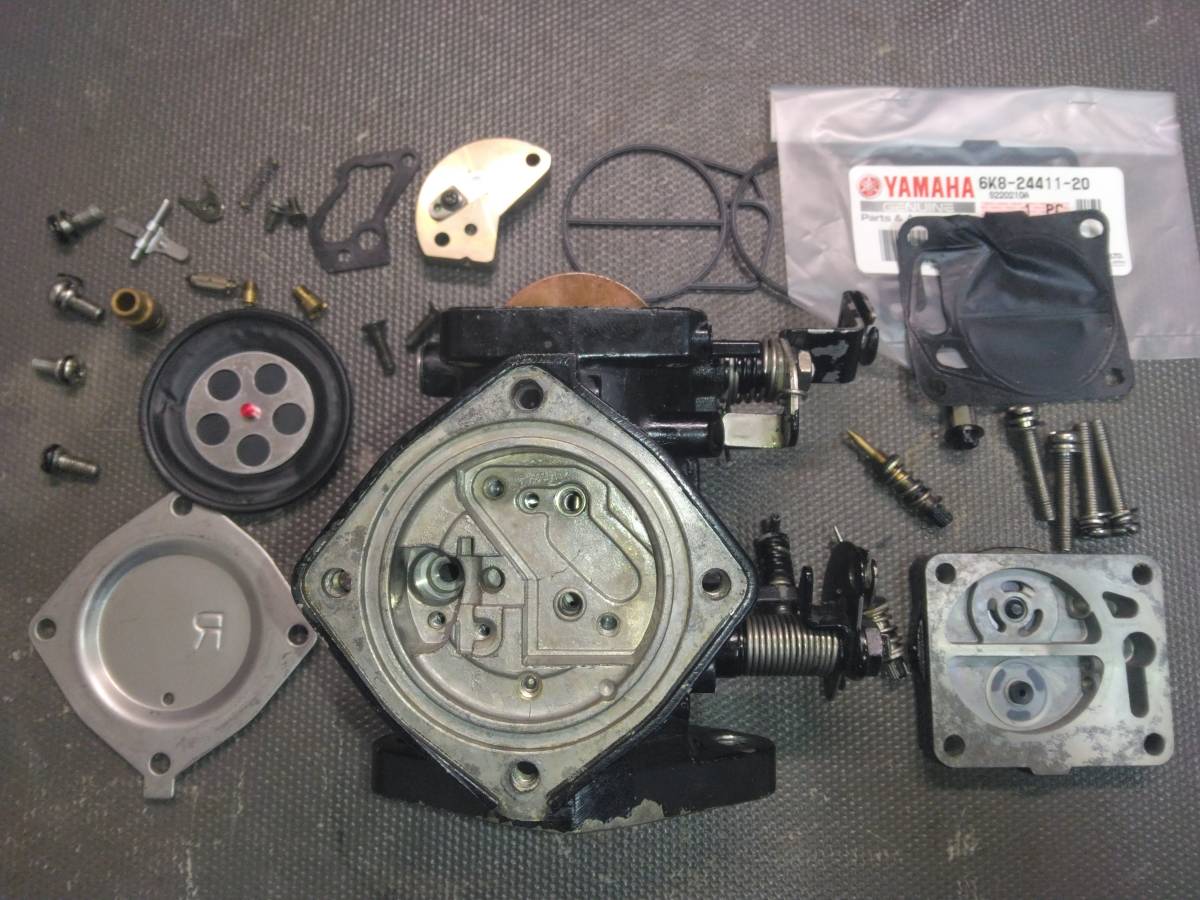
What you're opening up: the same carburettor stripped on the bench — body in the centre, jets, diaphragm, gaskets and screws laid out around it. The tiny jets are where varnish from stale fuel blocks the flow.
2 · Starts, then dies
A motor that starts proves it has fuel, spark, and compression — at least for a moment. Dying is about what runs out. When and how it dies tells you what:
Dies on a timer — runs 1–3 minutes, quits, restarts after sitting
The tank-vent vacuum lock, and outboards hide it better than any other engine. As fuel drains, air must enter through the vent; if the vent screw is closed or the vent is clogged, a vacuum builds until it beats the fuel flow and the motor starves. Sitting lets air slowly leak back in, so it restarts like nothing happened. Open the vent fully; on a portable tank, try running briefly with the cap loosened — if the dying stops, you've confirmed it.
Dies unless you keep squeezing the primer bulb
You're doing the fuel pump's job by hand. The engine's fuel pump is weak or its diaphragm is tired, or the pickup inside the tank is clogging. Check the vent is fully open and the pickup screen is clear first (both free), then test or replace the pump.
Dies the moment you shift into gear or throttle up
It idles on what's in the bowl but can't make power: a partially blocked main jet, a clogged inline fuel filter, or a collapsing fuel line. Enough fuel to idle, not enough to work. This is a carburetor cleaning and a $5 filter (section 1, step 7), not an adjustment to live with.
Dies hot, restarts fine once it cools
A cracked spark plug or a failing ignition coil can spark cold and quit as it heats up — the motor dies like someone flipped a switch. New plug first (cheap, ten minutes); if it still dies hot, test for spark with an inline tester immediately after it dies. No spark while hot = coil.
3 · Runs rough, shakes, or won't idle
Idling is the hardest thing an outboard does all day: it takes the least fuel, at the lowest speed, and shifting into gear adds load at exactly that weakest point. That's why rough running almost always shows up at the dock first.
Stalls when you shift into gear is the signature of a partially clogged idle jet or water in the fuel — a bead of water sits in the bottom of the bowl and won't burn. Drain the bowl and the water-separating filter (where fitted) into a clear container and look at it: cloudy fuel, separated layers, or rust flecks mean drain the tank too.
Surging — revs rising and falling in a steady hunting rhythm at a fixed throttle — is a mixture swinging rich and lean: a half-blocked jet, or extra air sneaking in past a cracked intake gasket, perished fuel line, or loose carburetor. Squeeze rubber lines; cracks open up. Check carb mounting bolts for tightness.
Blubbering, smoking, and loading up at idle (2-stroke) often traces to the fuel itself: the wrong oil mix. Too much oil fouls plugs and carbon-loads the motor; too little oil is an engine-killer, not a tuning choice. Mix exactly to the ratio in your manual, in a clean can, with fresh fuel — and when in doubt about a can's ratio, dump it and mix a known batch.
Adjustment comes last, not first. On older outboards with adjustable jets, set the idle mixture per your manual, in gear, in the water or on muffs — never by ear alone at high RPM out of water, and never rev a motor on muffs beyond a fast idle: there's no load and no proper cooling margin. If the adjustment keeps drifting, the carb needs cleaning or a kit; a screw can't compensate for a clogged jet.
4 · No tell-tale stream, steam, or overheating
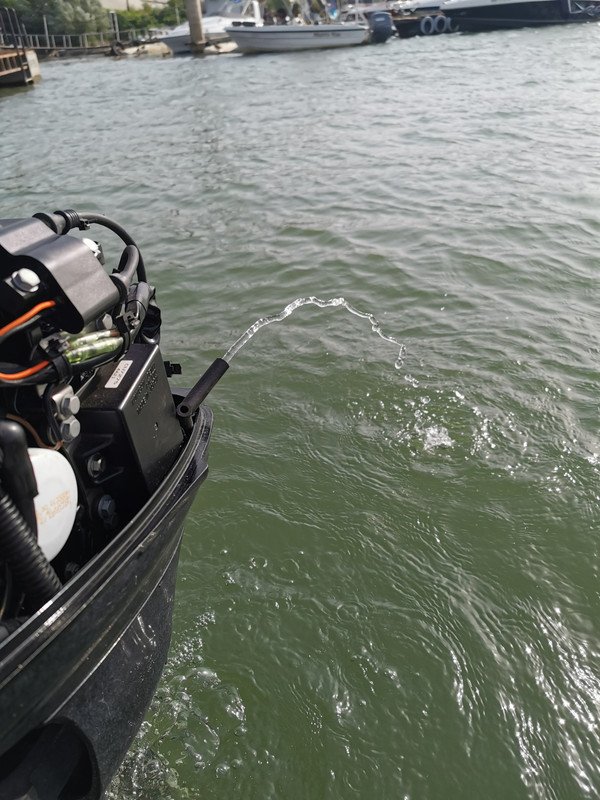
The tell-tale — the small stream of water from the side of the motor — is your cooling system's heartbeat. A strong stream should appear within seconds of starting. Weak stream, no stream, or white “smoke” that is really steam means cooling water isn't circulating. Stop the motor. An overheated outboard can be destroyed in minutes, and every minute of “running it to see” is scored cylinder walls.
Check the simple blockages first
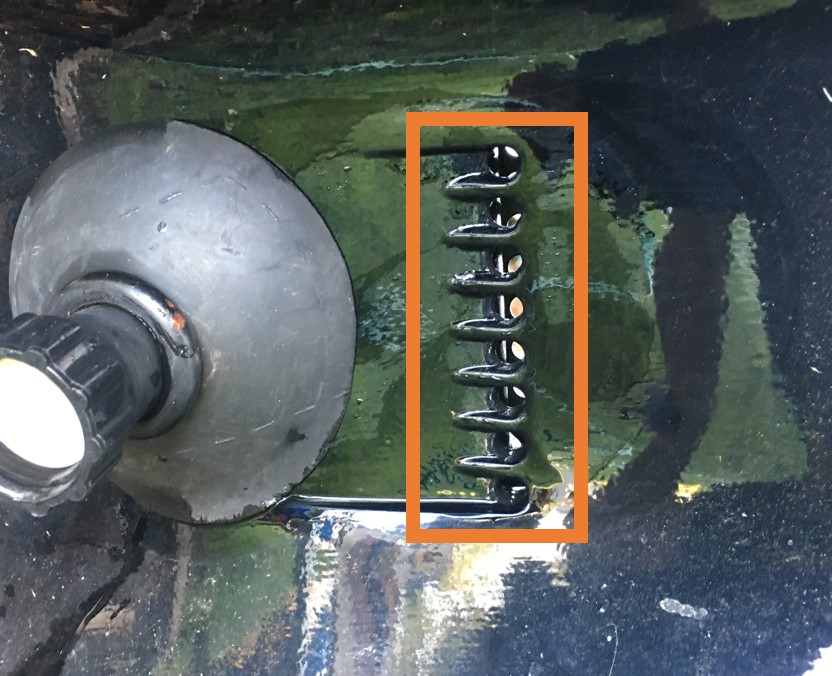
Kill the motor and look at the intake screens on the lower unit: weeds, a plastic bag, sand, or barnacles (on a slipped boat) block them constantly. Clear them and retry. Also check the tell-tale outlet itself — mud daubers and debris plug the little nozzle over storage, and a thin wire or a blast of air clears it. Strong water at the intakes + a plugged outlet reads exactly like a dead pump, and it's a two-minute fix.
Then suspect the impeller
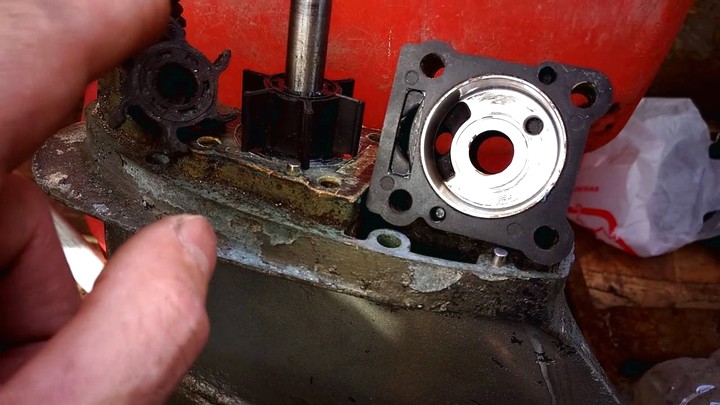
If intakes and outlet are clear and the stream is still weak, the water pump impeller is worn out. It's a flexible rubber wear part that lives in the lower unit, and it's meant to be replaced every couple of seasons. It fails in two classic ways: vanes that take a set and crack after long storage (the spring no-start that also doesn't pee), and vanes shredded by running in sand or — fastest of all — running the motor dry without water for even a few seconds. Replacement means dropping the lower unit and fitting an impeller or full pump kit with fresh gaskets: a doable driveway job with the manual for your model, basic hand tools, and gear oil to refill what drains. Note the shift-shaft alignment on reassembly — that's the step that makes it a shop job when rushed.
Still overheating with a new impeller?
Next suspects are a stuck thermostat (it never opens, so the powerhead overheats even with water flowing) and, on older motors, salt and scale narrowing the cooling passages. Both are diagnosable, but this is the honest point to get a shop involved if the basics are done.
5 · Lacks power — won't get on plane, bogs at speed
A motor that runs but can't do its work is rarely one problem — work from the back of the boat forward, because the cheapest causes are behind you.
Prop first: bent blade or spun hub
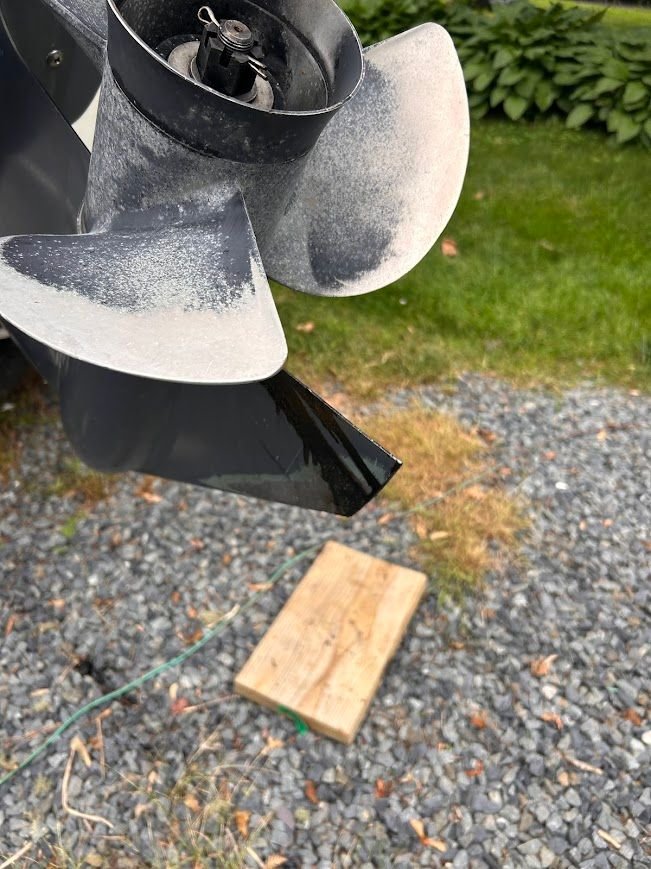
A dinged or bent blade wastes serious power and vibrates doing it. A spun hub — the rubber hub inside the prop slipping under load — is sneakier: the motor revs, the boat barely moves, exactly like a slipping clutch. Test it: draw a line across the hub and the prop shaft end, run the boat under load, and check whether the marks have separated. Separated marks = the hub is slipping; the fix is a rehub or a replacement prop, and carrying a spare prop (with a spare nut and cotter pin) ends the trip-ruiner version of this problem.
Then the hull and the load
A hull fouled with algae and growth can eat a third of your speed — the motor gets blamed for the boat's drag. Scrub it before you tune anything. Then check the obvious: weight distribution (everyone and the cooler in the stern will keep any boat from planing), motor trim angle, and whether the motor is mounted at the right height — a motor buried too deep drags its lower unit like an anchor.
Then the engine under load
If the prop and hull are honest, a partially blocked main jet starves the motor exactly when it works hardest — it will idle and troll all day and bog the moment you ask for power. The tell: partial choke restores power. That confirms fuel delivery, full stop: clean the carb, replace the inline filter, and check for a collapsing fuel line or weak fuel pump (section 2). On a 4-stroke, also check the air intake for a storage nest — it happens more than anyone admits.
6 · Prevent it: winterizing & spring checklists
Almost every repair above traces back to one autumn afternoon that didn't happen. Outboards live stored longer than almost any other engine — a little care at layup deletes most of this guide.
End of season (the hour that matters)
- Add fuel stabilizer and run the motor on muffs long enough for treated fuel to reach the carburetor — or drain the system dry, per your manual's storage method. Pick one; doing neither is the problem.
- Fog the cylinders (or follow your manual's storage-oil procedure) and change the engine oil on a 4-stroke while it's warm from that run.
- Change the lower-unit gear oil now, not in spring — and read the old oil. Milky oil means water is getting in, and it's far better to learn that in October than at the launch.
- Grease the fittings, pull the prop, grease the shaft, and check for fishing line wrapped behind the prop — line eats the seal it hides behind.
- Charge the battery, disconnect it, and store it somewhere it won't freeze flat. Clip the lanyard around the tiller or control so spring-you finds it.
- Note the impeller's age. Every couple of seasons is the replacement rhythm — a spring failure is a choice made by skipping this line two years running.
First trip (in the driveway, before the launch)
- Run the motor on muffs at home. A no-start in the driveway is an errand; at a busy launch with a line behind you, it's a story.
- Watch the tell-tale for a full minute. Strong stream before you go = a trip that starts with confidence.
- Buy fresh fuel for the season — don't start spring on last fall's gas can, stabilized or not.
- Squeeze the primer bulb and check every fuel line and connector for cracks, softness, and clicks.
- Confirm the spare prop, plug, and lanyard clip are in the boat — the three spares that have saved the most trips.
Frequently asked questions
Why won't my outboard motor start after sitting all winter?
Almost never a dead motor. Gasoline goes stale in 30–60 days and varnishes the carburetor jets shut. Drain the tank and carburetor, refill with fuel bought this season, and run the five-second checks first: lanyard clipped in, tank vent open, primer bulb squeezed firm, and both fuel connectors fully clicked on.
Why does my outboard crank but not start?
Two five-second checks cause a huge share of outboard no-starts: the kill-switch lanyard must be clipped in (no lanyard, no spark — by design) and the vent screw on a portable tank must be opened a turn or two (a closed vent starves the motor as surely as an empty tank). Then squeeze the primer bulb until it's firm; if it never firms up, a fuel connector is half-seated or the line is passing air instead of fuel.
Why does my outboard start and then die after a minute or two?
Dying on a timer, then restarting after sitting, is the classic closed or clogged tank vent: the motor drinks until vacuum in the tank beats the fuel flow. Open the vent screw fully. If it only stays running while you squeeze the primer bulb by hand, the fuel pump is weak or the tank pickup is clogging — you're doing the pump's job for it.
Why is there no water coming from my outboard's tell-tale?
A weak or missing tell-tale, especially with white smoke that's really steam, means cooling water isn't circulating. Stop the motor — an overheated outboard can be destroyed in minutes. Check the lower-unit intake screens for weeds, plastic or barnacles first; if they're clear, the water pump impeller is worn out. It's a rubber wear part meant to be replaced every couple of seasons.
Why does my outboard only run if I keep squeezing the primer bulb?
Because you're doing the fuel pump's job by hand. The pump is weak, its diaphragm is tired, or the pickup inside the tank is clogging. Check the tank vent is fully open and the pickup screen is clear first, then test or replace the fuel pump.
Why won't my outboard idle or stay running in gear?
Idling takes the least fuel of anything the motor does, so a partially clogged idle jet, water in the fuel, or stale fuel shows up at idle first — and shifting into gear adds just enough load to stall it. Clean the carburetor, drain any water from the bowl and filter, and only adjust the idle mixture afterwards, in gear, in the water or on muffs.
Why has my outboard lost power and won't get on plane?
Work from the back of the boat forward: a bent prop blade or a spun prop hub wastes serious power (mark the hub and shaft, run it, and see if the marks separate), a hull fouled with growth can eat a third of your speed, and a partially blocked main jet starves the motor exactly when it works hardest. Partial choke restoring power confirms a fuel-delivery problem.
When is an outboard problem a shop job, not a dock fix?
Low compression, water in the lower-unit gear oil (milky oil on the drain plug), a gearbox that grinds or won't shift, and any overheating that continues after a new impeller. Everything lanyard, vent, fuel, spark, carburetor and prop related is a realistic home fix with basic tools.
Still stuck? Run the guided diagnosis
Answer a few questions about your exact motor and symptom on Troubleshoot 101 and get your likely causes ranked, the fix step by step, and the parts to grab near you — the interactive version of this guide.
Start the outboard diagnosis →If it helped you, consider a tip.
Leave a tip