Jet ski / personal watercraft guide · Troubleshoot 101
Jet ski won't start?
Check the simple things first.
A ski that refuses to start at the launch usually isn't broken — the lanyard isn't seated, the security key isn't being read, or the battery is strong enough to crank but too weak to think. This guide works through every common symptom in the order a mechanic checks them: cheapest and most likely first, shop jobs clearly flagged last. Sea-Doo, Yamaha WaveRunner, and Kawasaki Jet Ski, two-stroke and four-stroke.
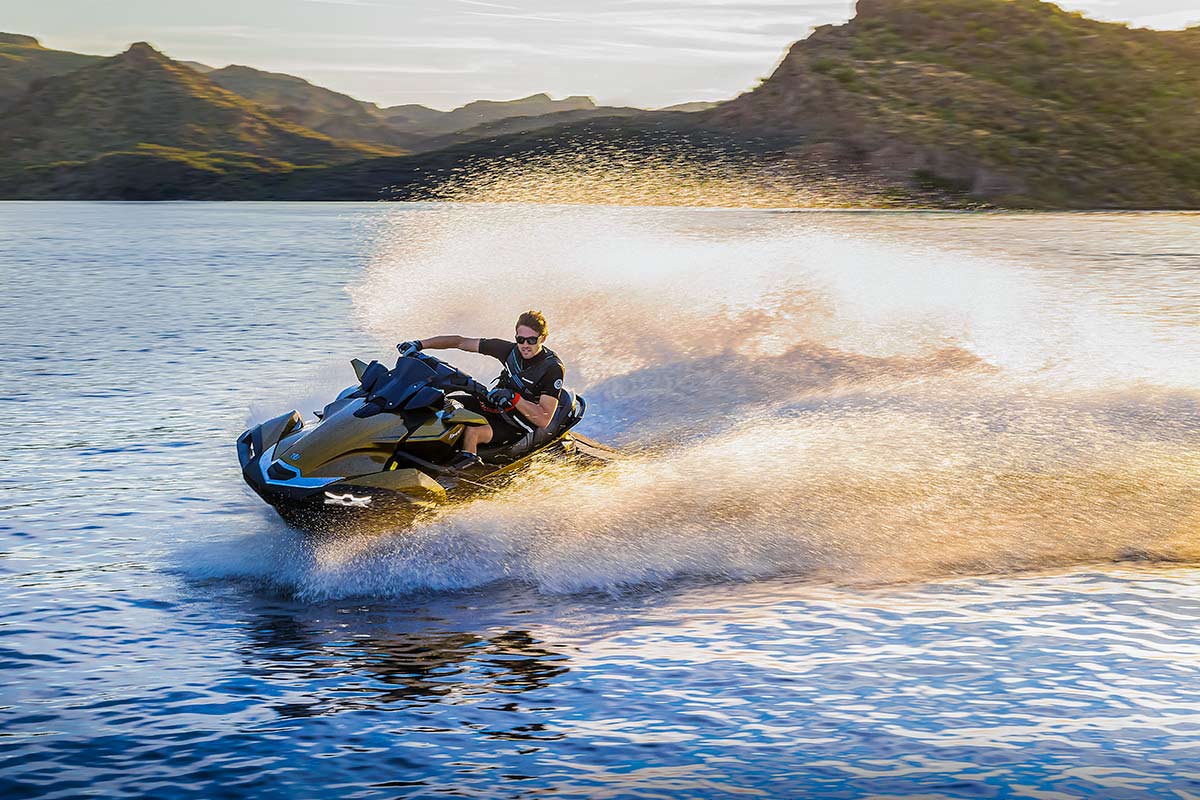
- Lanyard clipped fully onto the kill switch? No lanyard = no spark (or no crank), by design.
- Security key recognized? On a Sea-Doo, listen for two beeps when the DESS key goes on the post — two beeps means the ski knows its key.
- Battery strong? Terminals clean and tight, charge topped up — a ski battery that "cranks OK" can still be too weak for the electronics.
- Fuel in the tank — and is it fresh fuel, not what sat in it since last season?
- Intake grate under the hull clear? A clogged grate won't stop it starting, but it will fool you later — check it while you're down there (engine OFF, lanyard pulled).
1 · Jet ski won't start
This is the most common PWC problem there is, and on a modern ski it's electrical more often than mechanical. Three separate systems can veto a start before the engine ever gets a vote: the safety lanyard, the security key, and the battery — and a battery can pass the "it cranks, doesn't it?" test while still being too weak for the ECU and starter solenoid to do their jobs. Only after those three come fuel and spark, the same story as every engine that sat: gasoline goes stale in 30–60 days.
Note what your ski does when you hit start, because it splits the list in half: nothing at all (no crank, maybe a single click) points at the lanyard, key, battery, and solenoid; cranks but won't fire points at spark and fuel. Work the causes in this order — each is cheaper and more likely than the next.
| Cause | How to tell | Fix time | Cost |
|---|---|---|---|
| Lanyard not clipped / not fully seated | Nothing at all, or cranks with zero spark; clip half-on the post | 30 sec | Free |
| Security key not recognized (DESS etc.) | Sea-Doo: long beep or silence instead of two beeps; key warning on dash | 5 min | Free – post/key varies |
| Weak battery | Cranks slowly or clicks; dash dims or resets while cranking; sat all off-season | 20 min | Charge free · battery ~$60–120 |
| Corroded / loose battery terminals | White or green crust on the posts; cables wiggle by hand | 10 min | Free |
| Starter solenoid failed | Single solid click, no crank, battery tested strong | 30–45 min | ~$25–60 |
| Starter not engaging | Whirring/spinning sound but the engine doesn't turn over | — | Shop job (usually) |
| Start interlock not satisfied | Model needs neutral, or the brake/reverse lever set, before it will crank | 30 sec | Free |
| Flooded engine | Strong fuel smell after repeated cranking attempts | 10 min | Free |
| Stale fuel after storage | Fuel smells sour/varnishy; ski sat 2+ months | 30 min | Price of fresh gas |
| Fouled spark plugs | Plugs black, wet, or oily; weak or no spark on a tester | 15 min | ~$4–10 per plug |
| Fuel pump / clogged fuel filter | Cranks dry with good spark; no fuel pressure or prime sound | 45–90 min | Filter ~$10–25 · pump varies |
| Low compression | Cranks unusually fast and free; fuel + spark confirmed good | — | Shop job |
The fix, step by step
- Seat the lanyard like you mean it. Push the clip fully onto the kill-switch post until it sits flat — a half-seated lanyard is the single most common "dead ski" there is. On many models a missing lanyard means no spark; on others, no crank at all. Clip it to yourself for the test, not to the handlebars.
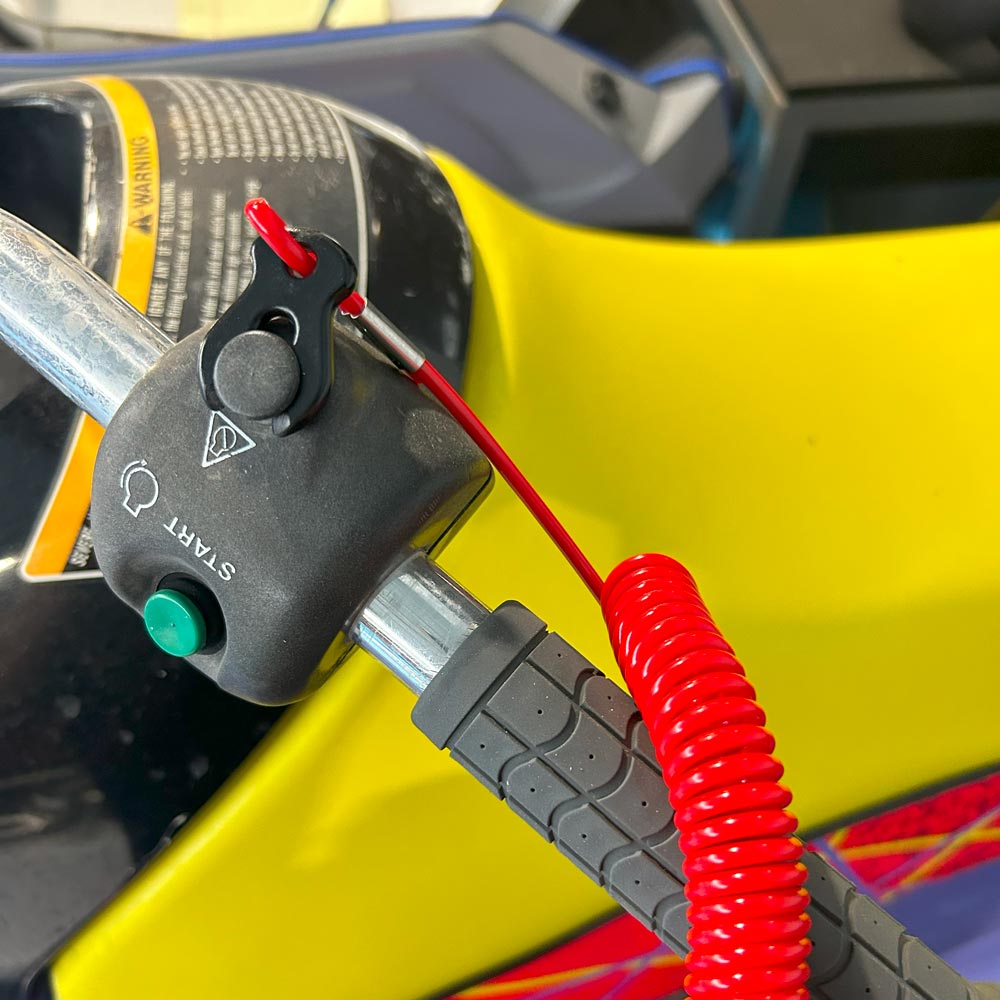
What 'fully seated' looks like: the clip sits flat under the kill-switch button on the handlebar pod, next to the start button. - Listen to the key. Put the security key on its post and pay attention. On a Sea-Doo, two short beeps means the DESS system read the key and you're cleared to start. A long beep, four beeps, or silence with a key warning means it didn't: wipe the post and the inside of the key cap clean and dry, try the spare key, and make sure it's the key programmed for this ski — keys from a second ski (and the restricted learning key) won't clear it. Yamaha and Kawasaki use their own security fobs and lock modes — check the dash isn't showing a locked state.
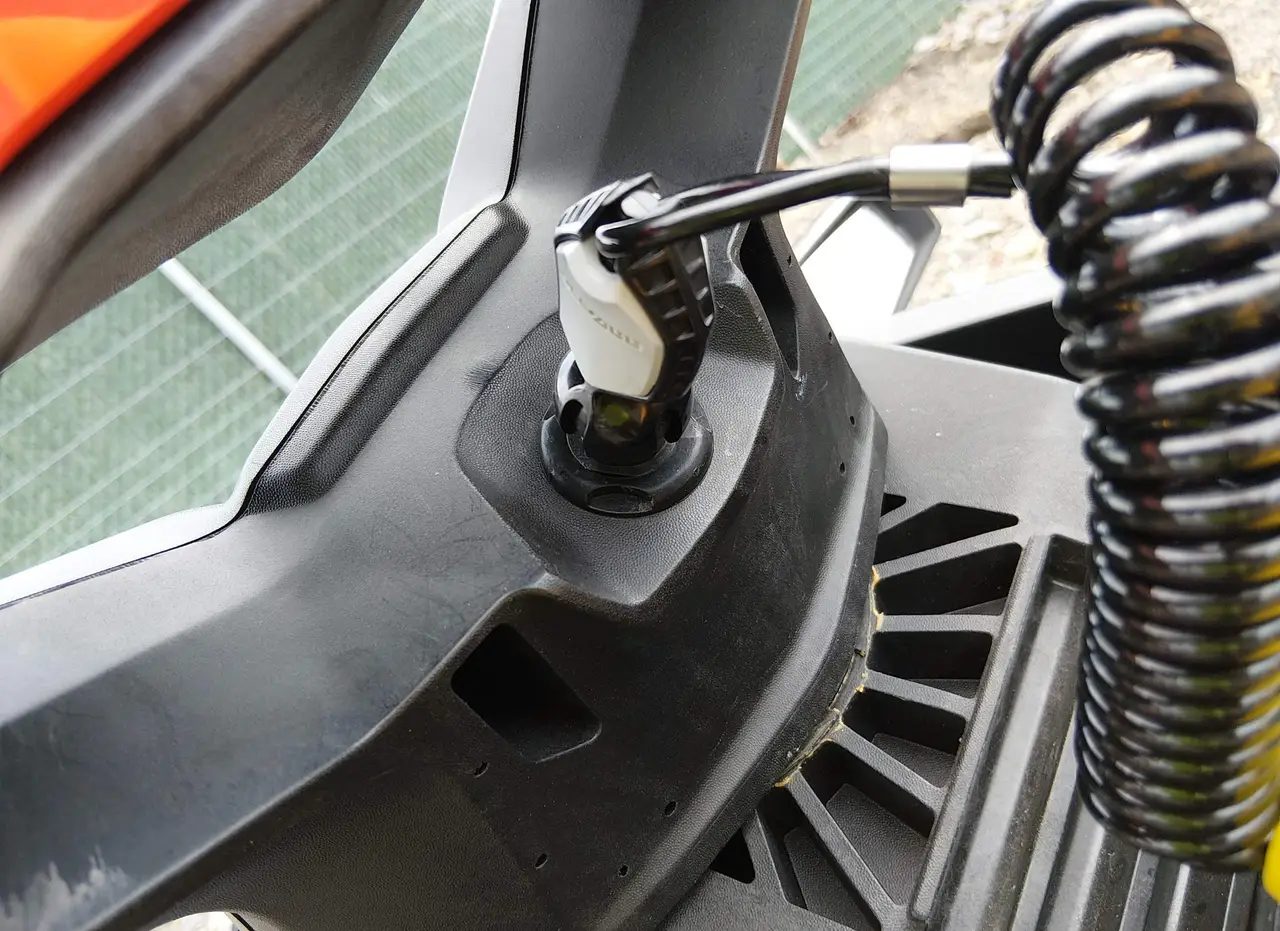
The DESS key seated on its post, ahead of the handlebars. Two beeps here means the ski has accepted this key. - Charge the battery, then load-test it. Don't trust "it cranks." PWC electronics are voltage-sensitive: a battery can spin the starter and still sag so low under load that the ECU and solenoid drop out mid-crank. Charge it fully, scrub the terminals shiny, tighten the cables so they can't twist by hand, and load-test — a battery that can't hold voltage under load is done, however new it looks. A battery that sat discharged all winter is usually sulfated and won't come back.
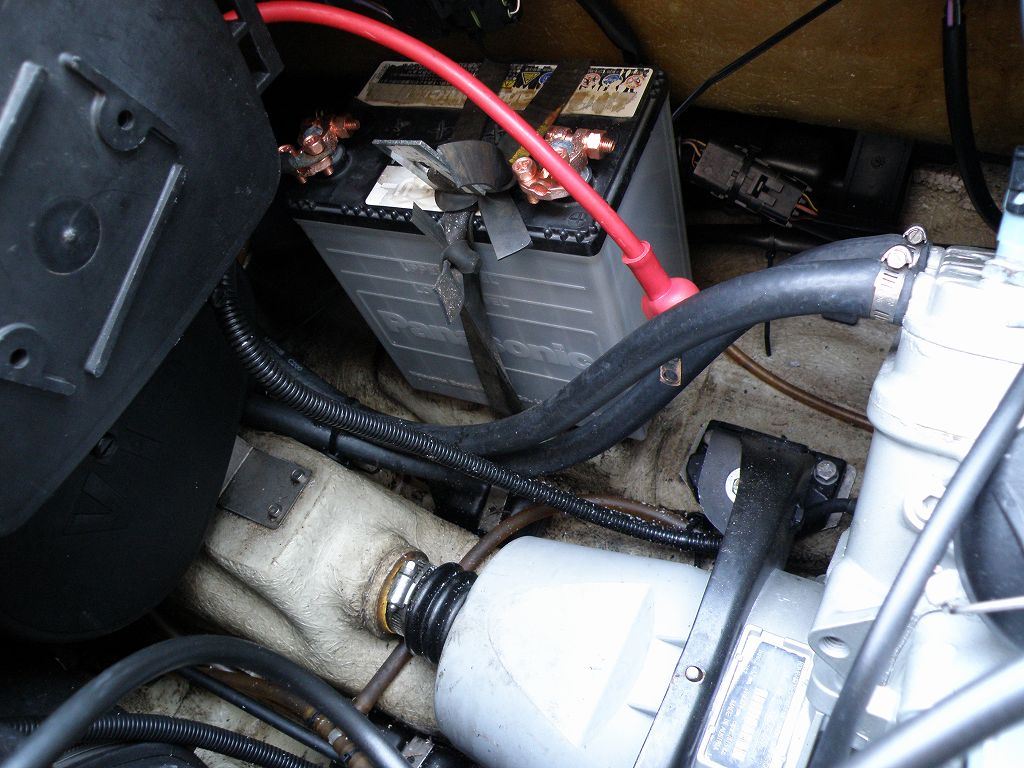
Where the battery lives: low in the hull beside the engine. Both terminals should be clean, tight, and impossible to twist by hand. 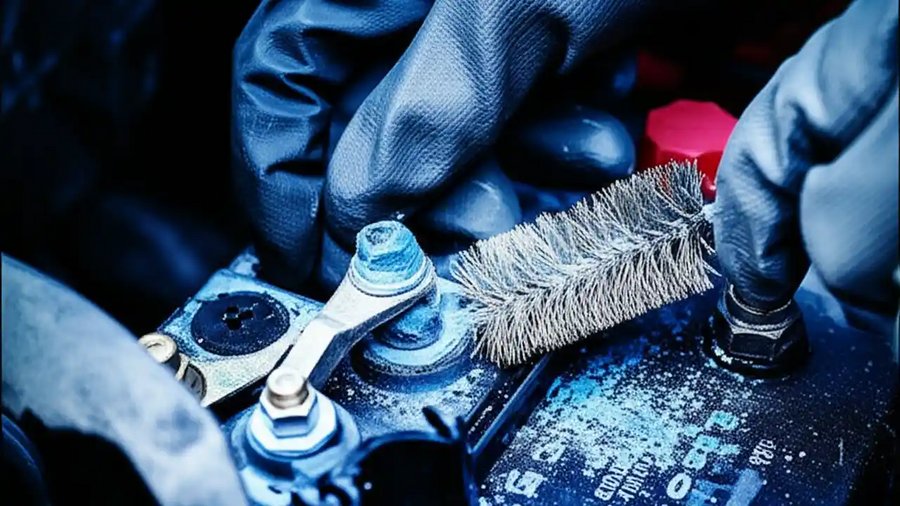
Scrub the posts and cable ends shiny with a wire brush — a dull, crusty connection can crank and still starve the electronics. - One click = solenoid territory. With a tested-strong battery and clean terminals, a single solid click and no crank points at the starter solenoid — a cheap, bolt-on part on most skis. A whirring starter that doesn't turn the engine over is the starter drive not engaging; that's usually a starter replacement, and on many models it's buried enough to be a shop job.
- Satisfy the interlocks. Some models won't crank unless they're in neutral or the brake/reverse lever is in the right position. Check your manual, set it, and try again before you take anything apart.
- Clear a flood before chasing fuel parts. Strong fuel smell after a lot of cranking? The engine is drowned, not starved. Follow the clear-flood procedure in your manual — on many fuel-injected skis, holding the throttle wide open while cranking tells the system to cut fuel and just pump air — then retry normally.
- Drain stale fuel and refill fresh. If the ski sat all off-season, don't try to "burn through" the old gas. Drain the tank into an approved container and refill with fuel bought this season, plus stabilizer. Dispose of stale fuel per your local rules — never on the ground or in the water.
- Pull the plugs and read them. Black and sooty = fouled. Wet with fuel = flooded or no spark. On a two-stroke, plugs foul fast and are a consumable, not a diagnosis. Replace with the exact plug and gap in the manual and confirm a strong blue spark with an inline tester — don't hold a bare plug in your hand while someone cranks.
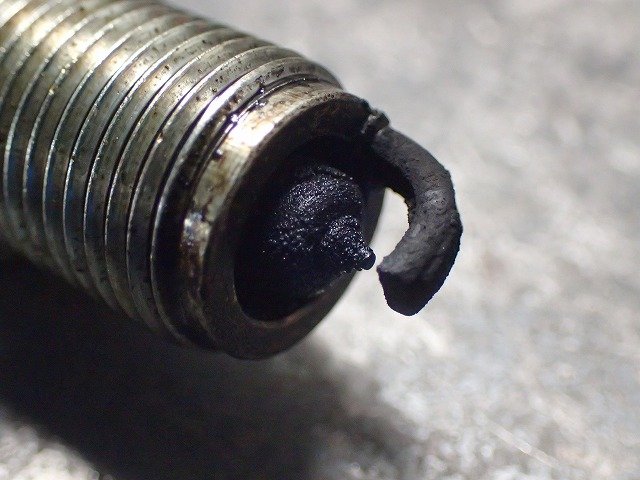
A fouled plug: black, sooty, and caked around the electrode. This plug gets replaced, not cleaned and prayed over. - Still dry with good spark? Fuel delivery is last. Check the fuel filter for clogging and listen for the fuel pump priming when the key goes on (fuel-injected models). A silent pump with good fuses, or a filter full of debris and water, has found your problem.
2 · Starts, then dies
A ski that starts has fuel, spark, and compression — something runs out, gets interrupted, or gets shut down. The pattern is the diagnosis: when it dies tells you which system to open first. Read the pattern that matches yours before touching parts.
| Cause | How to tell | Fix time | Cost |
|---|---|---|---|
| Worn lanyard clip pulling the kill switch | Dies the instant you move or the ski rocks; restarts immediately | 5 min | ~$10–20 clip/lanyard |
| Fuel starvation (clogged filter, pinched line) | Dies after a few seconds of running; restarts after a pause | 30 min | Filter ~$10–25 |
| Stale or water-contaminated fuel | Dies and runs worse as it warms; sat in storage; sputters first | 30 min | Price of fresh gas |
| Security system re-engaging | Dies cleanly with beeps/key warning; faulty or dirty DESS post | 10 min | Free – post varies |
| Heat-soak ignition or fuel fault | Runs fine cold, dies when fully warm, restarts after cooling | — | Varies · often shop |
| Loose battery cables | Dies in rough water or over wakes; dash flickers as it quits | 10 min | Free |
| Water in the engine compartment | Dies in chop; plug caps wet; bilge full after a capsize or leak | 30 min | Free – caps ~$15 |
Dies immediately — the kill switch is doing it
If the ski dies the moment you shift your weight, turn the bars, or the hull rocks, suspect the lanyard clip itself. The clip and the post wear, and a worn clip sits loose enough that vibration pops it off the switch — which cuts the engine exactly as designed. Swap in a known-good lanyard (this is why you carry a spare) before diagnosing anything else.
Dies after a few seconds — it's starving
- Restart test. If it restarts after sitting a minute and dies again on the same schedule, fuel is arriving slower than the engine drinks it: it runs on what seeps through, empties the line, and quits.
- Replace the fuel filter. Cheap, and the most likely restriction — especially after a winter on stale fuel.
- Trace the fuel line for pinches and kinks, particularly where the seat or storage bin closes over it, and confirm the tank vent isn't blocked — a vent that can't breathe starves the ski the same way (see the vent pattern in the outboard guide — same physics, smaller tank).
- Check the fuel itself. Siphon a sample into a clear jar: water settles to the bottom, and stale fuel smells like varnish. Either way, drain and refill fresh.
Dies when warm — heat is the trigger
Runs clean from cold, quits once it's fully hot, restarts after a cool-down: that's a heat-soak fault. On the simple end, check that the cooling system is actually flowing (a half-blocked cooling line makes everything under the seat hotter than it should be — go to section 5) and that plug caps are seated and dry. On the deeper end, ignition components and sensors that fail only when hot need a shop's diagnostic time — flag it honestly and don't shotgun parts at it.
Dies in rough water — something's loose or wet
- Wiggle-test the battery cables at the dock with the engine idling on the trailer (briefly, per the safety box). If a wiggle kills it, clean and properly tighten the terminals — hand-snug isn't enough on a ski that pounds over wakes.
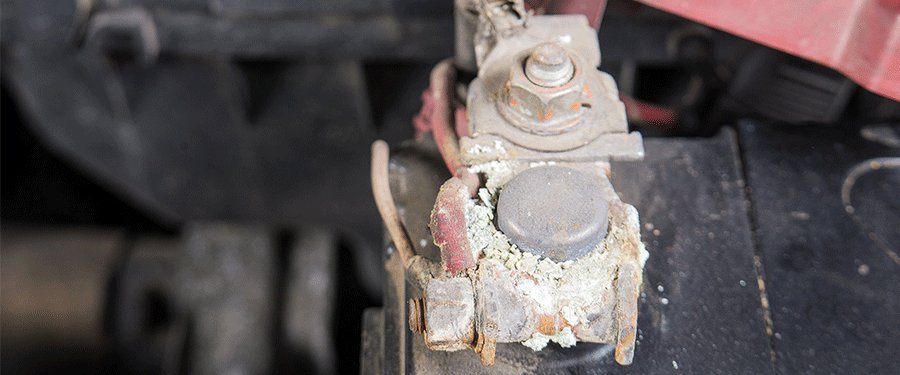
This much crust on a terminal is a loose connection waiting for rough water. Clean it to bare metal and tighten it properly. - Open the seat and look for water. A bilge that keeps filling points at a leak, a failed drain, or water left over from a capsize. Sloshing water reaches plug caps and electrical connectors in chop that it never touches on flat water.
- Dry and seat the plug caps. Pull each cap, dry it, and push it back on until it clicks or seats firmly. Cracked caps that arc when wet are a cheap replacement.
3 · Runs rough, shakes, or won't idle clean
Rough running is the engine telling you the mixture or the spark is almost right. On a ski, the causes are refreshingly unglamorous: plugs, old fuel, and water — in that order — account for most of it. Two-strokes add one more: they foul plugs and load up with carbon as a way of life, so "rough" on a two-stroke starts at the plugs every time.
| Cause | How to tell | Fix time | Cost |
|---|---|---|---|
| Fouled or wrong-gap spark plugs | Black/oily plugs; worse at idle; two-stroke history | 15 min | ~$4–10 per plug |
| Stale / phase-separated ethanol fuel | Sat over winter on pump gas; surging; worse under load | 30 min | Price of fresh gas |
| Water in the fuel | Water layer in a siphoned sample; rough after rain, capsize, or a bad fuel dock | 30 min | Free – filter ~$10–25 |
| Clogged injectors / carb jets | Fresh fuel and new plugs don't cure it; one cylinder weaker | 60–90 min | Cleaner ~$10 · kit varies |
| Wrong two-stroke oil, or oil starvation | Wrong spec oil in the tank; excessive smoke or none at all | 20 min | Correct oil ~$15–40 |
| Intake or exhaust leak | Hunting/surging idle; hissing; changed note under the seat | 30–60 min | Gasket/hose varies |
| Carbon buildup (two-stroke) | Gradual decline over seasons; plugs foul quickly again | 60 min | Decarb treatment ~$10–15 |
The fix, step by step
- New plugs first — correctly gapped. Pull each plug, read it (black = rich/fouled, wet = flooding or water, white = lean/hot), and replace rather than clean. Confirm the gap against the manual: a plug that's "close" out of the box can still be wrong for your engine, and a two-stroke will find that gap.
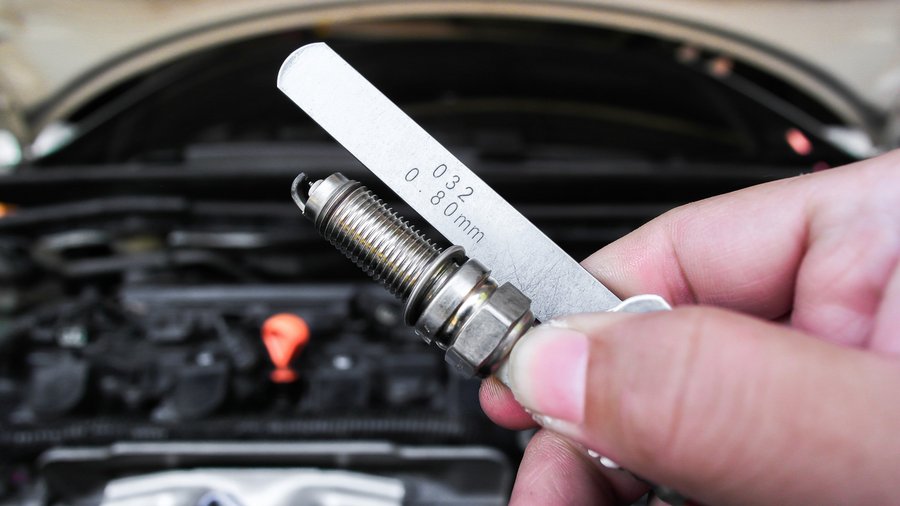
Check the gap on every new plug with a feeler gauge — 'close' out of the box isn't the spec in your manual. - Sample the fuel. Siphon a cup into a clear jar and let it settle. A distinct water layer at the bottom, or fuel that smells sour instead of sharp, ends the diagnosis: drain the tank completely, replace the filter, refill fresh.
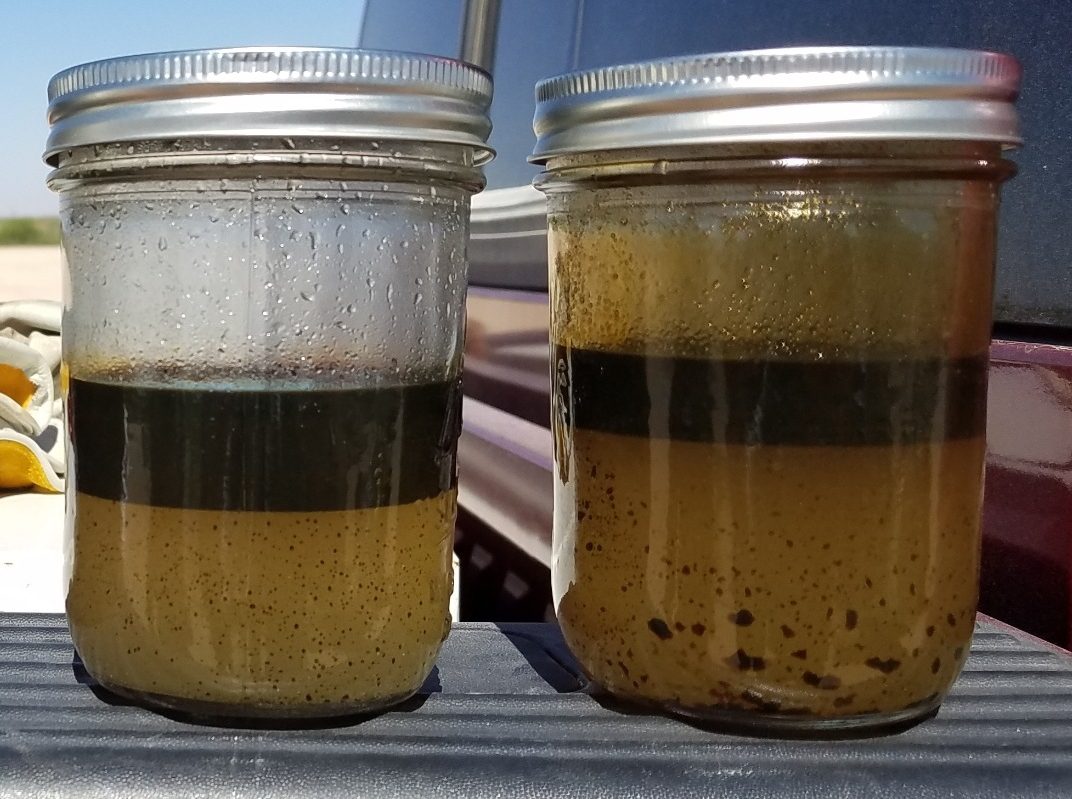
A settled sample tells the truth: water and debris sink into a separate layer at the bottom. Good fuel stays one clear, uniform layer. - Feed it fresh fuel and run it. Half of "rough running" cures itself within minutes on good gas once the old blend is fully out of the lines. Judge it after a real run, not at idle on the trailer.
- Check the two-stroke oil — the right oil, actually present. Confirm the oil tank has the spec of oil your manual calls for (two-stroke oils are not interchangeable across brands and types), and that the level is genuinely dropping in use. No smoke at all on a two-stroke that should have some is a warning, not good news — and many models drop into limp mode when the oil tank runs dry (see section 4).
- Then suspect injectors or carb jets. If plugs and fuel are new and it still stumbles, fuel delivery is partially blocked — varnish in a carb jet or a clogged injector. Run a quality fuel-system cleaner through a fresh tank first; a carb comes apart for cleaning if that fails.
- Look for leaks last. A surging, hunting idle that won't settle often means unmetered air: check intake boots and hoses for cracks and loose clamps, and exhaust connections for leaks under the seat.
4 · Revs climb, but it barely moves — cavitation & lost thrust
This is the signature PWC problem, and it fools people because the engine sounds healthy — revs climb happily while the ski wallows. A jet ski has no propeller and no gears: the engine spins an impeller inside a pump, and thrust is just water in through the intake grate under the hull and out the nozzle. Anything that breaks that clean flow of water — blockage in, leakage inside, damage to the impeller — gives you noise instead of push. Mechanics call the result cavitation: the impeller spinning in frothed, aerated water instead of a solid stream. Diagnose the pump before you touch the engine; the engine is usually innocent.
| Cause | How to tell | Fix time | Cost |
|---|---|---|---|
| Clogged intake grate | Sudden loss after weeds, shallows, or debris; vibration | 10 min | Free |
| Tow rope wrapped on the driveshaft | Sudden loss right after towing or a swimmer reboarding | 30–60 min | Free – seals vary |
| Worn wear ring | Gradual thrust loss over seasons; strong at idle, slips under load | 90–150 min | Ring ~$30–80 |
| Nicked / dinged impeller | Loss started after a gravel bar or rocky shallows; vibration | 90–150 min | File free · impeller varies |
| Limp mode (overheat or low oil) | RPM capped by the computer; warning light/beeper; low two-stroke oil | 10 min | Free – see cause |
| Misfire under load | Thrust pulses or stumbles as revs rise; fouled plug | 15 min | ~$4–10 per plug |
The fix, step by step
- Engine OFF, lanyard in your pocket. Everything in this section happens with the engine fully off and the lanyard pulled — hands go near the intake grate and driveshaft, and a bumped start button with your fingers in the pump is how people lose them.
- Clear the intake grate. Get the ski out of the water, or reach under the hull from behind/below as your manual directs. Weeds, a plastic bag, a chunk of wood, or a rock jammed in the grate strangles the pump. Pull everything out and check again by feel — debris hides ahead of the impeller.
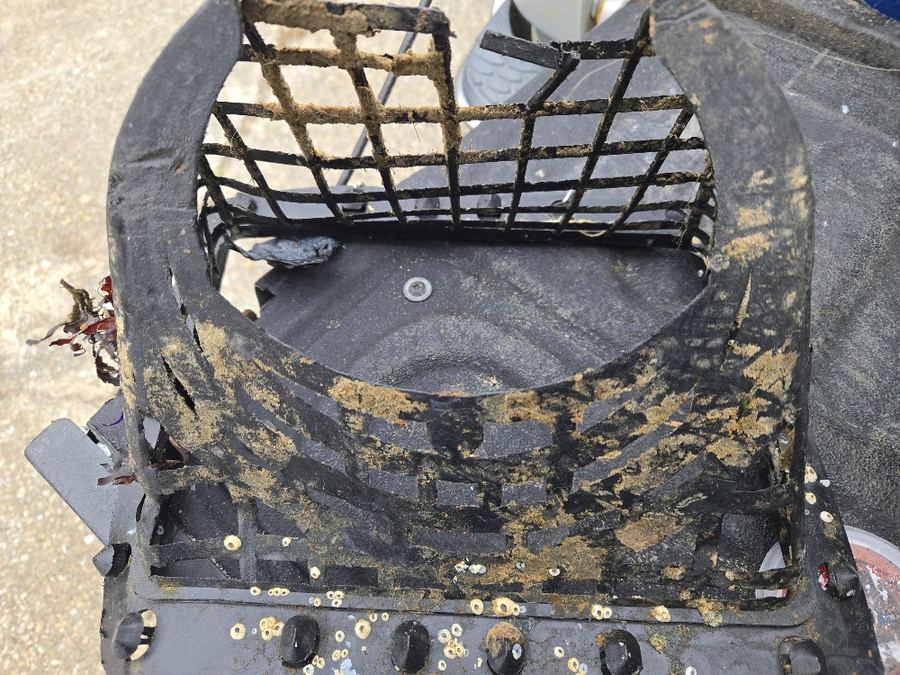
The intake grate under the hull. Sand, weed, and growth packed in like this strangle the pump — clear it by hand and by feel, engine off. - Check the driveshaft for a rope. The classic: the ski tows a tube, the slack rope drifts under the hull at idle, and the pump inhales it. Rope wraps tight around the driveshaft ahead of the impeller. Unwind it or cut it away strand by strand, and look for rope melted into the shaft seals — damaged seals make this a shop job (see the FAQ).
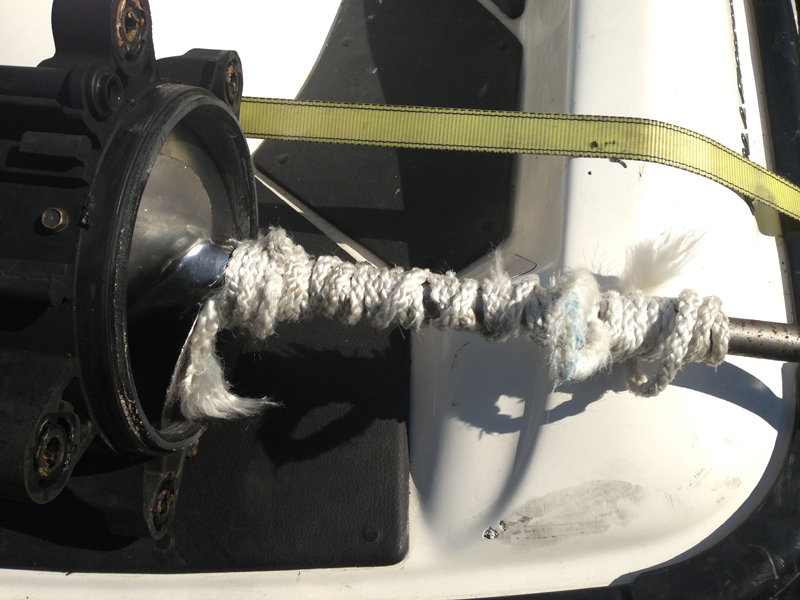
A sucked-up tow rope winds itself drum-tight around the driveshaft ahead of the impeller. Unwind or cut it away strand by strand. 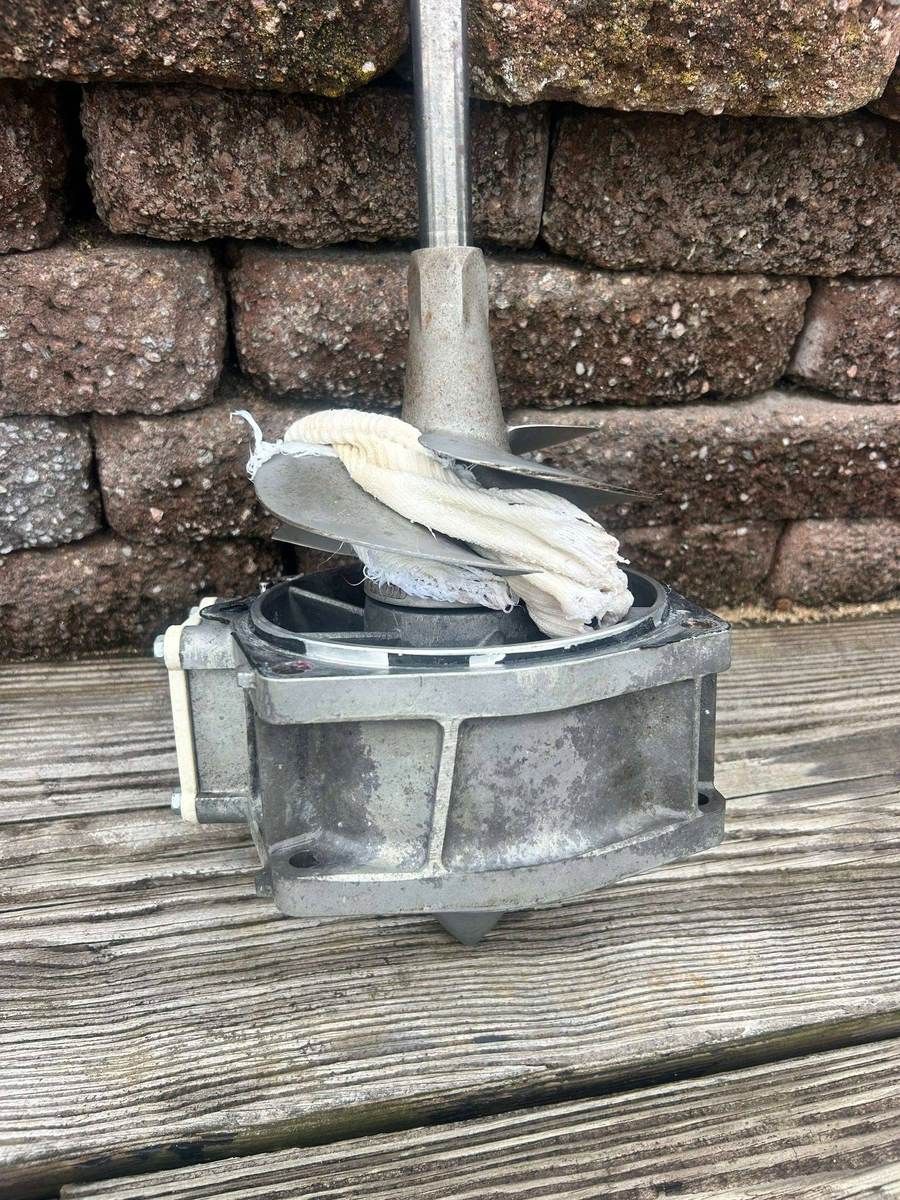
Second angle, pump removed: what's left of the rope balls up inside the impeller itself. - Inspect the impeller. Shine a light up through the grate and in from the nozzle. Leading edges should be smooth and sharp-ish, not nicked, bent, or chewed. Gravel through the pump dings edges fast, and every nick bleeds thrust. Small nicks can be filed smooth; bent blades are a replacement.
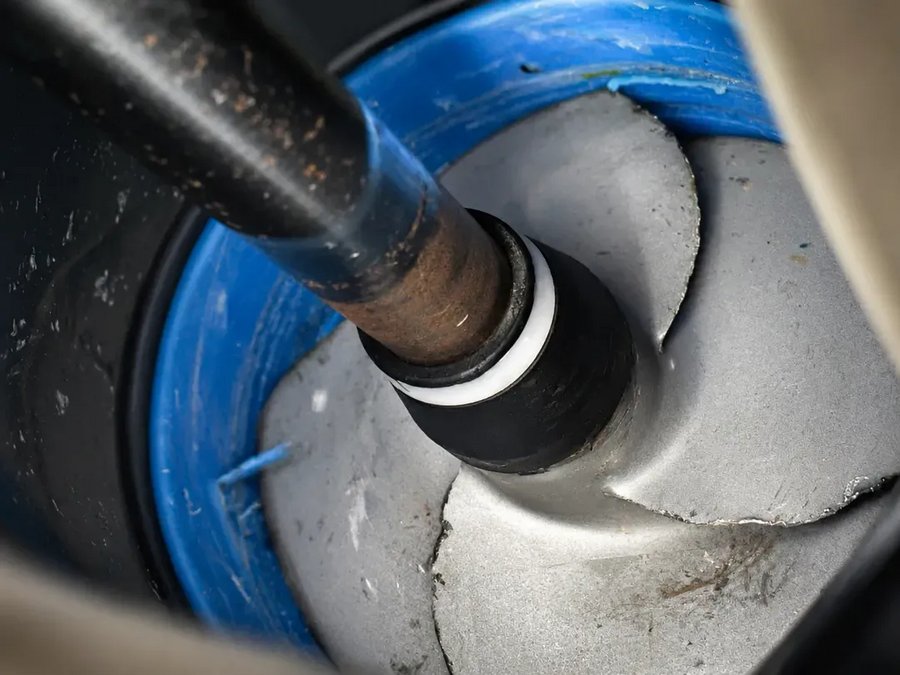
Looking into the pump: this impeller's leading edges are nicked and chewed. Edges should be smooth — every nick bleeds thrust. 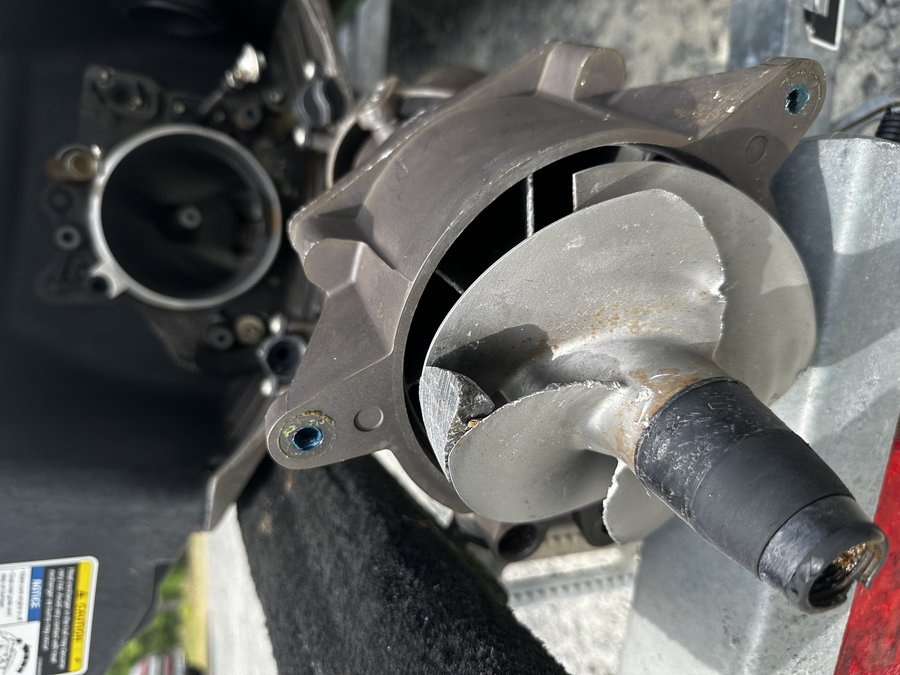
Too far gone to file: a blade with a chunk missing is a replacement, not a repair. - Check the wear-ring clearance. The impeller spins inside a replaceable wear ring with a gap of only a few thousandths of an inch. As the ring wears (sand is an abrasive, and it goes through the pump all day), the gap grows and pressure leaks around the impeller instead of pushing out the back — the ski still revs, it just slips. Measure the impeller-to-ring clearance with a feeler gauge against your manual's spec where the design allows. Out of spec = new wear ring: it's a wear part, priced like one, and it's the single most satisfying fix in PWC ownership.
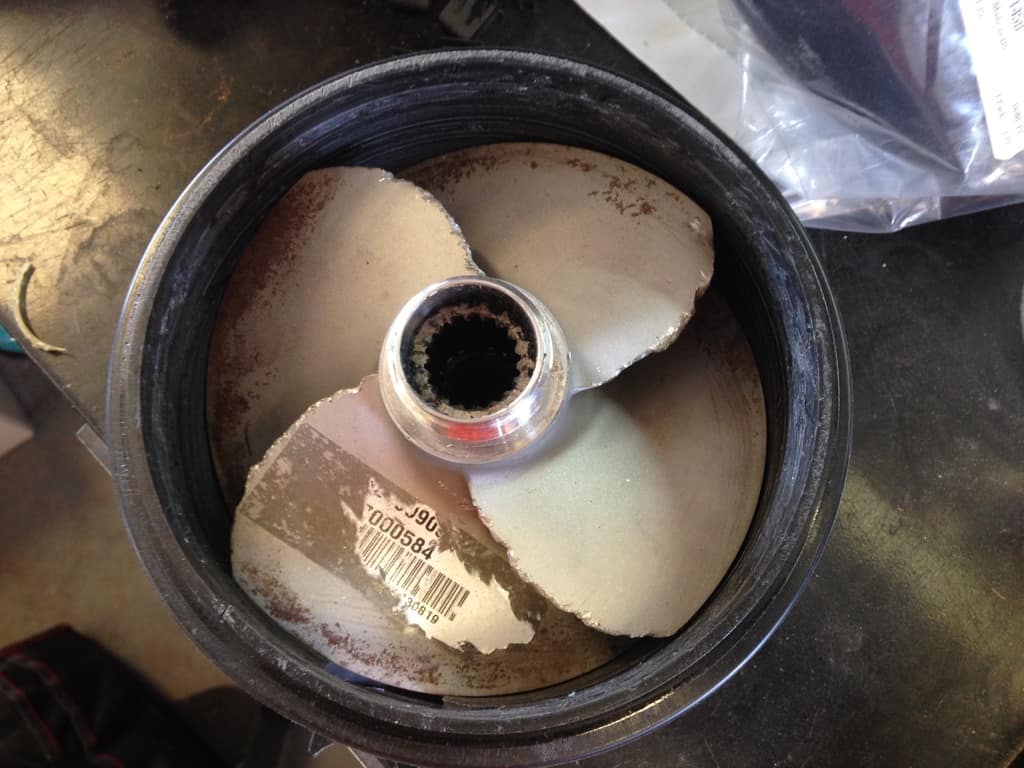
A worn wear ring: scored and opened up around the impeller, so pressure leaks past instead of pushing. The gap should be only a few thousandths of an inch. 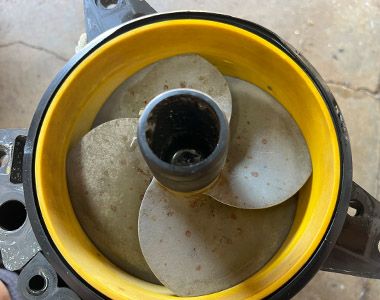
For comparison, a new wear ring: smooth, un-scored, and sitting tight around the impeller. - Rule out the computer. If revs are capped at a clean, consistent limit with a warning on the dash, the ski is protecting itself in limp mode — most often for overheating (go to section 5) or, on two-strokes, an empty oil tank. Top up the oil or fix the cooling first; the power comes back on its own.
- And rule out a misfire under load. If thrust pulses or stumbles as the revs rise rather than slipping smoothly, swap in fresh plugs (see section 3) before you pull the pump apart — a plug that fires at idle can quit under load.
5 · Overheating — beeper, limp mode, or a weak pisser stream
Most PWCs are open-loop cooled: there's no radiator and no coolant — the jet pump draws lake water in and circulates it straight through the engine, then out. That design is simple and works brilliantly right up until the water stops flowing, at which point you have an engine being cooled by nothing. An overheat warning on a ski is not advisory. Stop, find the blockage, and only then ride — gently — back.
| Cause | How to tell | Fix time | Cost |
|---|---|---|---|
| Intake grate blocked | Overheat right after weeds/shallows; thrust also down | 10 min | Free |
| Sand or debris in cooling lines | Weak tell-tale stream; ran shallow or beached recently | 30 min | Free |
| Blocked tell-tale (pisser) outlet only | Stream weak but engine temp normal; outlet crusted with sand/salt | 5 min | Free |
| Failed flush habits (salt/sand buildup) | Saltwater ski, rarely flushed; recurring overheats | 30 min | Free |
| Thermostat stuck (four-stroke) | Overheats despite clear intake and strong stream | 45–60 min | ~$20–50 |
| Faulty temp sensor | Warning with a cool engine and strong cooling flow | — | Shop diagnosis |
The fix, step by step
- Stop at the first beep. A continuous warning beeper, a temperature light, or the ski dropping into limp mode (revs capped) is the engine asking for exactly one thing: off. Idling "just to get back" on a blocked intake cooks seals and warps heads. Get towed or drift and fix it.
- Check the intake grate first. Engine off, lanyard out. The same weeds, bag, or shell that blocks thrust blocks cooling — on most skis they're the same mouthful of water. Clear it (per section 4) and half of all overheat warnings are already fixed.
- Read the tell-tale. Where fitted, the pisser stream is your flow gauge: it should be a strong, steady stream at idle once warm. Weak or absent with a hot engine = water isn't circulating. Weak stream with a cool-running engine is often just the pisser outlet itself plugged with sand or salt — clear it with a small wire or compressed air before assuming worse.
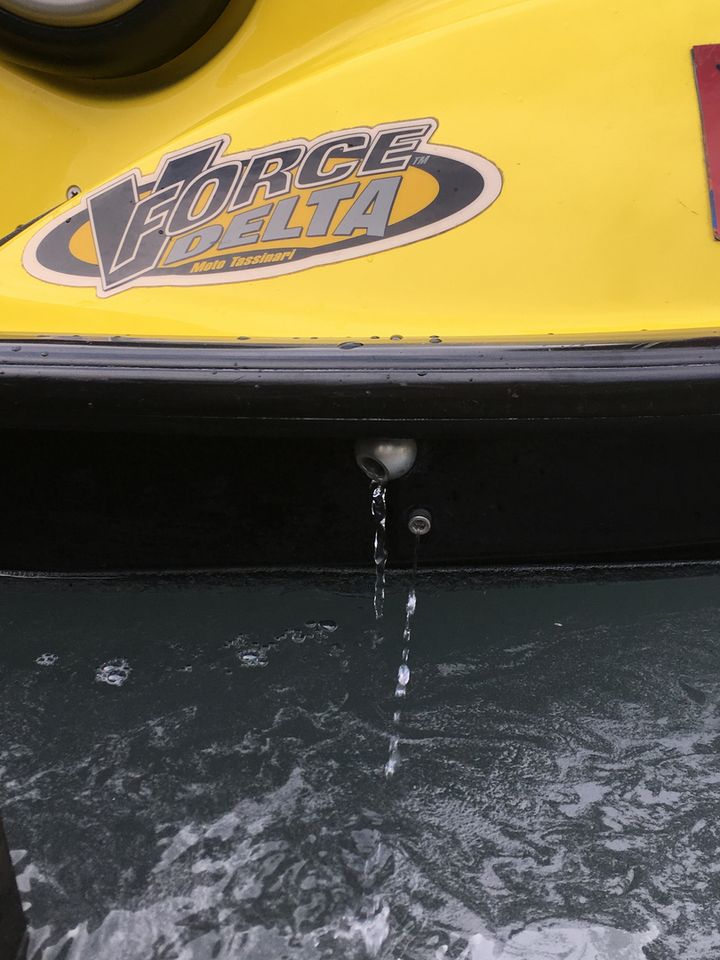
The tell-tale outlet on the hull side. This dribble is the weak case — at idle, warm, you want a strong, steady stream. - Flush the cooling lines. Sand pumped in the shallows settles in cooling passages. On the flush port, back-flush the system following your manual — and get the order right: engine running first, then water on; water off first, then engine off. Water pressure into a stopped engine can push water where it should never go.
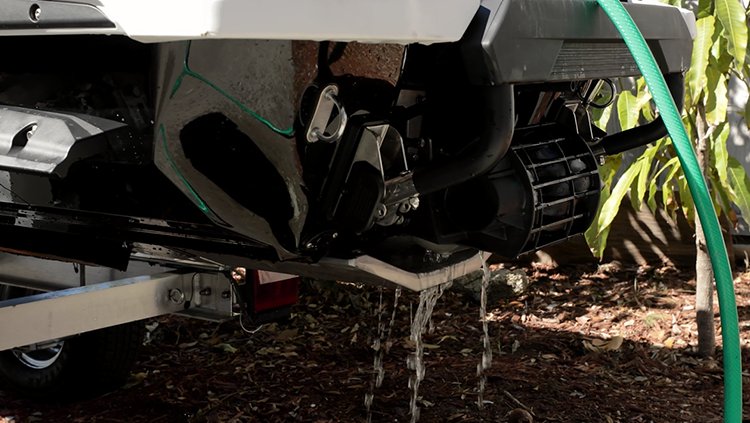
Flushing on the trailer: hose on the flush port, water draining out through the pump. Engine on first, then water on — water off first, then engine off. - Make flushing a habit, not a repair. After every saltwater ride and every shallow, sandy day: a brief fresh-water flush on the hose, same on/off order, every time. Salt and sand buildup is the slow cause behind most "mystery" overheats on coastal skis. Some models are closed-loop (they carry coolant like a car, with lake water cooling only the ride plate/exhaust) — if yours is, check coolant level too and follow that manual's procedure.
- Four-strokes: suspect the thermostat. Clear intake, strong stream, clean flush — and it still heats up? A thermostat stuck shut does exactly that. It's a cheap part; test or replace it before suspecting the sensor or the engine.
6 · Prevent it: winterizing & spring checklists
Almost everything in sections 1–5 is a storage injury: stale fuel, a sulfated battery, fouled plugs, sand left in cooling lines. One careful hour in the fall buys you a ski that starts on the first warm Saturday — and in Minnesota, that Saturday is not one you want to spend in the driveway with a multimeter.
End of season (the hour that matters)
- Stabilize the fuel, then run it in. Add fuel stabilizer to a full tank of fresh fuel and run the ski briefly (on the hose, correct order) so treated fuel reaches the whole system — or drain the system entirely if your manual prefers it.
- Fog the engine — critical on two-strokes. Fogging oil through the intake (and into the cylinders per your manual) coats internals against a winter of condensation. Four-strokes: follow the manual's cylinder-oiling procedure.
- Flush, then drain the cooling system. Final fresh-water flush, then drain residual water from the exhaust and cooling lines so nothing freezes and cracks. Short bursts of throttle (engine only, per the manual) help blow water out of the exhaust.
- Antifreeze where the manual calls for it. Some models want RV/marine antifreeze run through the cooling loop for winter; closed-loop models differ — they keep their own coolant and have a different procedure. This is the step to read your manual for, not to guess.
- Four-strokes: oil and filter now, so it sits all winter on clean oil instead of used, acidic oil.
- Battery out and on a tender. Remove it, store it somewhere that doesn't freeze hard, and keep it on a maintainer — not a dumb charger cooking it for five months. A battery left flat in the ski is next spring's section-1 problem.
- Clean, dry, and cover. Wash off salt and scum, dry the engine compartment, leave the seat cracked or off for airflow, and cover it. Check the intake grate and impeller one last time while you're down there.
- Trailer bearings. A ski that starts perfectly but loses a wheel bearing on the way to the lake still ruins the day — repack or at least inspect the bearings while the tools are out.
First ride (in the driveway, before the launch)
- Charge and load-test the battery before it goes back in; clean terminals, tight cables (section 1, step 3).
- Fresh fuel. If the tank sat on last fall's fuel without stabilizer, drain and refill — don't gamble the first ride on it.
- Inspect the pump before the first launch: intake grate clear, impeller edges clean, wear-ring clearance in spec (section 4). Winter is when this job is pleasant.
- Test the lanyard and kill switch for real: start it (briefly, on the hose, correct on/off order), pull the lanyard — the engine must die instantly.
- Flush-test on the hose briefly and watch the tell-tale stream — strong and steady before the ski ever touches the lake (section 5).
- Drain plugs IN. Say it out loud at the launch. Every spring, someone doesn't. Check the bilge is dry and the plugs are home before the hull leaves the trailer.
Frequently asked questions
Why won't my jet ski start after sitting all winter?
It is almost never a dead engine. Gasoline starts going stale in 30–60 days, the battery self-discharges and sulfates on the shelf, and spark plugs foul. Work the 2-minute pre-check first: lanyard clipped fully on, security key recognized (two beeps on a Sea-Doo), battery charged and load-tested, tank filled with fuel bought this season. Most stored skis start at one of those four steps.
Why does my jet ski crank but not start?
Cranking proves the starter works — the engine is missing spark or fuel. The top cause is the safety lanyard: if the clip isn't fully seated on the kill switch, many skis crank with no spark at all, by design. Next, confirm the security key is recognized — on a Sea-Doo, two short beeps means the DESS key is accepted; a long beep or silence means it isn't. Then check fuel: fresh gas, no water in the tank, and plugs that aren't fouled.
What do the beeps mean when I put the key on my Sea-Doo?
Two short beeps means the DESS (Digitally Encoded Security System) post has read your key and the ski is cleared to start. One long beep, four beeps, or no start with a key warning on the dash means the key isn't recognized — try the spare key, clean the post and the inside of the key cap, and make sure you're using the key programmed for that ski, not a key from another one. Other brands use their own security keys and lock modes, but the idea is the same: no recognized key, no start.
Why does my jet ski rev up but barely move?
That's cavitation — the jet pump is spinning but not making thrust. The usual causes, in order: the intake grate under the hull is clogged with weeds, plastic, or a rock; something is wrapped around the driveshaft (a tow rope is the classic); or the wear ring is worn, leaving too much clearance between the impeller and the ring so pressure leaks away instead of pushing. Kill the engine, clear the intake, and inspect the impeller and wear ring before blaming the engine — the engine is usually fine.
My jet ski sucked up the tow rope. What do I do?
Kill the engine immediately and pull the lanyard — never reach into the intake grate with the engine running, and never try to power through it. Get the ski out of the water or roll it as your manual directs, then remove the intake grate if needed and unwind or cut the rope off the driveshaft, checking for rope melted into the shaft seals. If the shaft won't turn freely by hand afterward, or you find seal damage, it's a shop job — a cooked seal lets water into the pump bearings.
How long can I run my jet ski out of the water or on a flush hose?
Only seconds dry, and only briefly on the hose. A PWC's cooling water comes through the jet pump, so out of the water the engine has no cooling at all. On a flush hose, follow the order in your manual — on most models: start the engine first, then turn the water on; turn the water off first, then stop the engine. Getting the order backwards can push water back into the engine. Keep flush runs short — just long enough to rinse salt and sand out.
Why is my jet ski overheating?
Most PWCs are open-loop cooled: lake water is drawn in through the jet pump and circulated through the engine, so anything that blocks the intake grate or a cooling line — weeds, sand, a plastic bag — overheats the engine fast. Check the tell-tale (pisser) stream where fitted: weak or no stream with a beeping warning or limp mode means stop now. Clear the intake, flush sand out of the cooling lines, and on four-strokes check the thermostat. Never keep riding on an overheat warning — a cooked engine costs far more than a tow.
When is a jet ski problem a shop job, not a dock fix?
Low compression, a seized or damaged jet pump (bent driveshaft, wrecked bearings or seals), water inside the engine after a sinking or a bad flush, electrical faults in the ECU or security system beyond a dirty key post, and overheating that continues after the intake and cooling lines are cleared. Everything lanyard, key, battery, fuel, plug, intake, and wear-ring related is a realistic home fix with basic tools.
Still stuck? Run the guided diagnosis
Answer a few questions about your exact ski and symptom on Troubleshoot 101 and get your likely causes ranked, the fix step by step, and the parts to grab near you — the interactive version of this guide.
Start the jet ski diagnosis →If it helped you, consider a tip.
Leave a tip