Car guide · Troubleshoot 101
Car won't start?
Click, crank, or silence — start here.
A car that won't start is telling you exactly which system quit — you just have to listen the right way. A click, strong cranking, and a start-then-die are three different fault trees. This guide works through every one in the order a mechanic checks them: battery and connections first, starter and switches next, then fuel pump, crank sensor and spark — cheapest and most likely first, shop jobs flagged honestly last.
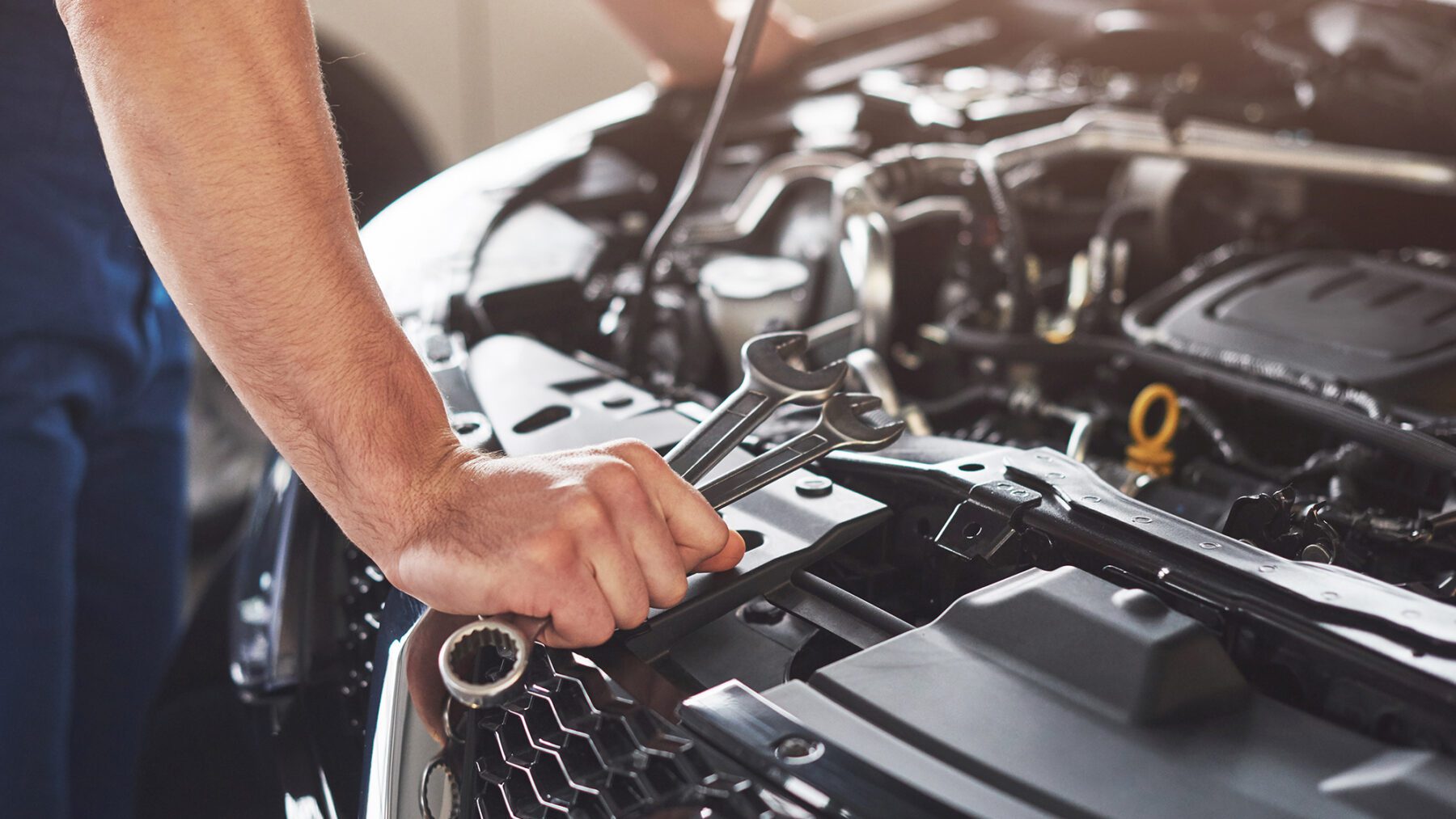
- Turn the key and listen: one click, rapid clicks, silence, or strong cranking? That sound picks your section.
- Dash lights bright, or do they dim and die when you try to crank? Dimming = battery or connections.
- Try starting in Neutral (foot on the brake). Starts there but not in Park = neutral safety switch.
- Key to ON (no crank): can you hear a 2-second hum from the rear seat / fuel tank area? That's the fuel pump priming.
- Is the security / immobilizer light flashing? Try the spare key before you touch a wrench.
1 · Click, or nothing at all: no-crank
The starter motor needs roughly ten times the current of everything else in the car combined. That's why a battery that happily runs the radio and dash lights can still fail to crank: cranking is the only job that exposes a weak battery, a corroded connection, or a tired starter. Work this list in order — the top two causes cover the overwhelming majority of no-cranks.
| Cause | How to tell | Fix time | Cost |
|---|---|---|---|
| Discharged battery | Rapid clicking; dash dims or dies when you try; rested voltage under 12.4V | 30 min charge | Free–$25 charger |
| Failed battery (bad cell) | Voltage looks okay rested, collapses under load; 4+ years old; jump works, next start doesn't | 30 min | $120–250 |
| Corroded / loose terminals | White-green crust, clamp twists by hand, voltage good at posts but not at clamps | 15 min | ~$5–10 |
| Charging failure (alternator) | Starts on a jump, dies when cables come off; battery light on while driving | 1–2 hrs | $250–600 |
| Starter motor / solenoid | One loud click, dash stays bright, battery proven good | 1–2 hrs | $150–400 |
| Neutral safety / clutch switch | Starts in Neutral but not Park (auto), or clutch must be floored twice (manual) | 45 min | $30–90 |
| Ignition switch | No click, no dash response in START position; wiggling the key changes things | 1 hr | $40–150 |
| Blown main fuse / fusible link | Total electrical silence — no dash, no dome light, nothing | 30 min | $5–30 |
| Seized engine | Starter clunks hard, engine won't turn by hand either | — | Shop job |
Start with the battery — and actually measure it
“The lights work, so the battery's fine” is the most common wrong diagnosis in the driveway. A multimeter across the posts, engine off, after the car has sat a few hours (or after turning the headlights on for 30 seconds to burn off surface charge), tells the real story. These are typical rested values for a standard 12V lead-acid battery:
| Rested voltage | State of charge | What it means |
|---|---|---|
| 12.6V or higher | Fully charged | Battery charge is not your problem — look at connections, then the starter |
| ~12.4V | ~75% | Should crank fine; find out why it's not fully charged |
| ~12.2V | ~50% | Half empty — may crank warm, will betray you on a cold morning |
| ~12.0V | ~25% | Effectively discharged; charge fully before judging it |
| Below 11.9V | Discharged / bad cell | Charge and load-test; a battery that won't come back past ~12.4V after charging is done |
Rested voltage is a fuel gauge, not a health certificate. A battery can show 12.5V and still collapse the moment the starter asks for 200 amps — that's what a load test (free at most auto-parts stores) or a voltage-drop test adds: with a helper cranking, voltage at the battery shouldn't fall below roughly 9.6V, and the drop across each cable and connection should be under about 0.5V total per side. A big drop across one corroded clamp, with a healthy battery behind it, is the whole diagnosis in one measurement.
The fix, step by step
- Read the symptom precisely. Rapid-fire clicking = the solenoid is chattering because voltage collapses under load: battery or connections. One single loud click, then nothing, with the dash staying bright = the solenoid engaged but the starter motor didn't turn: starter, or a connection dropping everything at one point. Total silence with no dash at all = main fuse, fusible link, or a completely dead battery.
- Clean the terminals before you buy anything. Negative cable off first. Scrub posts and clamp interiors with a terminal brush until the metal is bright — corrosion is an insulator, and a thin white film you can barely see can drop the volts that matter. Refit snug (a clamp you can twist by hand is not tight), slide on anti-corrosion felt washers, reconnect negative last, and don't overtighten: lead posts deform.
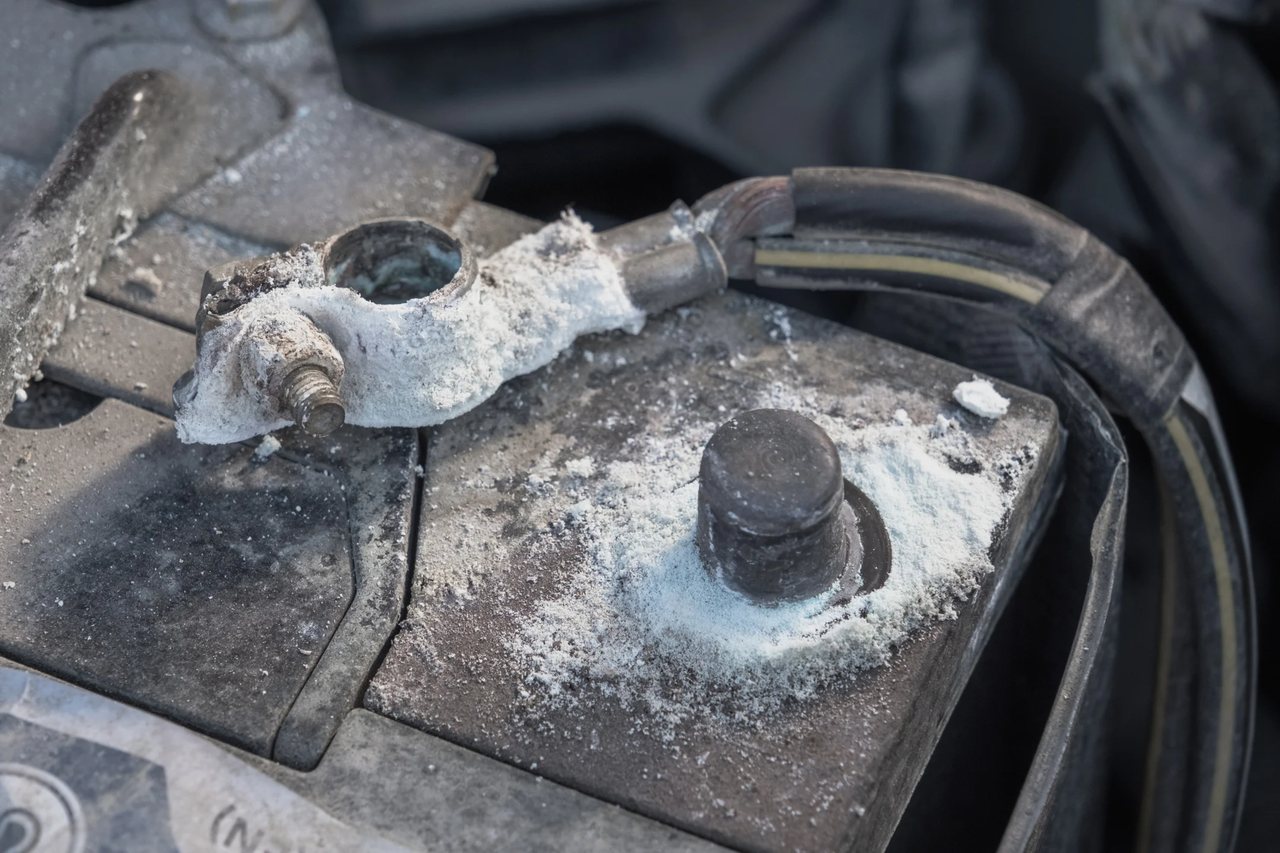
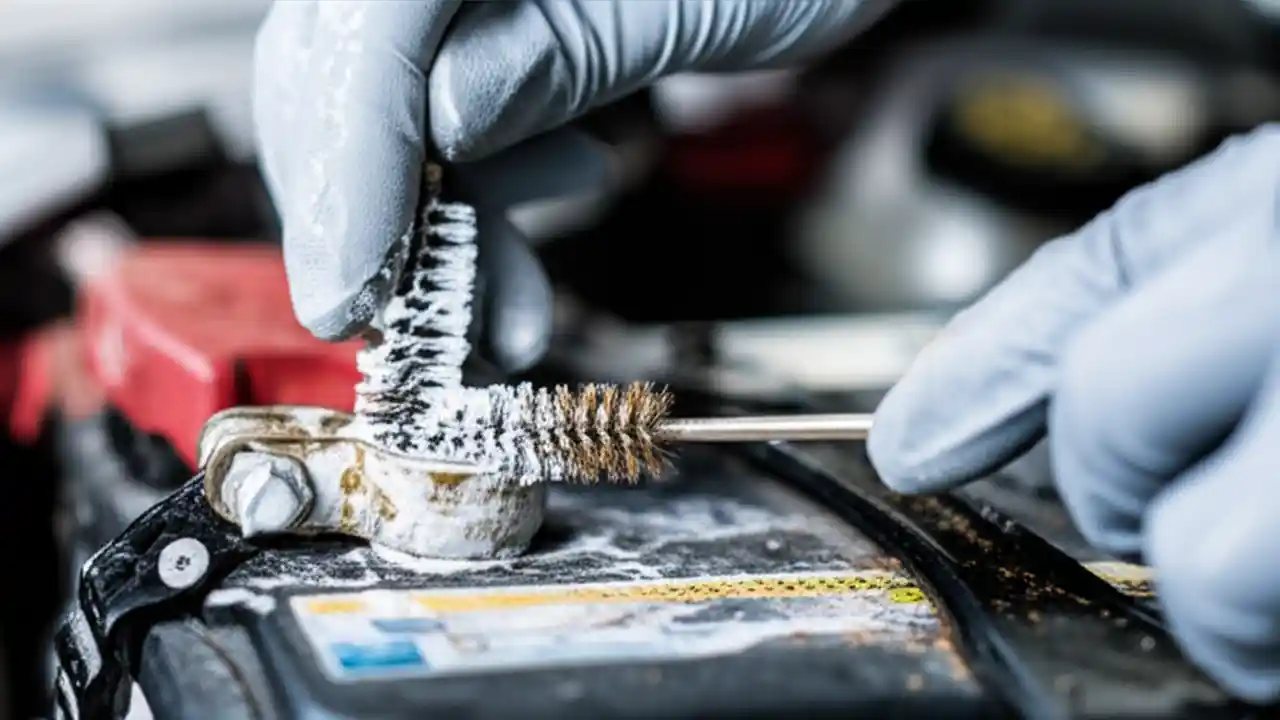
What you're cleaning off — and the cleaning itself. Left: a post and clamp buried in white corrosion, exactly as you'll find them. Right: a terminal brush worked inside the clamp until the metal is bright. - Charge, then retest — don't condemn a battery on one reading. A slow charge overnight, then rested voltage again. Still under ~12.4V, or it won't hold through one crank attempt, and a parts-store load test says replace: believe it. Most stores test free and recycle the old battery against a core charge.
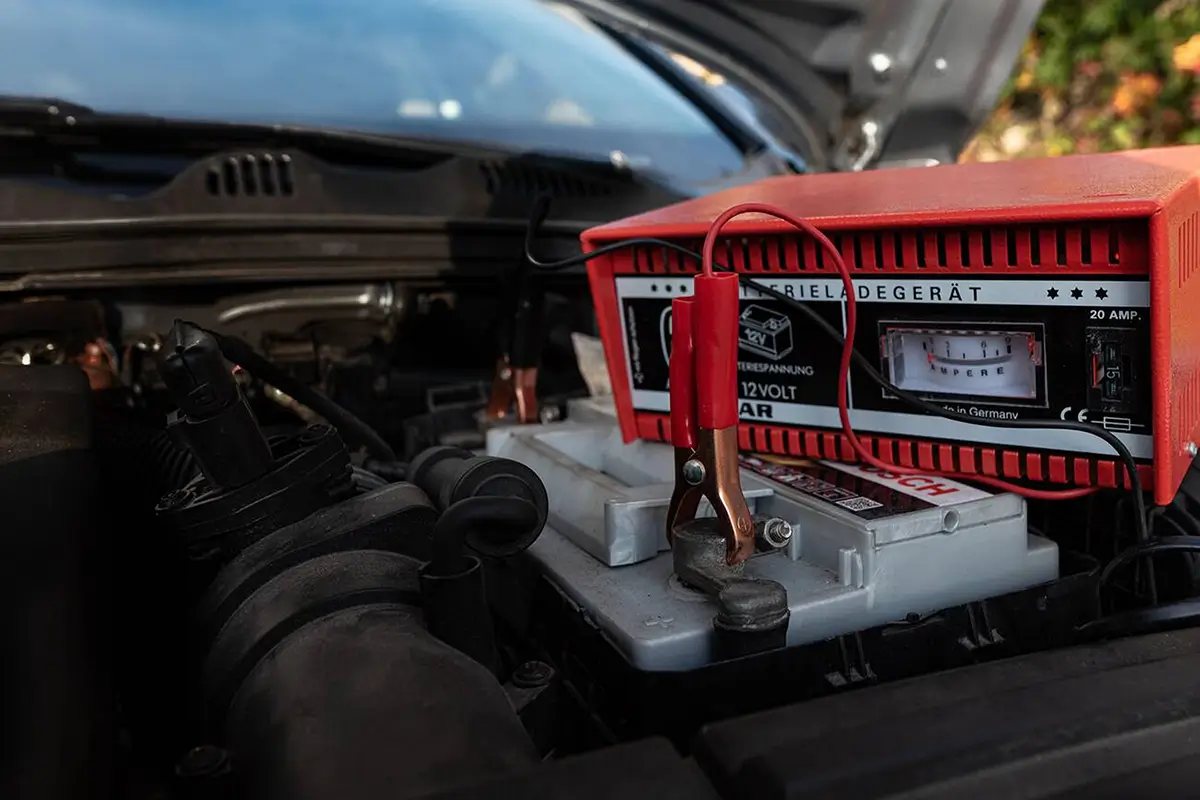
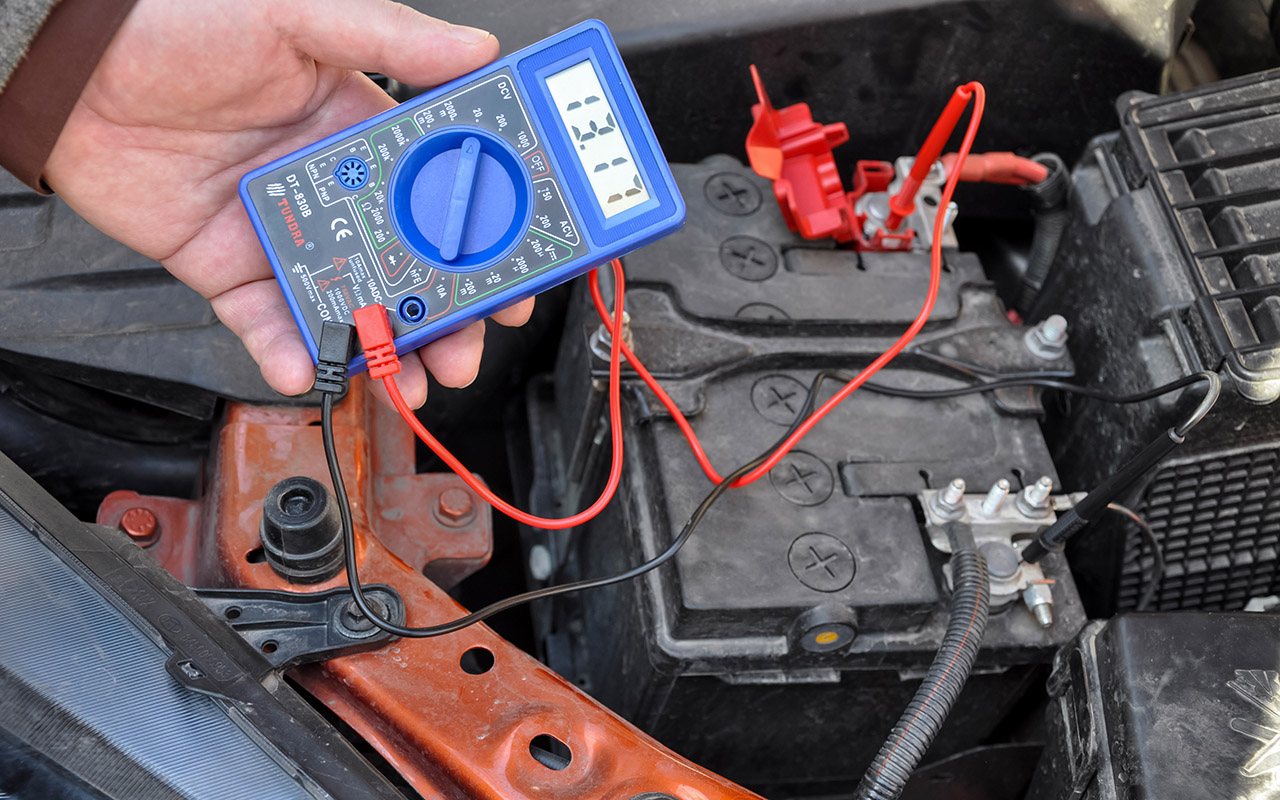
Charge it where it sits, then measure it the same way: probes on the posts, engine off, car rested. This one reads 12.27 V — only about half charged, exactly the reading that fools people into condemning (or trusting) a battery too early. - Rule out the switches — free tests first. Foot on the brake, try starting in Neutral. Starts there? The neutral safety (range) switch is worn or out of adjustment. Manual transmission: the clutch safety switch at the pedal does the same job — if pumping or pressing the clutch harder changes the result, that's your suspect.
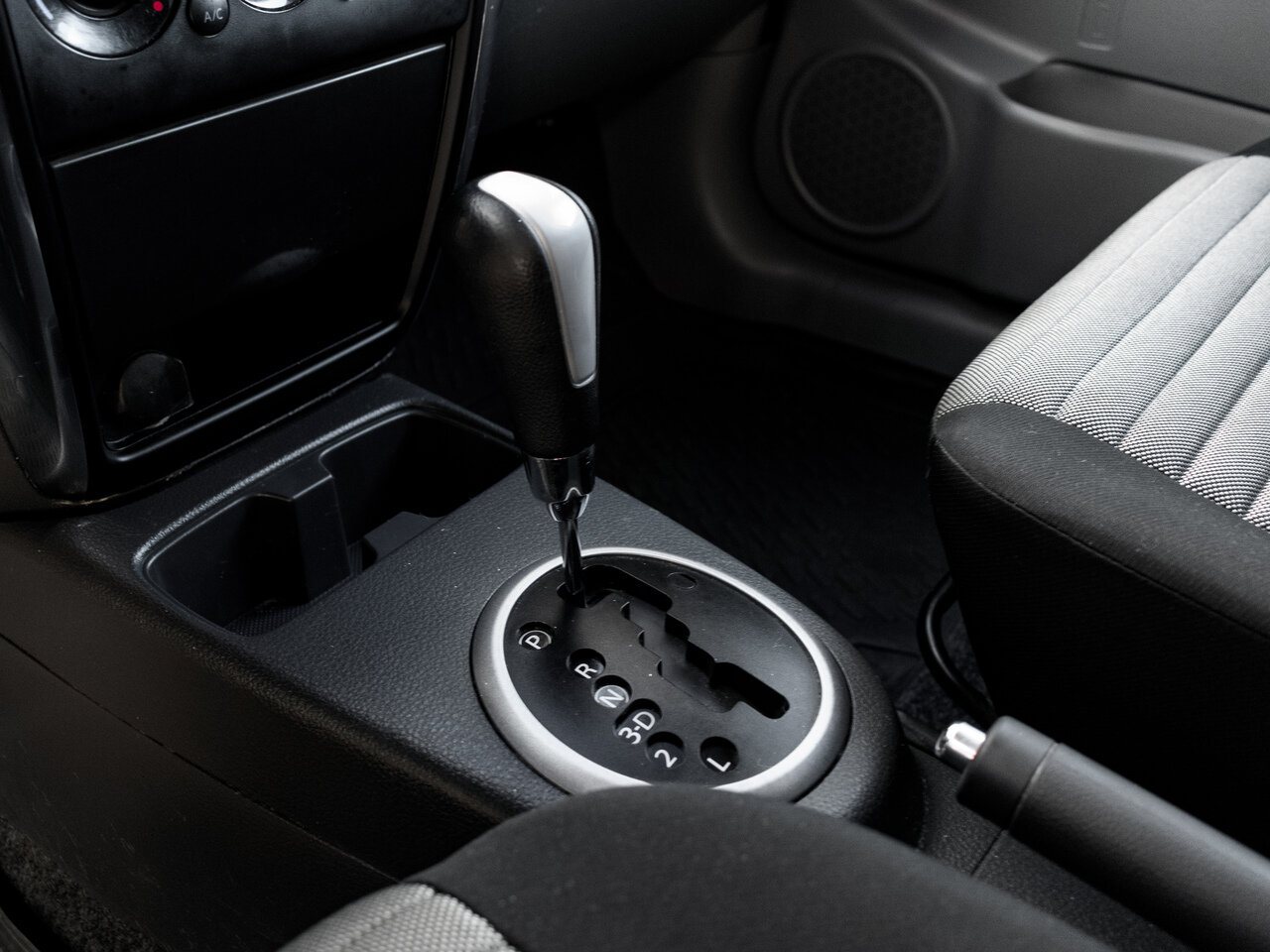
The selector gate — P, R, N, D. Foot on the brake, drop the lever to the N position marked here, and try the key again. - Then, and only then, the starter. With battery and connections proven, one loud click points at the solenoid or a worn starter motor. The famous tap test — a helper holds the key in START while you tap the starter body firmly with a hammer handle — can free a stuck solenoid or worn brushes and get you home. It is a get-home trick, not a fix: a starter that needed tapping is a starter that's finished, and it will strand you again, usually somewhere worse.
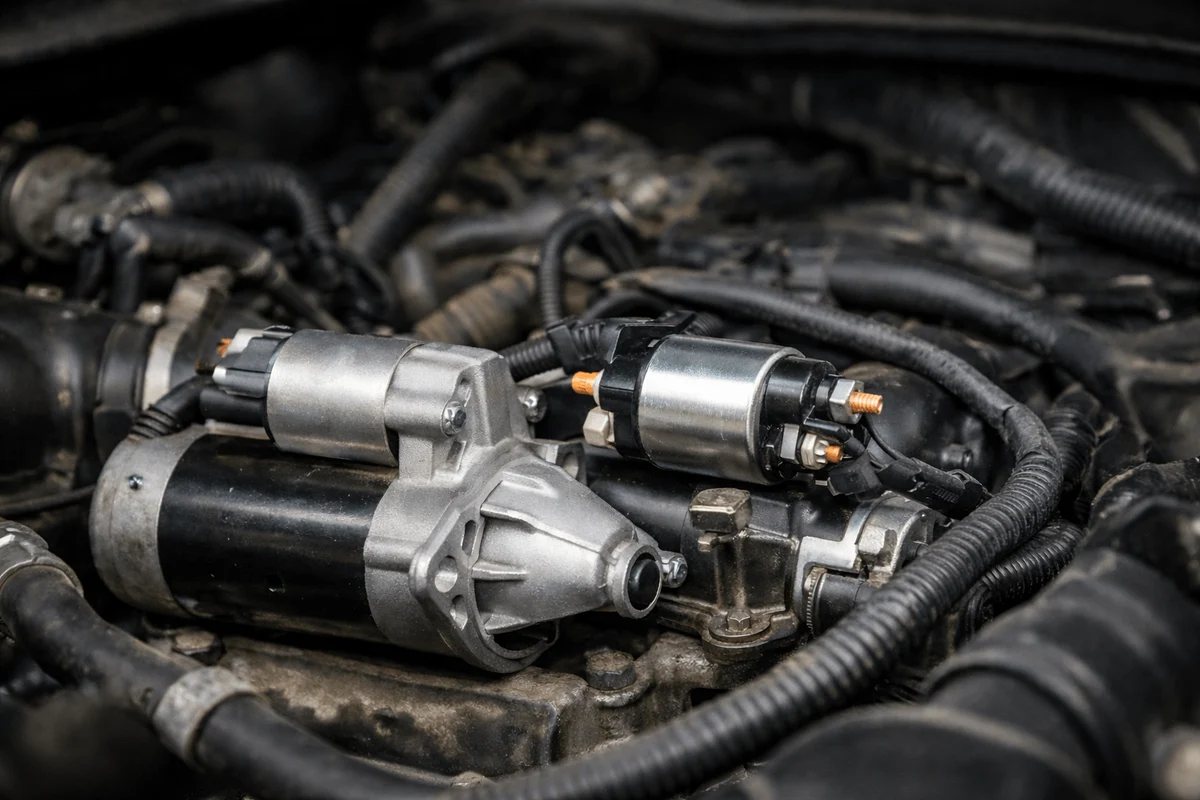
What you're looking for: the starter is the black cylinder low on the engine, with the smaller solenoid cylinder riding on top — that's the body a helper taps while you hold the key at START. - Hunt a parasitic drain if a good battery keeps dying overnight. Something is staying awake: a glovebox or trunk light, a module that never sleeps, an aftermarket accessory. A draw over roughly 50 milliamps after the car has sat 30–45 minutes is worth chasing with a multimeter in series and fuses pulled one at a time. (Pulling fuses on a modern car can wake modules — give it time to go back to sleep between tests.)
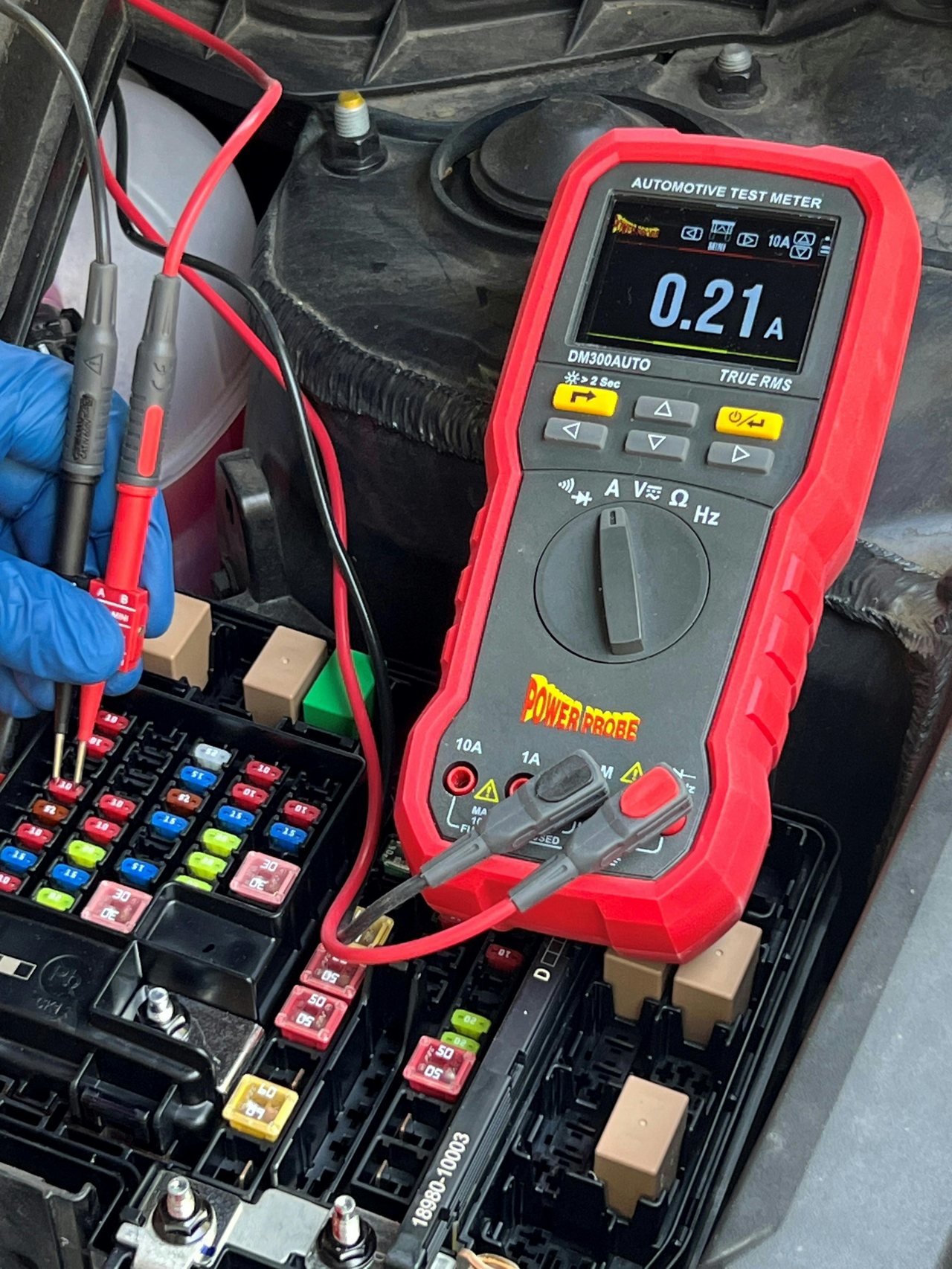
The hunt, in place: a meter reading 0.21 A — 210 milliamps, well over the ~50 mA sleep target — while testing across the fuses. A draw like this is a module or light staying awake overnight.
Jump-starting, done safely
- Both cars off, keys out. Line them up so cables reach without stretching, and keep the vehicles from touching each other.
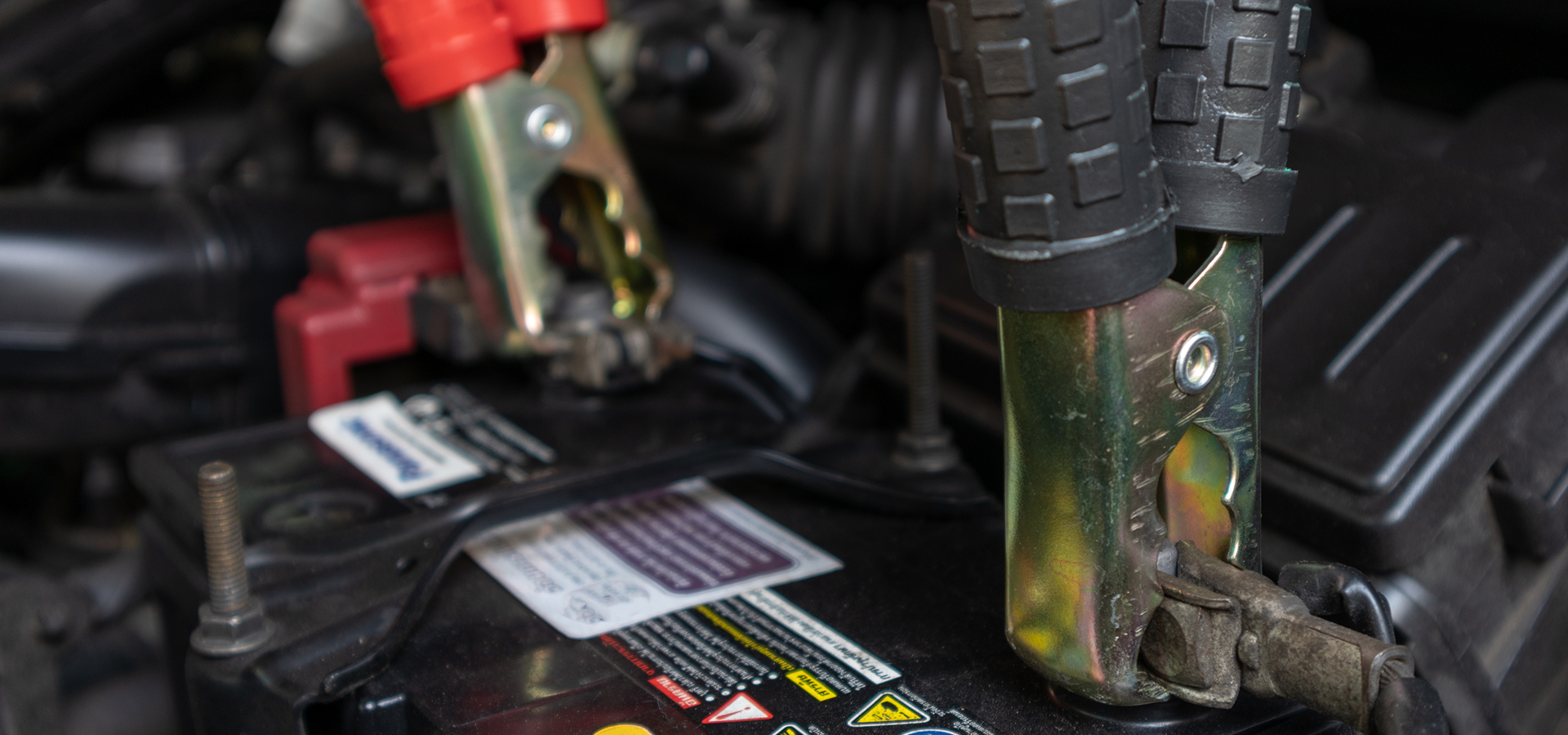
- Red clamp to the dead battery's positive (+) post — usually marked and often under a red cover.
- Other red clamp to the donor battery's positive.
- Black clamp to the donor battery's negative (–).
- Last black clamp to bare, unpainted engine metal on the dead car — a strut bolt or lifting eye, away from the battery. This is the step people skip, and it matters: the final connection is the one that sparks, and a battery vents flammable hydrogen. Keep the spark away from it.
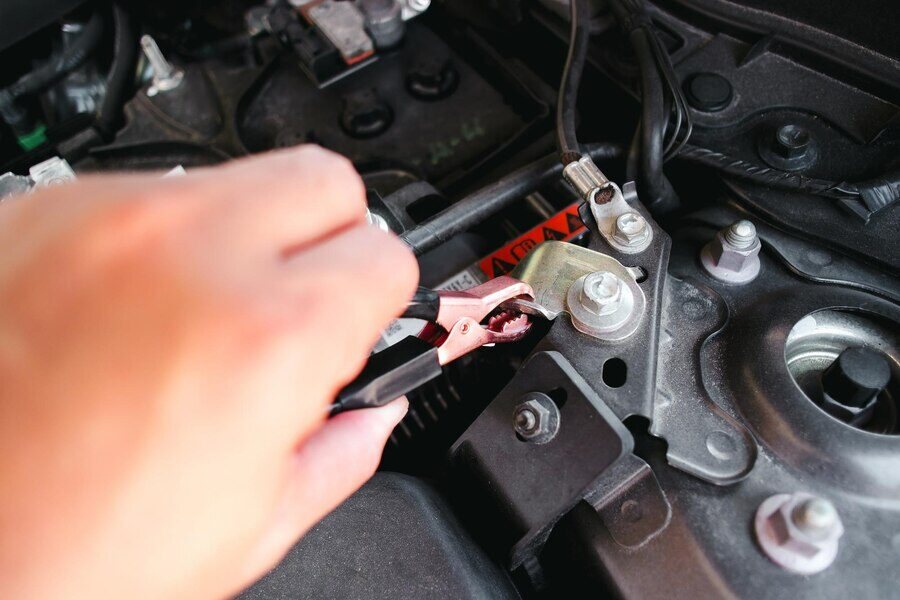
The last clamp goes here — bare engine-bay metal like this strut-tower bracket, away from the battery — because this is the connection that can spark. - Start the donor, wait 2–3 minutes, then start the dead car. Remove cables in exact reverse order. Then drive or charge the battery properly — and if it dies again, test the charging system: with the engine running, you should see roughly 13.8–14.5V at the battery.
2 · Cranks strong but won't start
Good news buried in the frustration: the battery, starter, and switches just proved themselves. An engine needs fuel, spark, and compression, arriving at the right moment — cranking without starting means one of the three is missing, or the computer isn't allowing it. Two free tests split this section in half before you spend a dollar: the fuel-pump prime hum, and the tachometer.
| Cause | How to tell | Fix time | Cost |
|---|---|---|---|
| Out of fuel (don't laugh) | Gauge says E or the sender is lying; car parked nose-up on a hill | 10 min | Price of a gas can |
| Fuel pump relay failed | No 2-second prime hum at key-ON; swapping in an identical relay restores it | 5 min | $10–25 |
| Fuel pump failed | No prime hum with a good relay and fuse; may have died gradually with hot stalls | 2–4 hrs | $150–450 |
| Clogged fuel filter (where serviceable) | High miles, worse after running low on fuel; sputters under load before it quits | 30–60 min | $10–30 |
| Crankshaft position sensor | Tachometer sits at zero while cranking; often stalls hot, restarts cold, then quits for good | 30–90 min | $25–80 |
| No spark — coils / ignition | Spark tester dark; multiple cylinders dead at once points upstream of the coils | 30–60 min | $30–90 per coil |
| Flooded engine | Strong raw-fuel smell after repeated start attempts; short-trip cold starts | 10 min | Free |
| Immobilizer not recognizing the key | Security light flashing while cranking; spare key works | 5 min | Free (spare key) |
| Timing belt snapped | Cranks suspiciously fast, light and even — no compression pulses | — | Shop job |
The fix, step by step
- Listen for the prime. Quiet garage, key to ON (not START): a healthy system runs the fuel pump for about 2 seconds to pressurize the rail — a soft hum from under the rear seat or tank. No hum: check the fuel pump fuse, then find the pump relay in the fuse box, pull an identical relay from a non-essential circuit (horn relays are the usual twin), swap, and listen again. Hum restored = a $15 relay was your whole problem.
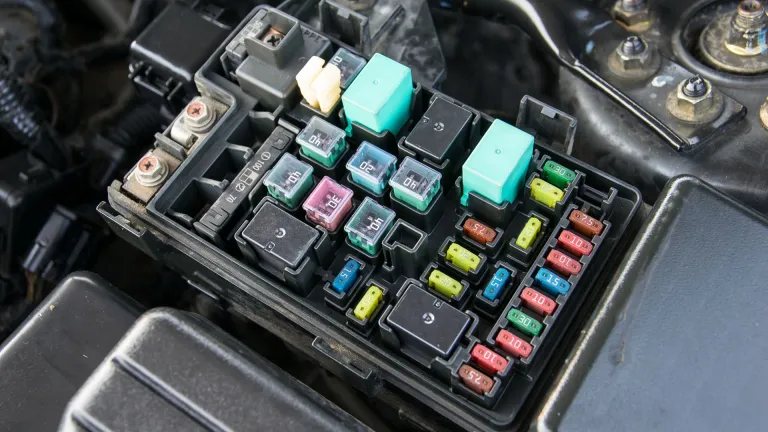
Where the swap happens: the under-hood fuse and relay box. The pump relay is one of the larger blocks — pull an identical one from a non-essential circuit and swap. - Watch the tach while a helper cranks. The needle should lift slightly off zero as the computer counts crankshaft revolutions. Pinned at zero while cranking strongly is the classic crankshaft position sensor tell — no crank signal means no injector pulses and no spark, by design. These sensors often fail with heat first (stalls hot, restarts when cool — see section 3) before dying outright.
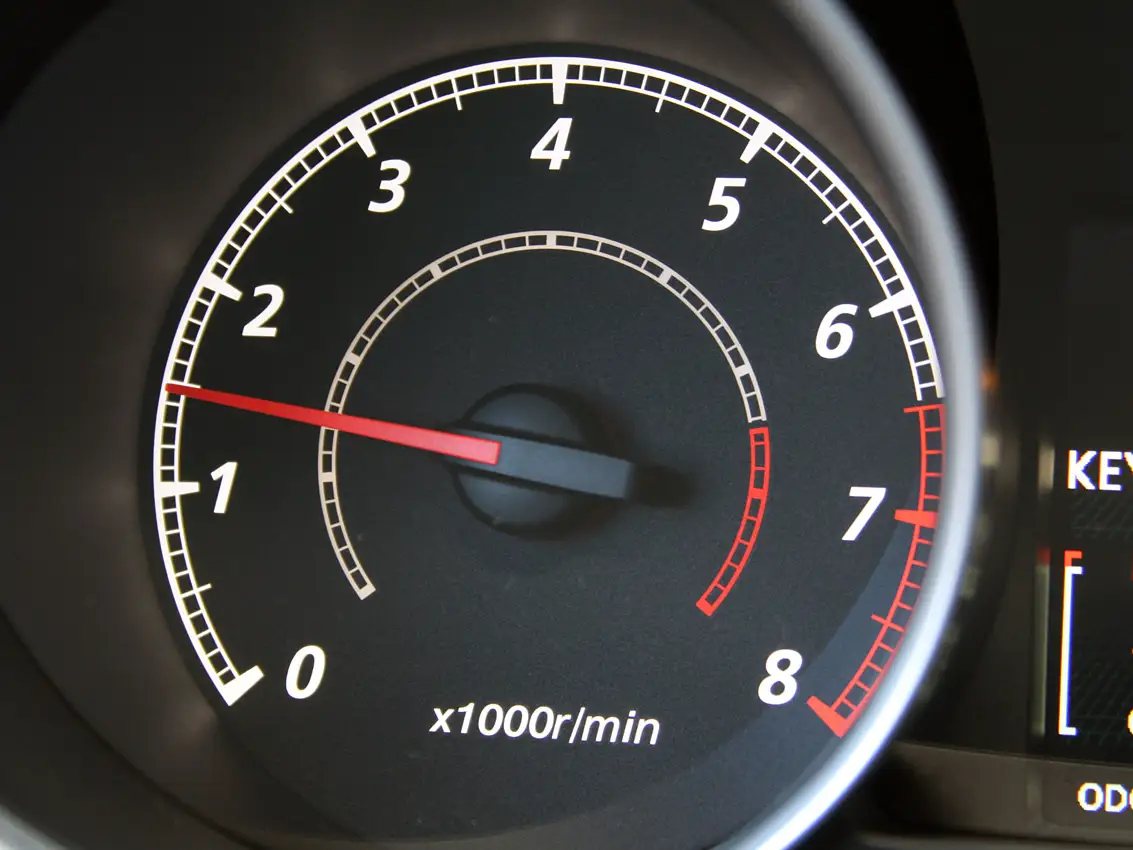
The tach. While cranking it should lift slightly off the 0, like this needle at running speed — pinned dead at zero while the engine turns over is the crank-sensor tell. - Test spark properly. An inline spark tester between the coil (or plug wire) and the plug flashes with every firing event — far safer and more honest than holding a plug against the block near fuel vapor. No flash on any cylinder points upstream: crank sensor signal, a coil power feed, or the immobilizer. Flash on some cylinders only: swap coils between a dead and a live cylinder and see if the miss follows the coil (section 4's swap test works here too).
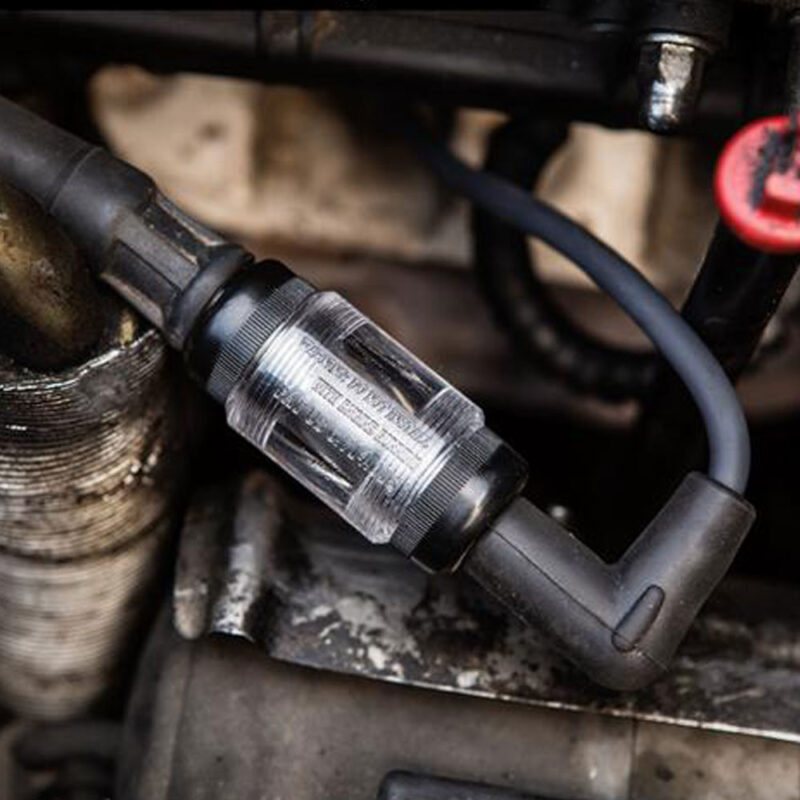
An inline spark tester, fitted between the lead and the plug in the bay. It flashes with every firing event — no flash on any cylinder means work upstream, not plugs. - Pull one plug and read it. Wet with fuel = fuel is arriving but not burning (spark, flooding, or compression). Bone dry after cranking = fuel isn't arriving, whatever the pump sounded like — now a fuel pressure gauge (a free loaner tool at most parts stores — relieve pressure before connecting anything) earns its keep.
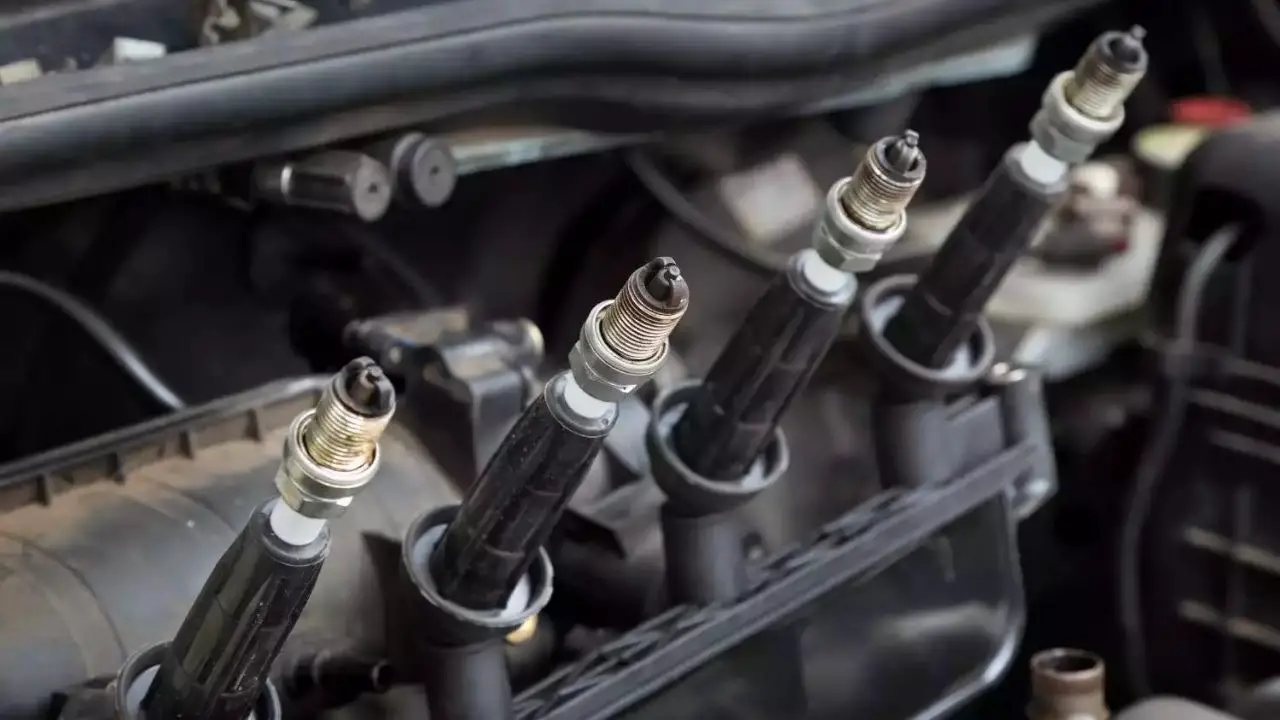
Plugs out and readable, still in the bay. Wet with fuel on the firing end means fuel is arriving; bone dry after cranking means it isn't. - Clear a flood before you chase anything else. Repeated failed attempts soak the plugs. Hold the accelerator to the floor and crank in 10-second bursts: on most fuel-injected cars this is clear-flood mode — the computer cuts injector fuel while cranking wide-open, and the engine pumps the excess out. When it starts to catch, release the pedal.
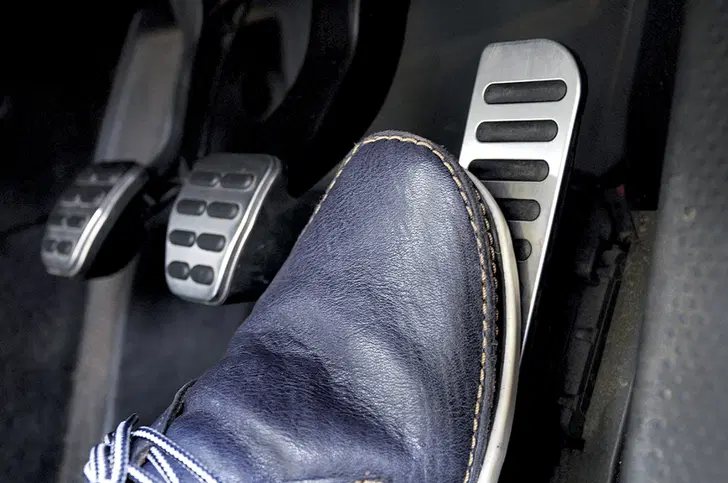
Clear-flood mode is this: accelerator flat to the floor, held there, while you crank in 10-second bursts. - Check the security light. If the theft/immobilizer light flashes while cranking and the engine fires for one second then dies — or never fires at all — try the spare key. A damaged key chip or a weak reader ring is a key problem, not an engine problem.
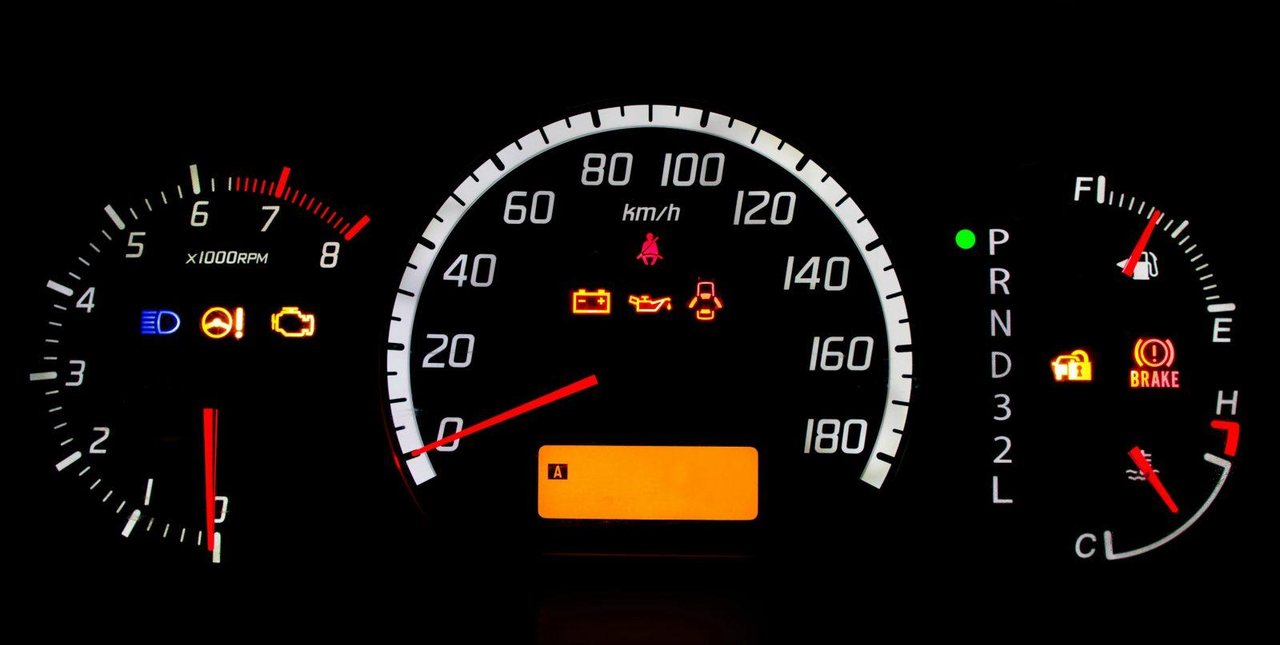
The lights to read at key-on — including the one that matters here: the car-and-padlock security symbol (right side). If that one flashes while you crank, try the spare key before anything else.
3 · Starts, then dies
An engine that starts has fuel, spark, and compression — briefly. What it loses, and when it loses it, is the whole diagnosis. Read the pattern before touching a part.
| Cause | How to tell | Fix time | Cost |
|---|---|---|---|
| Dirty throttle body / idle air control | Dies at idle, fine if you hold a little throttle; worse after a battery disconnect relearn | 30 min | $8 cleaner |
| Large vacuum leak | Audible hiss; a hose visibly off; dies at idle, smooths out with revs | 15–45 min | $5–20 hose |
| MAF sensor fault | Unplugging the MAF makes it idle better on the backup fuel map | 20 min | $10 cleaner · $80–200 sensor |
| Ignition switch (or ballast, older cars) | Dies the instant the key springs back from START to RUN | 1 hr | $40–150 |
| Crank sensor failing hot | Runs cold, dies fully warm, restarts after a 20–40 min cool-down | 30–90 min | $25–80 |
| Fuel pump dying hot / clogged filter | Dies after a long drive or under load; prime hum sounds weak or absent when hot | 2–4 hrs | $150–450 |
Dies the instant you release the key
The starter circuit and the run circuit are different paths through the ignition switch. If the engine fires while the key is held at START and dies the moment it springs back to RUN, the switch is feeding one and not the other. On older cars with a ballast resistor, a burned ballast does exactly the same trick. Either way: switch (or resistor) first, not the fuel system.
Dies at idle, runs if you feather the gas
Idle is the engine's smallest air opening, so it's the first thing carbon defeats. A throttle plate rimmed with deposits — or a sticking idle air control valve on cable-throttle cars — chokes the idle airflow the computer expects. Clean the throttle bore and plate edges with throttle body cleaner on a rag (never flood an electronic throttle body or force the plate). While you're there, hunt the hiss: a split PCV hose or a brake-booster line popped off leans the idle mixture past recovery, and unmetered air explains why it smooths out as revs rise.
Dies when warm, restarts when cool
Heat-soak failure is the crankshaft position sensor's signature — the sensor's electronics break down hot, the computer loses the crank signal, and the engine stops like it was switched off. Twenty minutes of cooling resurrects it, which fools everyone once. A fuel pump on its last legs does the same pattern from the other side: listen for the prime hum when it's hot and dead. No hum, no tach movement tells you which of the two you're chasing.
The MAF unplug test
If the engine stalls or stumbles at idle but settles down when you unplug the mass airflow sensor, you've learned something real: the computer was trusting a lying sensor, and unplugged it falls back to a safe default map. Clean the MAF element with proper MAF cleaner (nothing else — the sensing wire is fragile), let it dry fully, and retest before replacing.
4 · Rough idle & misfire
A shake at idle with the check-engine light on means one or more cylinders aren't contributing. The single most important sentence in this section: if the light is flashing, park it. A flashing light is an active, severe misfire dumping raw fuel into the exhaust, and raw fuel overheats and destroys the catalytic converter — turning a $30 plug job into a four-figure repair in a surprisingly short drive.
| Cause | How to tell | Fix time | Cost |
|---|---|---|---|
| Worn / fouled spark plugs | High miles on the set; code names one cylinder (P0301–P0308); plug reads worn or fouled | 30–60 min | $4–15 per plug |
| Failed ignition coil | Single-cylinder code; swapping the coil moves the code to the other cylinder | 20 min | $30–90 |
| Vacuum leak | Hiss at idle; random/multiple misfire code P0300; worse at idle, better with revs | 15–45 min | $5–20 hose |
| Dirty MAF / throttle body | Rough idle with lean codes (P0171/P0174); improves with MAF unplugged (section 3) | 30 min | $10–15 cleaners |
| EGR valve stuck open | Rough, stumbling idle that smooths out above idle; stalls at stops | 45 min | $0 clean · $80–200 |
| Low fuel pressure | Misfires spread across cylinders, worse under load; weak pump or clogged filter | 1–4 hrs | $10 filter – $450 pump |
| Worn engine mounts (feels rough, isn't) | Shake is worst in Drive with your foot on the brake, engine codes clean, visible rocking on throttle blips | 1–2 hrs | $40–150 per mount |
The fix, step by step
- Read the code before buying anything. Auto-parts stores (O'Reilly, AutoZone, NAPA and others) will scan OBD2 codes free, and a basic reader of your own pays for itself in one use. P0300 means random/multiple misfire; P0301–P0308 name the exact cylinder — that number focuses everything below.
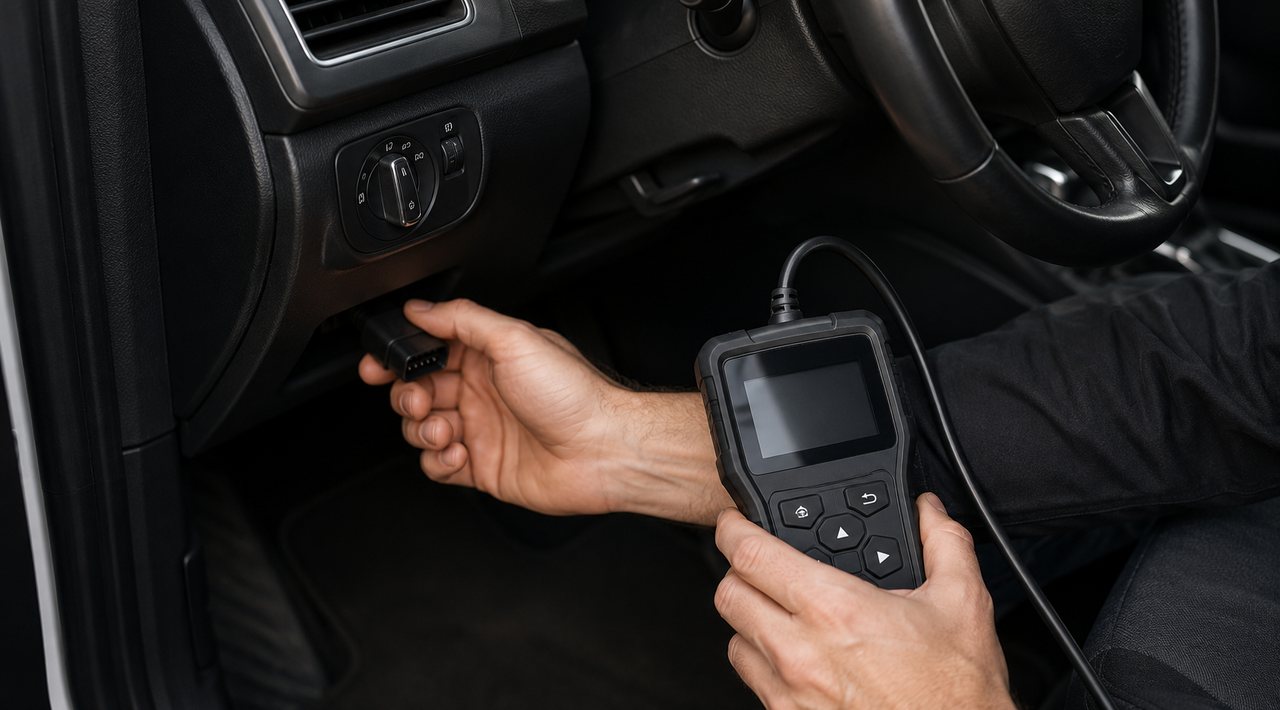
The port is here: under the dash, driver's side, usually left of the steering column. The reader only fits one way — don't force it. - Do the coil swap test on a single-cylinder misfire. Move the suspect cylinder's coil to a different cylinder, clear the code, run it, and rescan. If the misfire code follows the coil, the coil is condemned with evidence — no guessing, no parts cannon. If it stays on the original cylinder, swap the plug next, the same way.
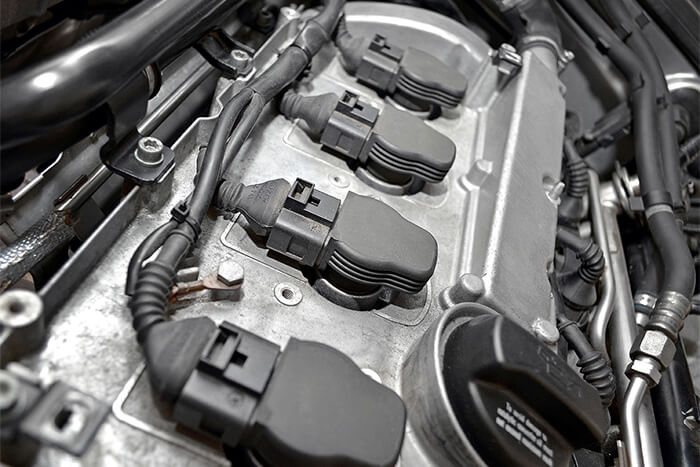
The coils, in place on the valve cover — one per cylinder, in a row. The swap test is just: move the suspect one to another cylinder and see if the misfire code follows it. - Pull and read the plugs. A healthy plug is tan-gray. Black and sooty = rich or weak spark on that cylinder. White and blistered = lean/hot. Oil-fouled = oil is getting where it shouldn't (valve cover tube seals are the friendly version). Replace in full sets, gapped to the spec in your manual — “pre-gapped” still deserves a check.
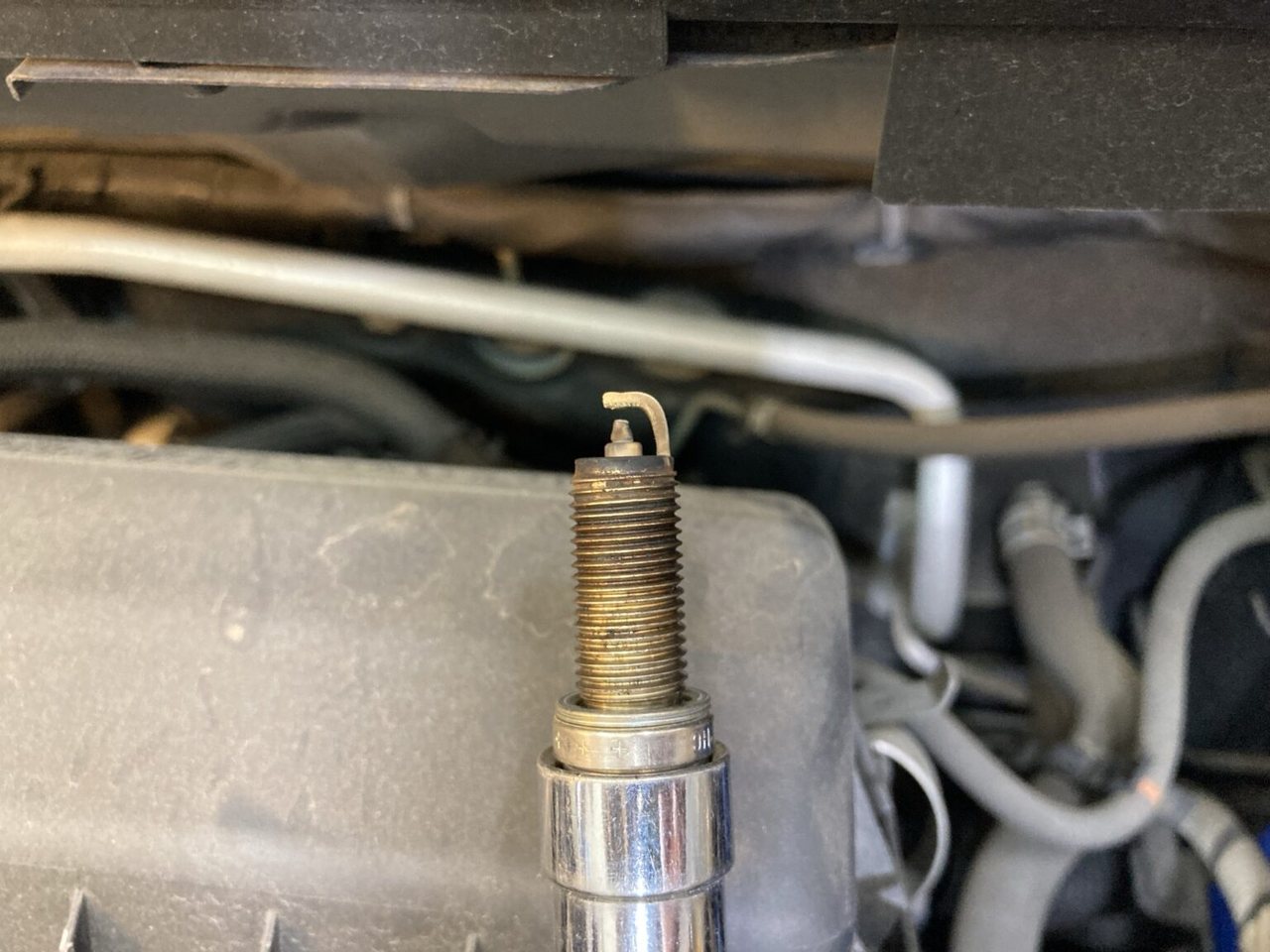
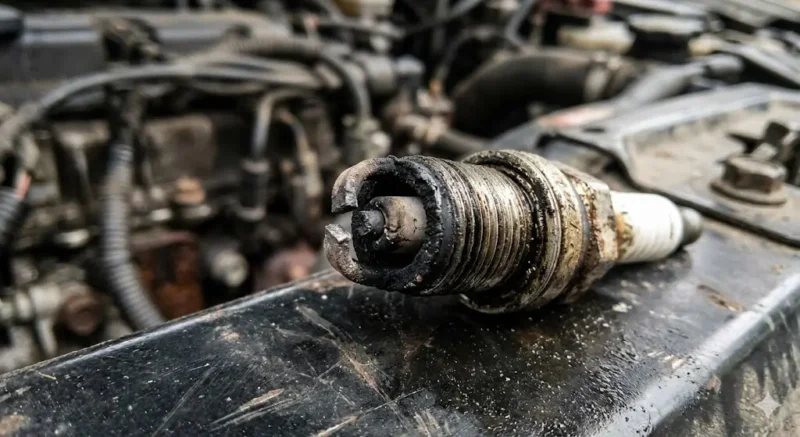
Read yours against these two. Left: a healthy plug — even tan-brown, electrode square and intact. Right: a fouled one — black, sooty, worn. Black and sooty on one cylinder only points at that cylinder's spark or mixture. - Hunt vacuum leaks by ear and eye. Cracked PCV hoses, a split intake boot after the MAF, a brake booster hose half off its nipple — a leak admits air the computer never measured, and idle is where the error is proportionally biggest. Hissing is a gift; follow it. (Skip the old spray-and-listen tricks with flammable sprays around a hot engine — a length of hose as a stethoscope finds the same leak safely.)
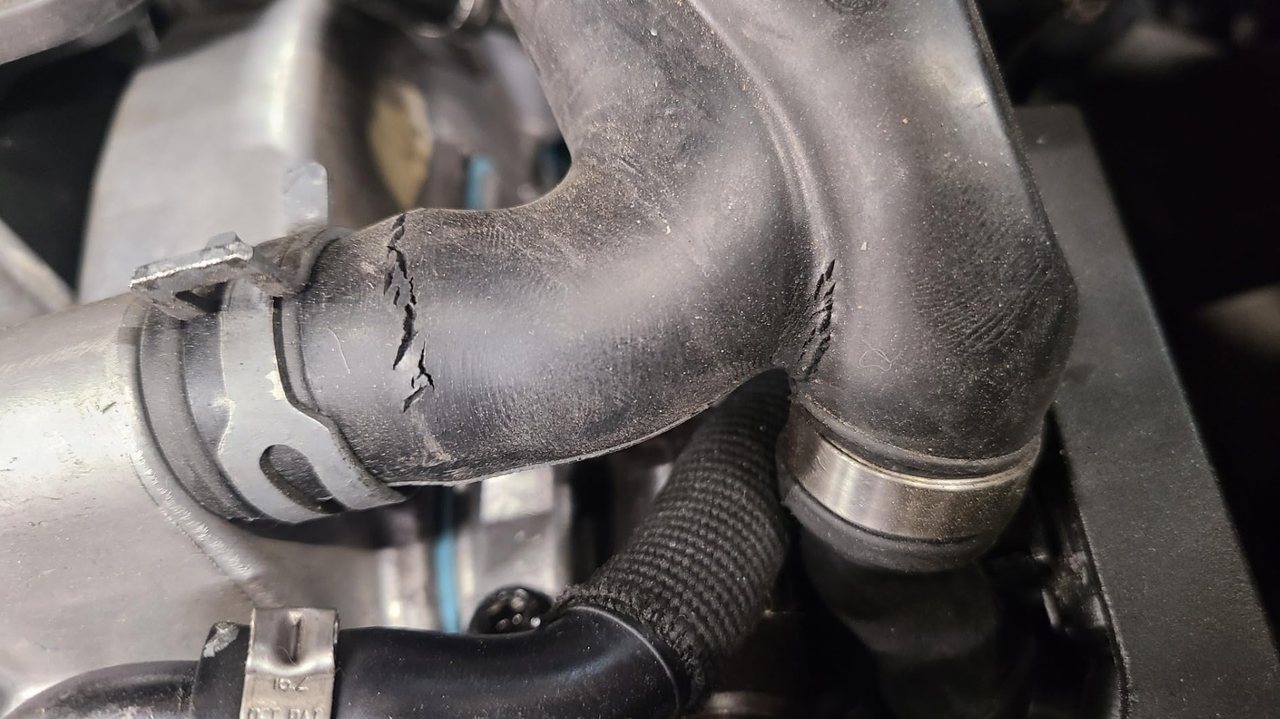
What a vacuum leak looks like when it's visible: a breather/PCV hose split at the bend, in place. Check the bends and the ends first — that's where the rubber lets go. - Separate a real misfire from a fake one. If there are no misfire codes, the idle shake is worst in gear at a stop, and the engine visibly rocks or clunks when you blip the throttle, suspect engine mounts: the engine may be running perfectly and simply transmitting every pulse into the cabin through collapsed rubber. Different fix, different budget — and no amount of plugs will cure it.
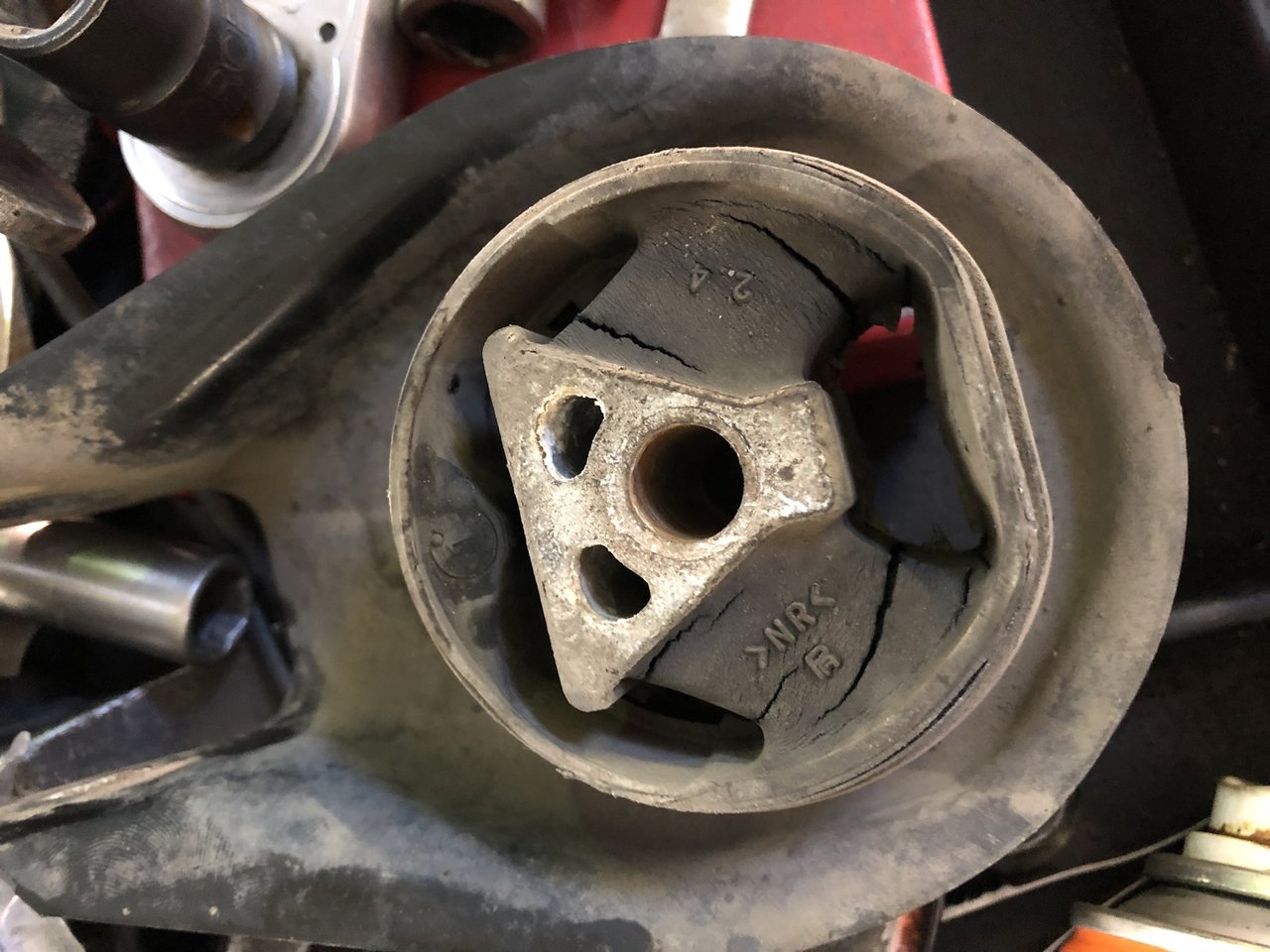
A mount that has stopped mounting: rubber cracked right through (shown removed so you can see it). In the car, look for the same deep splits and a sagging, collapsed shape.
5 · Lacks power
Power loss has one great separating question, and it costs nothing: does the engine rev freely while the car barely goes, or does the engine itself refuse to rev? Revs without go is the transmission slipping — say so honestly, because no engine part fixes it. An engine that won't rev is breathing, fueling, or exhausting badly, and most of those are on this list.
| Cause | How to tell | Fix time | Cost |
|---|---|---|---|
| Clogged air filter | Filter dark and packed; gradual loss over months | 10 min | $12–30 |
| Clogged fuel filter / weak pump | Fine at light throttle, falls flat when you ask for power or climb | 30 min–4 hrs | $10–450 |
| Dragging brake caliper | One wheel noticeably hotter than the others after a drive; burning smell; pulls slightly | 1 hr | $60–180 |
| Turbo boost hose popped off (turbo cars) | Sudden loss right after a hard pull; whoosh/hiss under boost; hose visibly loose | 20 min | $0–15 clamp |
| Clogged catalytic converter | Rotten-egg smell; worse hot and uphill; engine feels strangled above ~3,000 rpm | — | Shop job ($300–1,500+) |
| Slipping transmission / clutch | Engine revs climb, road speed doesn't; flare between shifts | — | Shop job |
How to narrow it down
Start with air. Pop the air filter out and hold it to the light. A filter you can't see light through is a muffler on the intake. It's the cheapest power restoration there is, and skipping it invalidates every test after it.
Fuel shows itself under demand. Idles fine, cruises fine, falls on its face merging or climbing: the pump or filter delivers idle quantities but not working quantities. A fuel pressure gauge that sags under load — or the loaner-gauge test from section 2 held at a fast idle — confirms it before you drop a tank.
Check for a brake that's doing the slowing. After a normal drive, carefully compare wheel temperatures (an infrared thermometer is ideal; a cautious hand near — not on — each wheel works). One hot wheel with a burning smell is a seized caliper or collapsed hose, and it will happily impersonate a weak engine all day.
The clogged converter tells on itself. A converter choked with melted or broken substrate strangles the exhaust: power fades the hotter and harder you run, there's often a rotten-egg (sulfur) smell, and a vacuum gauge on the intake shows vacuum falling and staying low as revs rise instead of snapping back. Converters usually clog because something upstream — like an ignored flashing-light misfire from section 4 — cooked them, so a shop replacing one should also find the cause.
Turbo cars, one extra look. A sudden, total loss of boost right after a pull, with a hiss under throttle, is very often a charge-air hose blown off its pipe. Reseat it, replace the clamp, and check why — oil-soaked, split hose ends let go again.
6 · Read the symptoms: warning lights vs mechanical faults
Dashboard lights are clues, not diagnoses — a code names a circuit or a condition the computer noticed, not a part to buy. But four lights carry real urgency differences, and treating them alike is how minor faults become major ones.
| Light | What it actually means | What to do |
|---|---|---|
| Oil pressure (oil can) | Oil pressure has dropped below the safe minimum — not “oil is a bit low” | Stop the engine now |
| Temperature (thermometer) | Coolant is overheating; aluminum heads warp fast | Stop soon, cool fully |
| Battery / charging (battery icon) | The alternator is not charging — you're driving on battery reserve, often 20–30 minutes of it | Drive to help, loads off |
| Check engine — steady | A fault is stored: emissions, sensor or a developing misfire | Read the code this week |
| Check engine — flashing | Active severe misfire; raw fuel is overheating the catalytic converter | Stop driving it (section 4) |
The oil light deserves its own paragraph
Of every light on the dash, oil pressure is the one where minutes matter. An engine run without pressure destroys bearings in very short order. If it comes on while driving: off the road, engine off, then check the dipstick once stopped. Low oil after a leak or overdue change may be the whole story — but if the level is fine and the light was real, do not restart it to “check”; have it towed. Never open the coolant cap on a hot engine to compare notes, either — let a temperature-light engine cool completely first.
Get the codes read — free, in most towns
OBD2 codes are the fastest honest starting point for any light. O'Reilly, AutoZone and NAPA stores will typically scan your car free and print the codes, and several run loaner-tool programs for the gauges and specialty tools this guide mentions — ask at the counter. A $25 Bluetooth or handheld reader of your own removes the trip entirely.
The discipline: pair the code with the symptom
A code for a crank sensor circuit plus a tach that sits at zero while cranking (section 2) is a diagnosis. The same code alone, on a car that starts fine, may be an old ghost. Work it the way this guide is built: name the symptom, find its section, run the cheap test that separates the causes, and only then buy the part. That order — symptom, test, part — is the entire difference between troubleshooting and guessing.
Frequently asked questions
Why does my car just click and not start?
A single loud click with bright dash lights usually means the battery can power the dash but the starter solenoid or motor isn't turning the engine — check connections first, then the starter. Rapid clicking, or clicking with dimming lights, is almost always a discharged or failed battery, or corroded terminals that can't pass cranking current. Start at the battery: clean terminals and a rested-voltage test separate the two in minutes.
Why does my car crank but not start?
The engine is turning, so the battery and starter are doing their jobs — what's missing is fuel, spark, or the computer's signal to fire. Listen for the fuel pump's 2-second prime hum, watch whether the tachometer moves while cranking (stuck at zero points at the crankshaft position sensor), and check the security light. Work fuel first, then spark, then sensors.
What voltage should a car battery have — is 12.2 volts enough?
A fully charged battery reads about 12.6 volts or higher after resting several hours with the engine off. Around 12.4 volts is roughly 75% charged, 12.2 volts is only about 50% — it may crank a warm engine, but it's half empty and a cold morning exposes it — and 12.0 volts or below means discharged or a bad cell. Charge it fully and retest before condemning it; voltage alone doesn't prove health, a load test does.
My car starts with a jump but dies or won't restart — is it the battery or the alternator?
If it starts on a jump and dies when the cables come off, suspect the alternator and charging system — the engine was running on the donor battery. If it keeps running but won't restart the next time you switch it off, suspect the battery itself: it took a surface charge but can't hold one. A parts store will test both free; with the engine running, charging voltage at the battery should be roughly 13.8–14.5 volts.
Why does my car start then die right away?
The pattern matters. Dying the instant you release the key points at the ignition switch (or a ballast resistor on older cars). Dying at idle after a few seconds points at a dirty throttle body, a failed idle air control valve, or a large vacuum leak. Dying only when fully warm points at a crankshaft position sensor or fuel pump failing with heat.
Is a flashing check-engine light serious?
Yes — stop driving it. A steady light means the computer has stored a fault to check soon; a flashing light means an active misfire is dumping raw fuel into the exhaust, which can overheat and destroy the catalytic converter in minutes. Get the code read, fix the misfire — usually a plug or a coil — and don't keep driving to see if it clears.
How do I start a flooded fuel-injected engine?
Use clear-flood mode: hold the accelerator pedal to the floor and crank. On most fuel-injected cars the computer cuts injector fuel while cranking with the throttle held wide open, so the engine pumps the excess fuel out. Crank in 10-second bursts; once it starts to catch, release the pedal. If it still won't start, pull a spark plug — if it's wet with fuel, let the cylinders air out.
When is a no-start a shop job instead of a driveway fix?
When you've confirmed fuel and spark are both present but it still won't run (think timing or compression), when the engine turns over with no resistance or a seized engine won't turn at all, when the timing belt has snapped, or when the fault is inside the transmission or a sealed control module. Everything battery, starter, relay, sensor, plug and coil related in this guide is a realistic driveway fix with basic tools.
Still stuck? Run the guided diagnosis
Answer a few questions about your exact symptom on Troubleshoot 101 and get your likely causes ranked, the fix step by step, and the parts to grab near you — the interactive version of this guide.
Start the guided diagnosis →If it helped you, consider a tip.
Leave a tip